Journal
Turkey tail mushroom (wrośniak różnobarwny): a complete guide
Turkey tail (wrośniak różnobarwny, Trametes versicolor): what it is, how it looks, where it grows, TCM tradition and what studies show, with limits.
TCM therapist · Doctor of Acupuncture (WFAS) · author of a book on functional mushrooms
7 min read
Contents
- What is turkey tail, and how does it relate to coriolus?
- What does turkey tail look like and where does it grow in Poland?
- Fruiting body or grain-grown mycelium: how do you read a turkey tail extract label?
- What does TCM tradition say about turkey tail?
- What do studies say about turkey tail, and what are their limits?
- How is turkey tail extract used?
- When should you talk to a doctor before using turkey tail?
- FAQ
- What to read next about turkey tail?
Turkey tail (Trametes versicolor) is a bracket mushroom with fan-shaped, banded fruiting bodies. In Polish it is called wrośniak różnobarwny, and in shops it is often sold as coriolus. It grows commonly in Polish deciduous forests, and in supplements it is used as an extract.
This guide covers the names, the look, TCM tradition, the research with its limits, and safety. Narrower topics such as dosage and product forms have their own posts, linked in the text.
What is turkey tail, and how does it relate to coriolus?
Turkey tail is the English name of the mushroom Trametes versicolor, a member of the Polyporaceae family. Coriolus is its trade name and an older Latin synonym (Coriolus versicolor), and wrośniak różnobarwny is the Polish name. All four terms describe one species, so compare Latin names on labels, not the language of the packaging.
The confusion comes from taxonomic history: the species was classified in the genera Polyporus and Coriolus, and today the accepted name is Trametes versicolor. In Chinese tradition it is yun zhi, the "cloud mushroom", and in Japanese kawaratake, the "roof-tile mushroom".
What does turkey tail look like and where does it grow in Poland?
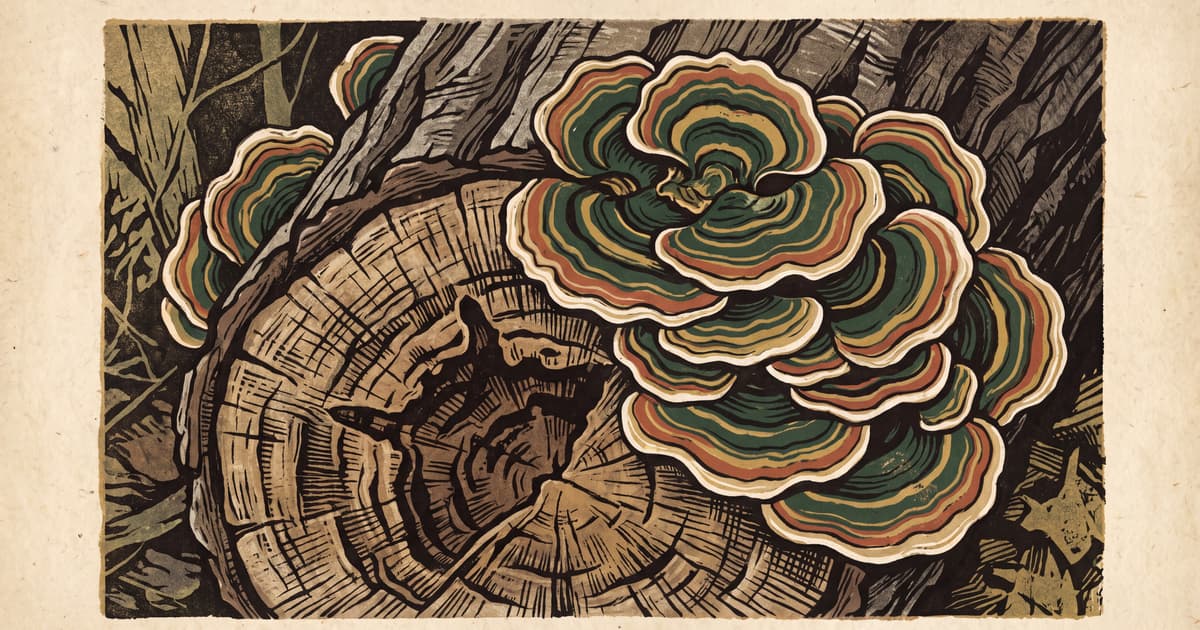
Turkey tail forms thin, fan-shaped fruiting bodies layered like roof tiles on the trunks of deciduous trees, with concentric bands of brown, grey, cream and blue-grey. In Poland it grows commonly in deciduous and mixed forests, most often on dead or dying birch, beech and oak wood, through most of the year.
The banded pattern, resembling a spread bird's tail from a distance, gave the species its English name. The underside is pale and porous, without gills. Wild specimens are not suitable for supplements, because they can accumulate metals and their content of active compounds is unpredictable. Raw material for an extract comes from controlled cultivation on a substrate of beech sawdust and bran.
Fruiting body or grain-grown mycelium: how do you read a turkey tail extract label?
A turkey tail extract is made either from the fruiting body, the mature visible part of the mushroom, or from mycelium grown on grain and dried together with the substrate. These are two different raw materials. On the label check the mushroom part, the standardization ratio such as 10:1, the product form and the daily serving.
Mycelium grown on grain contains a lot of starch from the substrate, and cheap products can count it among the declared polysaccharides. Our extract comes from the fruiting body, at a 10:1 ratio, standardized to at least 30% beta-glucans, with no maltodextrin. A full label-reading walkthrough is in coriolus extract: 10:1, PSK and PSP, and the raw-material difference is covered in fruiting body or grain-grown mycelium.
What does TCM tradition say about turkey tail?
In Chinese tradition turkey tail is yun zhi, the cloud mushroom, described in the compendium Ben Cao Gang Mu in 1578. Tradition classed it among tonics of Spleen and Lung Qi, with a sweet taste and a slightly cool nature. This is a cultural story, not a promise or a health recommendation.
Li Shizhen placed it in the "shang yao" category, the highest class of tonics, described as gentle with long use. In tradition it is not taken continuously but in cycles of several weeks, most often in autumn and winter. Concepts such as Qi or meridian do not map directly onto Western anatomy. More on symbolism and forms is in coriolus: TCM tradition, forms and choosing an extract.
What do studies say about turkey tail, and what are their limits?
Research on turkey tail concerns mainly the polysaccharide fractions PSK and PSP, described in laboratory and animal work. Human studies are few and small. The best described is an 8-week randomized trial in 24 healthy volunteers that assessed the effect of PSP on gut microbiota (PMID 25006989).
In that study (Pallav and colleagues, 2014, PMID 25006989, doi 10.4161/gmic.29558) volunteers took 3600 mg of PSP a day for 8 weeks, and the authors described changes in microbiota composition, including a rise in Bifidobacterium and Lactobacillus. The result concerns bacteria counts, not health status.
The limits are worth stating plainly:
- most data on immunity come from in vitro and animal studies (review: Saleh and colleagues, 2017, PMID 28932226),
- the human trial was small, and results need replication in larger studies,
- PSK and PSP are isolated fractions, while a fruiting-body supplement is a different product with a different concentration and regulatory path,
- "boosts immunity" has no hard measure, because immunity is not a single parameter.
Studies describe mechanisms and tendencies. They are not a promise of an effect in any one person.
How is turkey tail extract used?
Turkey tail extract is used according to the label of the specific product: a daily serving taken with water, ideally at a steady time, in the morning or before noon. It is sold as capsules, powder and drops. Never exceed the recommended serving, and treat doses from studies as information, not as a recommendation.
Tradition and our own materials describe seasonal use, in cycles of several weeks with breaks, rather than all year without a pause. Serving size, time of day and how to assess a ritual are in the post on coriolus dosage, and choosing a form is in capsules, powder or drops. You can check current forms and price on the turkey tail extract product page.
When should you talk to a doctor before using turkey tail?
Turkey tail is not used after a transplant with immunosuppression, during a flare of autoimmune disease, in children or with a mushroom allergy. Anticoagulant medication, oncology treatment, pregnancy, breastfeeding and planned surgery call for a doctor's advice first. It is a food supplement, not a medicine, and does not replace medical advice.
Autoimmune disease in remission should also be discussed with your doctor before the first serving. Before planned surgery our materials advise stopping the extract at least 14 days earlier. Reported complaints are mainly mild, temporary digestive symptoms in the first week. If itching, swelling or shortness of breath appears, stop the product and contact a doctor.
FAQ
Turkey tail capsules: how do they differ from powder and drops? It is the same raw material in three forms, so the difference is convenience and taste, not species. Capsules are neutral in taste, powder goes into a drink, drops are measured with a dropper. A comparison is in capsules, powder or drops.
Turkey tail dosage: how much per day? According to the label of the product you choose. A study in healthy volunteers used 3600 mg of PSP a day for 8 weeks (PMID 25006989), but that is a research dose, not a recommendation. Details are in the post on coriolus dosage.
Turkey tail reviews: where can you read them? Customer reviews of our extract are on the product page. A review describes one person's experience, so it is not proof of an effect and does not replace studies or a conversation with your doctor.
Turkey tail contraindications: who should be careful? It is not used after a transplant with immunosuppression, during an autoimmune flare, in children or with a mushroom allergy. With anticoagulants, oncology treatment, pregnancy, breastfeeding or planned surgery, talk to your doctor first.
Turkey tail mycelium: is it the same as a fruiting-body extract? No. Mycelium grown on grain is a different raw material from the fruiting body, with a different composition and a lot of starch from the substrate. The label should state which part of the mushroom the extract comes from.
What to read next about turkey tail?
Turkey tail has several posts on this blog, each expanding one thread: TCM tradition and forms, dosage according to the label, reading an extract label, and choosing between capsules, powder and drops. The articles below add what this guide deliberately does not repeat.
- Coriolus: TCM tradition, forms and choosing an extract
- Coriolus dosage: how much per day and when
- Coriolus extract: what 10:1, PSK and PSP mean
- See the wider overview in functional mushrooms.
Author: Mateusz Rosa, TCM practitioner and founder of Aloha Fungi · about us
This content is for educational purposes only and does not constitute medical advice. A food supplement does not replace a varied diet or a healthy lifestyle. If in doubt, consult your doctor or pharmacist.