Journal
Coriolus (turkey tail): TCM tradition, forms and choosing an extract
Coriolus, or turkey tail (Trametes versicolor). On TCM tradition, appearance, supplement forms, label-based dosage and choosing a standardized extract.
TCM therapist · Doctor of Acupuncture (WFAS) · author of a book on functional mushrooms
6 min read
Contents
- What is coriolus?
- What does turkey tail look like in nature?
- What is the history of coriolus in TCM tradition?
- PSK and PSP: polysaccharides characteristic of coriolus
- Which forms of coriolus supplements are available?
- How should coriolus be used according to the label?
- What should you look for when choosing a coriolus extract?
Coriolus, known as turkey tail (Latin Trametes versicolor, or wrośniak różnobarwny in Polish), is one of the functional mushrooms most often named in classical Chinese fungotherapy, alongside reishi or shiitake. This post gathers what is worth knowing before you reach for its extract: where the tradition around it comes from, what it looks like in nature, which supplement forms exist, and what to look for when choosing one.
What is coriolus?
Coriolus is a zonate bracket fungus from the polypore family, whose Latin name Trametes versicolor describes its defining trait: "versicolor" means "many-colored." In Chinese tradition it is called yún zhī ("cloud mushroom"), and in English-speaking countries turkey tail, for its resemblance to a spread turkey's tail. In Polish mycological naming it is wrośniak różnobarwny.
What does turkey tail look like in nature?
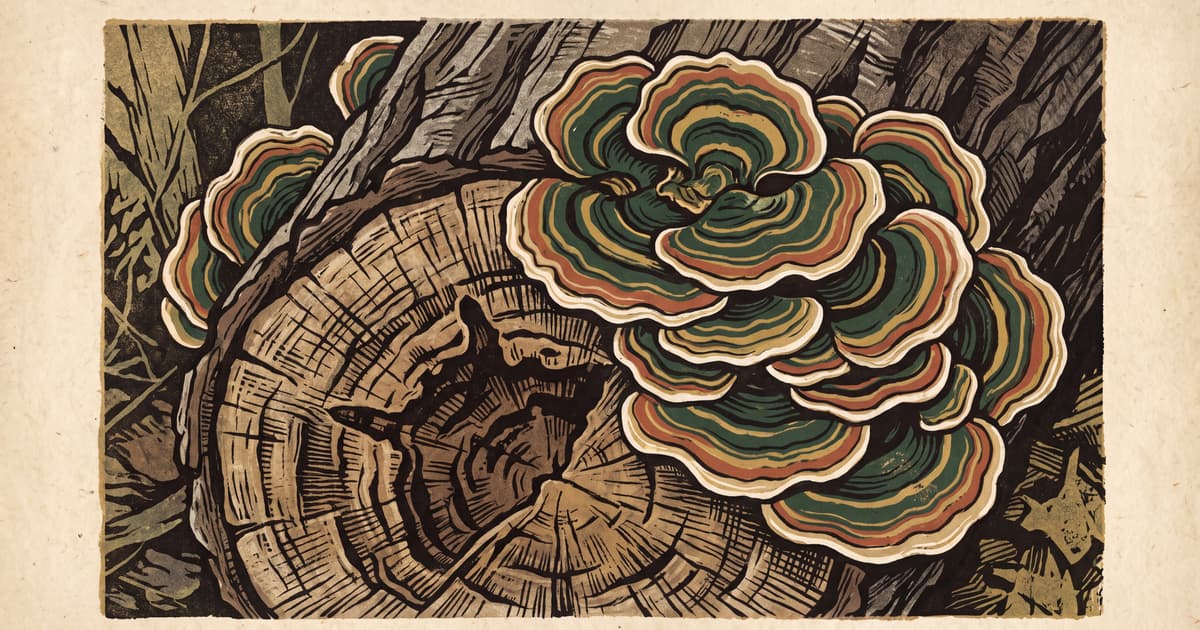
Turkey tail grows in thin, fan-shaped brackets layered like roof tiles on the trunks of dead or dying deciduous trees. Its defining feature is a pattern of concentric bands in shades of brown, grey, cream and blue-black, while the underside of the bracket is pale and porous, with no gills.
This banded pattern is what gave it the English name turkey tail, since from a distance it resembles a spread bird's tail. In Poland it grows commonly in deciduous and mixed forests, most often on stumps and fallen trunks.
What is the history of coriolus in TCM tradition?
The "Hidden Pathogen" is one of the more pictorial concepts of classical Traditional Chinese Medicine (TCM). It describes an idea ancient physicians used to explain why an ailment might stay "dormant" and surface only after time had passed. This is the language of ancient diagnostics, recorded in old texts, not a modern medical diagnosis.
Classical TCM writings described how such a factor could "hide" in various layers of the body, from the surface to deeper tissues, and reveal itself only under favorable conditions, for instance during a particular season. It was a way for ancient medicine to organize observations of chronic and recurring ailments, long before knowledge of viruses or bacteria existed.
In the classical view, working with a "hidden pathogen" was tied to the idea of strengthening the body's Qi (vital energy), alongside herbs and therapeutic mushrooms, acupuncture and lifestyle changes. This was part of a holistic approach, in which ancient practitioners looked beyond the symptom to the broader context of a patient's condition. An important distinction: this is a description of a historical system of thinking about health, predating modern microbiology, not an instruction for diagnosing or treating any present-day medical condition.
Tradition assigned coriolus a role in supporting the body's resilience within the framework of Qi, and in contemporary research on functional mushrooms it is often examined for its content of beta-glucans, compounds characteristic of the fruiting body structure (research overview: PubMed). We cite scientific literature here, not a promise of effect.
PSK and PSP: polysaccharides characteristic of coriolus
Turkey tail holds a special place in mushroom science thanks to two compounds isolated from this very species: PSK (polysaccharide-K, also known as Krestin) and PSP (polysaccharopeptide). Both belong to the family of protein-bound polysaccharides: their core is built of sugar chains similar in structure to beta-glucans, linked to short protein fragments.
PSK was first described in Japan in the 1960s, and PSP was isolated in China from the COV-1 strain in the 1980s. They are among the most studied mushroom-derived compounds overall, with hundreds of scientific publications (overview: PubMed). As always in this section: we cite literature as a bibliographic fact, not as a promise of what a supplement does.
For a practical reader the key point is that PSK and PSP occur in the fruiting body and mycelium of Trametes versicolor, and their content depends on the raw material and the extraction method. That is one more reason to look at the mushroom part and polysaccharide standardization when choosing an extract, which we cover below.
Which forms of coriolus supplements are available?
Coriolus extract most commonly comes in three forms: powder for dissolving in liquids, capsules to swallow with water, and drops (tincture) dosed with a pipette. The choice of form is a matter of convenience and ritual, not a difference in raw material, as long as the producer works with the same fruiting body and standardization.
- Powder · easiest to add to a morning infusion, smoothie or coffee. The most affordable entry format.
- Capsules · convenient while travelling, no mushroom taste, a fixed portion in every piece.
- Drops · a ritual format, easy to dose drop by drop, convenient to add to water or an infusion.
How should coriolus be used according to the label?
Dose coriolus strictly based on the label of the specific product you buy. Producers differ in the drug extract ratio, DER (e.g. 10:1), and in the standardization of active compounds, so the daily portion of powder, number of capsules or drops can vary between brands.
A food supplement's label carries the recommended daily portion and method of use set by the producer in line with food supplement regulations. That is the source of truth, not general guides found online. If you take medication, are pregnant, breastfeeding, or have health concerns, discuss using coriolus with your doctor or pharmacist before starting supplementation.
What should you look for when choosing a coriolus extract?
Three things matter when choosing a coriolus extract: the part of the mushroom it was made from (fruiting body, not mycelium grown on grain), standardization stated as a number (e.g. 10:1 or a percentage of polysaccharides), and the availability of batch testing confirming composition.
- Fruiting body, not mycelium · the part of the mushroom that tradition and research treat as the main source of species-characteristic compounds. Unseparated myceliated-grain biomass is often cheaper, but much of its mass is starch from the substrate. Pure, separated mycelium is a different raw material and not every mycelium product is worse, yet for coriolus both tradition and research describe the fruiting body first.
- Standardized extract · a way of concentrating the raw material described by a technical parameter (e.g. 10:1), not a promise of an effect. A 10:1 figure only says how much raw material went into a kilogram of extract · what a serving contains is determined by standardization (e.g. polysaccharide percentage) and the serving mass on the label, not by the ratio alone.
- Batch testing · a solid producer provides a Certificate of Analysis for a given batch, confirming beta-glucan content and the absence of contaminants.
- A piece of tradition, not a prescription · read the "Hidden Pathogen" as a story about ancient thinking on health, not as a diagnosis of your own condition.
At Aloha Fungi we work with the fruiting body of coriolus, the part of the mushroom that tradition describes and that contemporary mushroom science studies.
This content is for educational purposes only and does not constitute medical advice. A food supplement does not replace a varied diet or a healthy lifestyle. If in doubt, consult your doctor or pharmacist.