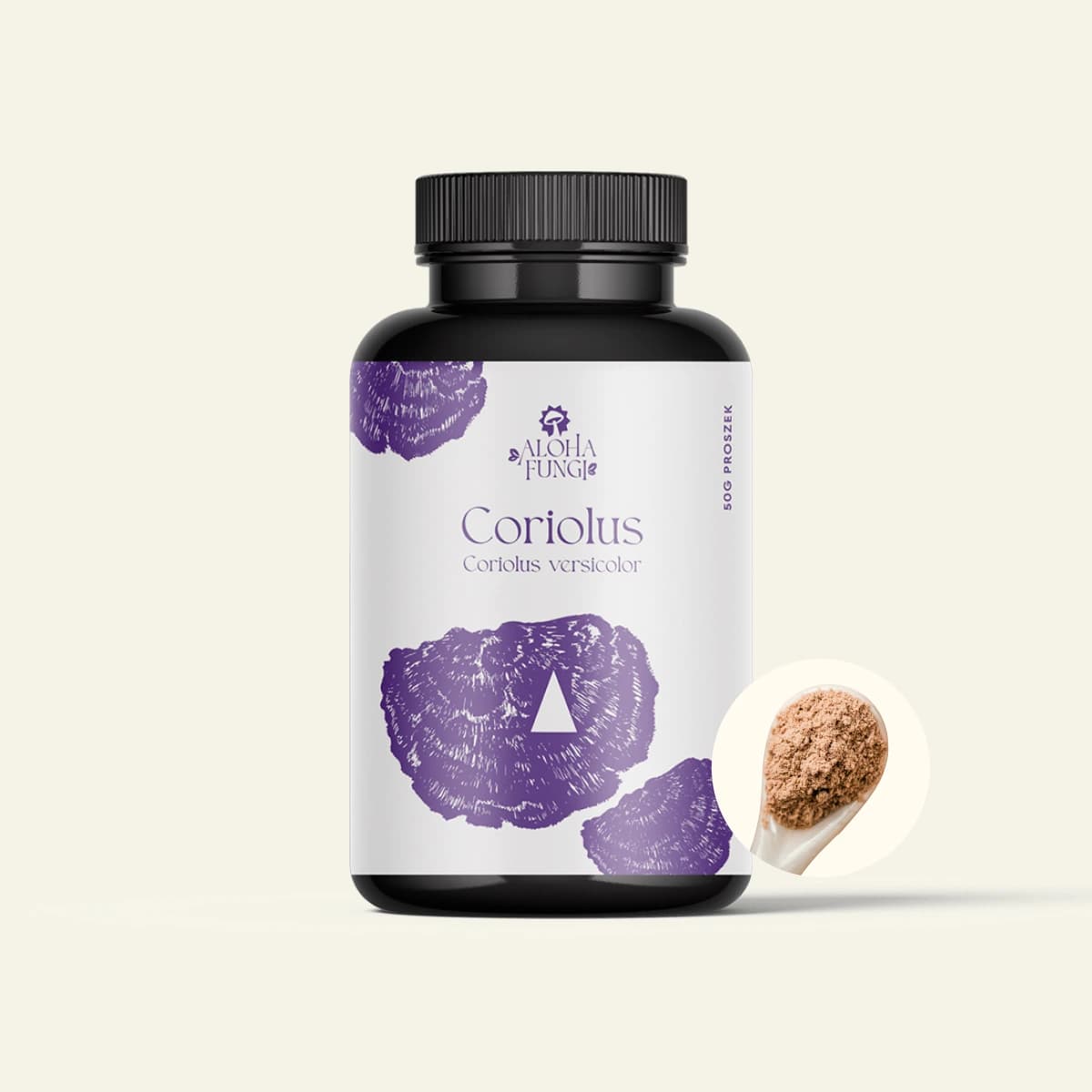
MushroomsSubscription −15%
Coriolus
Trametes versicolor
Powders · LONGEVITY149 zł
Below you will find every available product for this species. Each tile opens the product page with the selected format and line preselected.
Version 1.1 · Updated: 19 September 2026 · Subject-matter reviewer: Mateusz Rosa, founder of Aloha Fungi, TCM therapist (8 years of practice), Doctor of Acupuncture level A (WFAS 2018).
Coriolus in 60 seconds
Coriolus is a saprophytic and parasitic fungus of the Polyporaceae family. It grows on dead and living trunks and logs of deciduous trees (most often beech, oak, birch, alder, poplar), causing white wood rot. It occurs worldwide except Antarctica and high alpine zones and is common in Polish deciduous forests. Wild specimens are unsuitable for supplementation because of metal accumulation and uncontrolled PSK content.
In controlled cultivation T. versicolor is grown on substrates of beech wood chips and bran, which gives a repeatable PSP content and full control of contaminants. Different zones of the fruiting body contain different polysaccharide profiles; the highest PSK concentration is in the young, still-growing zones at the margin, which is why a good extract is collected from the fruiting body at a specific growth stage, not from old forest specimens.
The first written mention is in „Ben Cao Gang Mu" (Compendium of Materia Medica, 1578) by Li Shizhen, where yun zhi is described as a Qi tonic strengthening the Spleen and Lungs, recommended for chronic cough, liver inflammation, exhaustion and general weakness. It was classed as „shang yao", the highest-class tonics, safe for long-term use. In Japan kawaratake was used for centuries during recovery from prolonged illness, in herbal-tea protocols.
The Western renaissance began in the late 1960s, when a chemical engineer at Kureha Chemical Industry became interested in a traditional decoction of an unusual mushroom (saru-no-koshikake, „monkey stool"). In 1971 Kureha isolated a polysaccharide-peptide fraction from the CM-101 strain, named PSK (Polysaccharide-K, after the Kureha company). This fraction subsequently became the subject of extensive laboratory research into its immunological properties.
In Poland research on T. versicolor and medicinal mushrooms is led by prof. Bozena Muszynska at the Department of Pharmaceutical Botany, Collegium Medicum of Jagiellonian University. Her team has published about 15 papers on chemical composition, bioavailability and potential applications (among others in „Postepy Fitoterapii" and „Acta Mycologica").
Dozens of compounds are documented in the Coriolus fruiting body. The most important for supplementation are two polysaccharide-peptide fractions and free beta-glucans:
Polysaccharopeptide PSP, the main fraction of the Chinese extract (COV-1 strain), molecular weight about 100 kDa, composed of 30-60% polysaccharide (a beta-glucan with side beta-1,6 bonds) and 10-30% peptide bound through O- or N-glycosidic bonds.
Polysaccharide PSK (krestin), the main Japanese fraction (CM-101 strain), structurally similar to PSP but with a greater proportion of alpha-(1->4) glucosidic bonds.
Free beta-1,3/1,6-glucans, not bound to peptide. Standardised in our extract to above 35%. In addition the polysaccharide fractions CVPS-1 to CVPS-6 (six isolated by chromatography, of different masses and receptor specificity), phenolic compounds and flavonoids (antioxidant activity), ergosterol and provitamin D₂, and amino acids and trace elements (zinc, selenium).
Coriolus contains the polysaccharopeptides PSP and PSK together with beta-glucans above 35%. In vitro and animal studies, PSP and PSK act as agonists of the TLR2 receptor, stimulating immune cells (NK cells, macrophages) and shifting the cytokine profile toward Th1. Separately, in a human study (RCT Pallav 2014), PSP acted prebiotically, supporting Bifidobacterium and Lactobacillus in the gut.
The full description of the three mechanisms of action and the strength-of-evidence table for each claim are further down this page.
In Chinese tradition Coriolus (yun zhi) is used seasonally, most often in autumn and winter, in cycles of several weeks with breaks, rather than continuously all year. The time of day is morning or before noon, in line with the general TCM principle that Qi tonics coordinate better with the morning phase of the day than with the evening.
You can check the available fruiting-body extract forms on the Coriolus product page.
Coriolus is dosed in the morning or before noon, most often in a rhythm of 5 days on and 2 days off. The typical serving is 1200-3600 mg a day of an extract standardised to above 35% beta-glucans: seasonal prophylaxis 1200-2400 mg, post-antibiotic support 2400 mg, intensive convalescence 2400-3600 mg.
The full protocol, including the rhythm of intake and what to observe over the following weeks, is described in the "How to take Coriolus: the protocol" section further down this page.
PSK and PSP bind as agonists to the Toll-like receptor TLR2 on the surface of dendritic cells, macrophages and monocytes. This triggers the MyD88 and NF-kB signalling pathway, leading to cytokine production (IFN-gamma, IL-12) and shifting the immune response toward a Th1 profile.
In Torkelson 2012 doses of 6-9 g/day raised the lymphocyte count and 6 g/day enhanced the functional activity of NK cells, that is, they strengthened the „recognise and destroy" response. The TLR2 mechanism differs from the beta-glucan mechanism of Reishi and Chaga, which act mainly through Dectin-1 and TLR4. This is why Coriolus and Reishi form a complementary, not redundant combination: they stimulate two different gateway receptors of innate immunity.
PSP is not digested by human enzymes. It reaches the colon unchanged and serves as a substrate for bacteria beneficial to humans. In the RCT Pallav 2014 (n=24 healthy volunteers, 3600 mg PSP/day, 8 weeks) a significant increase in Bifidobacterium and Lactobacillus abundance was recorded, and the in vitro study Yu 2013 showed a reduction in the pathogenic genera Clostridium and Staphylococcus.
The gut microbiota is responsible for a substantial part of the immune response (about 70% of the body’s immune cells reside in the intestinal mucosa), so microbiota regeneration brings overall immunological improvement. This explains why Coriolus was traditionally used for „weakness after a prolonged illness".
In the amoxicillin group of Pallav 2014, PSP significantly shortened the dysbiosis period after antibiotic therapy and supported the restoration of microbiota diversity. This is the only direct prebiotic-vs-antibiotic comparison in the medicinal-mushroom literature in humans. The typical return of the microbiota to baseline is 2-8 weeks after antibiotics, and Coriolus may shorten this recovery window.
In practice Coriolus is selected for three groups: people shortly after antibiotic therapy (especially repeated courses in a short time), people in the convalescence phase after a prolonged infection (post-COVID, mononucleosis, prolonged flu) and people with recurrent seasonal infections (more than 3-4 a year).
Coriolus does not treat cancers and does not replace oncology therapy. It does not replace vaccines or antibiotics during an active bacterial infection. Nor is it a suitable choice for people in an active flare of autoimmune disease, because the Th1-stimulation mechanism may worsen the state.
In the morning or before noon. As a stimulator of innate immunity it can subtly invigorate, so it is not recommended in the evening (especially in the early phase, when the body responds more strongly). In TCM the slightly cool nature and the direction toward the Liver and Lungs coordinate better with the yang phase of the day (morning to noon) than with the yin phase (evening and night).
In the cited clinical trials doses range from 1200 mg (a typical prophylactic dose) to 9000 mg a day (maximum-tolerated-dose studies). In practice 1200-3600 mg/day is used in line with the best-documented RCTs. Seasonal prophylaxis: 1200-2400 mg/day. Post-antibiotic support: 2400 mg/day. Intensive convalescence protocol: 2400-3600 mg/day. Do not exceed the recommended daily serving.
As a polysaccharide mushroom Coriolus does not require fat for absorption. It pairs well with warm water, green or white tea, cacao, a smoothie with ginger and turmeric, or bone broth. The traditional yun zhi cha recipe combines Coriolus powder with ginger, a slice of lemon and a touch of honey as a morning immunity-supporting infusion.
The classic rhythm is 5 days on, 2 days off, more important for Coriolus than for gentler mushrooms (Tremella, Reishi). The TLR2 receptor undergoes desensitisation with continuous stimulation, while a pulsed serving schedule maintains its responsiveness and prevents chronic immune activation (itself problematic at an autoimmune predisposition).
1-2 weeks: the first mild immune reaction. In people with compromised immunity, sometimes subtle „pre-infection" symptoms (slight fatigue, a heavy head) that usually resolve within a few days.
2-4 weeks: a noticeable improvement in digestion (prebiotic effect), less bloating, bowel regularity after antibiotics, a shorter infection if one occurs.
4-8 weeks: the full manifestation of immunomodulation (Pallav 2014 measured the microbiome effect at week 8), stabilisation of the gut flora, fewer recurrent infections.
8-12 weeks: long-term immunity support, a seasonal protocol (autumn-winter). Some people feel a subtle „sensation of infection" without true symptoms in the first week (slight fatigue, a heavy head, irritability). This is an effect of immune stimulation that passes in a few days; if it persists beyond a week, halve the serving or stop for several days.
Chaga (antioxidant, support for immune tone through Dectin-1) is the prevention phase, the shield; Coriolus through TLR2 triggers the „recognise and destroy" response, the attack phase. Different receptors, different directions. Chaga 2 g in the morning, Coriolus 2 g before noon. Duration: 8-12 weeks, the full October-March season.
Best after a prolonged infection. Coriolus supports the microbiota and the Th1 profile, Reishi regulates the HPA axis and supports nocturnal regeneration. Coriolus 2 g before noon, Reishi 1-2 g in the evening. Duration: 8 weeks, seasonally or after an infection.
Cordyceps regenerates ATP and energy economy, Coriolus rebuilds immunity. Indicated for a prolonged infection, overtraining, post-COVID fatigue syndrome. Cordyceps 1 g in the morning, Coriolus 2 g before noon; both mushrooms are stimulating, so avoid them after 2 pm. Duration: 12 weeks.
After a long antibiotic course (especially a repeated one) a double need arises: rebuilding the microbiota (Coriolus) and rebuilding Lung Yin and Jin Ye after fever and a dry cough (Tremella). The classic indication is post-COVID or after bronchitis treated with antibiotics. Coriolus 2 g in the morning, Tremella 1 g in the evening with dinner. Duration: 8-12 weeks.
Coriolus modulates the microbiota (the gut endpoint), Lion’s Mane supports NGF and BDNF production (the brain endpoint). Indicated for prolonged antibiotic therapy with „brain fog" and a decline in concentration. Coriolus 2 g in the morning, Lion’s Mane 1-2 g in the morning or in split dosing. Duration: 8-12 weeks.
In the Chinese tradition yun zhi (雲芝) is classed in the Zhi category, fungi strengthening vitality, which also includes Ling Zhi (Reishi, 靈芝). Li Shizhen in „Ben Cao Gang Mu" (1578) placed it in the „shang yao" category, the highest-class tonics, safe for long-term use. It tonifies Spleen Qi, removes Dampness, clears Heat and toxins, soothes chronic cough and strengthens Wei Qi.
Unlike most mushrooms, Coriolus is not recommended continuously but cyclically (8-12 weeks, 2-3 times a year, most often autumn-winter and early spring). The classical Materia Medica indicates four situations where the fruiting body is contraindicated: Spleen Yang deficiency (a sensation of cold, watery diarrhoea, oedema, which the slightly cool nature may deepen), acute febrile infections in the wei or qi phase without toxic Dampness, Lung Yin deficiency without Dampness (Tremella and Lily Bulb act more precisely) and autoimmune diseases in flare (the Wei Qi-stimulation mechanism may intensify the attack on one’s own tissues).
This is a frame of cultural observation, not a medical diagnosis. Concepts such as Qi, Wei Qi or meridian do not correspond one to one with Western anatomy or physiology.
| Taste | sweet, bland (淡 dan) |
| Nature | slightly cool (微寒 wei han) |
| Meridians | Spleen, Lung, Liver |
| Action | tonifies Spleen Qi, removes Dampness, clears Heat and toxins, soothes chronic cough, strengthens Wei Qi |
| Category | Qi tonic and detoxifier (补气解毒 bu qi jie du) |
Status after organ transplant with active immunosuppression (cyclosporine, tacrolimus, mycophenolate, everolimus, sirolimus). Coriolus stimulates cellular immunity, which may weaken the efficacy of the medication and increase the risk of rejection.
Active autoimmune diseases in flare: MS in relapse, RA in an active phase, systemic lupus erythematosus, ulcerative colitis in flare, Hashimoto’s with active TSH fluctuation. Th1 stimulation may worsen the state.
Children under 18 (no safety studies).
Known allergy to mushrooms of the Polyporaceae family (itching, oedema, cough, dyspnoea).
Autoimmune diseases in remission (stable Hashimoto’s, RA in remission, psoriasis without flare, stable MS): sometimes used under the supervision of a rheumatologist or immunologist with marker monitoring.
Anticoagulant and antiplatelet medicines (warfarin, NOAC, clopidogrel, aspirin at cardiology doses): PSK and some polysaccharide fractions may influence platelet adhesion; the effect is mild but requires INR monitoring.
Chemotherapy and radiotherapy in course: no supplementation should be started without the treating physician’s knowledge, and the decision is taken solely by the oncologist.
Pregnancy and breastfeeding: no adequate RCTs in this population; in practice we advise waiting until breastfeeding has ended.
Planned surgery: stop at least 14 days before the procedure (possible mild effect on platelets).
Reported rarely: mild gastrointestinal discomfort in the first week (bloating, softer stool from a rapid microbiota shift, usually resolving in 5-7 days; the serving can be split into 2-3 times a day), mild, transient „pre-infection" symptoms in weeks 1-2 (fatigue, a heavy head, irritability), and rare allergic reactions (itching, oedema, flushing) in people hypersensitive to mushrooms (then stop and contact a doctor).
In the cited RCTs effective doses are 1200-9000 mg/day. The maximum tolerated dose in the Phase I study (Torkelson 2012) was 9 g/day without serious adverse effects. In long-term practice most often 1200-3600 mg/day in line with the microbiome RCT (Pallav 2014).
Evidence verdict
We also show what is not proven. This is a dietary supplement, not a medicine.
2
Strong evidence
confirmed composition
5
Preliminary
in vitro and animal studies
3
Not proven
no human studies
Reviewed by
Mateusz Rosa · Doctor of Acupuncture (WFAS)
Version 1.1 · Updated: 19 September 2026 · Subject-matter reviewer: Mateusz Rosa, founder of Aloha Fungi, TCM therapist (8 years of practice), Doctor of Acupuncture level A (WFAS 2018).
Based on 12 verified sources
See sources ↓| Claim | Type of evidence | Strength |
|---|---|---|
| PSK and PSP are TLR2 agonists and activate innate immunity | in vitro and animal models, repeatedly confirmed (Saleh 2017, Wenner 2012) | STRONG |
| PSP modifies the gut microbiota, acting as a prebiotic | RCT n=24, 8 wks, randomised (Pallav 2014) + in vitro (Yu 2013) | STRONG |
| PSK raises macrophage and NK cell activity in laboratory models | in vitro and animal-model studies | PRELIMINARY |
| Increased NK activity and CD4+/CD8+ lymphocytes in humans | Phase I RCT n=11 (Torkelson 2012), a trend requiring replication | PRELIMINARY |
| Supports regeneration after antibiotic therapy in healthy humans | RCT Pallav 2014 amoxicillin group, needs larger RCTs | PRELIMINARY |
| Hepatoprotective action (chronic HBV) | open clinical studies in China, no adequately controlled RCT | PRELIMINARY |
| Prophylaxis of HPV-related changes (cervical LSIL) | pilot RCT, small n, requires large-scale studies | PRELIMINARY |
| „Cures" or „prevents" cancers as monotherapy | none; PSK in Japan is an adjunct, never monotherapy; a supplement does not replace oncology | NONE |
| „Strengthens immunity" universally in healthy people | no hard metrics; „immunity" is not a single measurable parameter | NONE |
| „Replaces" vaccines or antibiotics | none; the claim is prohibited by regulation | NONE |
STRONG = solid evidence · PRELIMINARY = moderate or preliminary · NONE = unsupported or prohibited by regulation.
Coriolus dosage step by step: how much coriolus daily per the label, when to take it, empty stomach or with food, and when to assess the ritual.
DER 10:1, standardization to beta-glucans, the PSK and PSP fractions. We break down a coriolus extract label point by point, before you buy.
Coriolus capsules, coriolus powder, or drops. The same raw material in three forms: we compare convenience, taste, and dosage, so you can pick what fits your ritual.
Coriolus, or turkey tail (Trametes versicolor). On TCM tradition, appearance, supplement forms, label-based dosage and choosing a standardized extract.
China is the cultural home of functional mushroom tradition and the site of the most advanced extraction technology. How Aloha Fungi verifies every batch.
Oxidative stress is an imbalance between free radicals and antioxidants. An educational look at the concept and antioxidant compounds in functional mushrooms.
The educational content on this page does not replace medical advice. A dietary supplement is not a medicine and should not replace a varied diet or medical consultation. Before starting supplementation, especially with autoimmune diseases, immunosuppression, pregnancy, breastfeeding or when taking medication (particularly immunosuppressive, anticoagulant or chemotherapeutic), consult your treating physician. Aloha Fungi does not claim therapeutic efficacy for any product; the mechanisms described are based on the current state of the literature. All products are dietary supplements notified to the Polish Chief Sanitary Inspectorate (GIS).
© 2026 Aloha Fungi™


