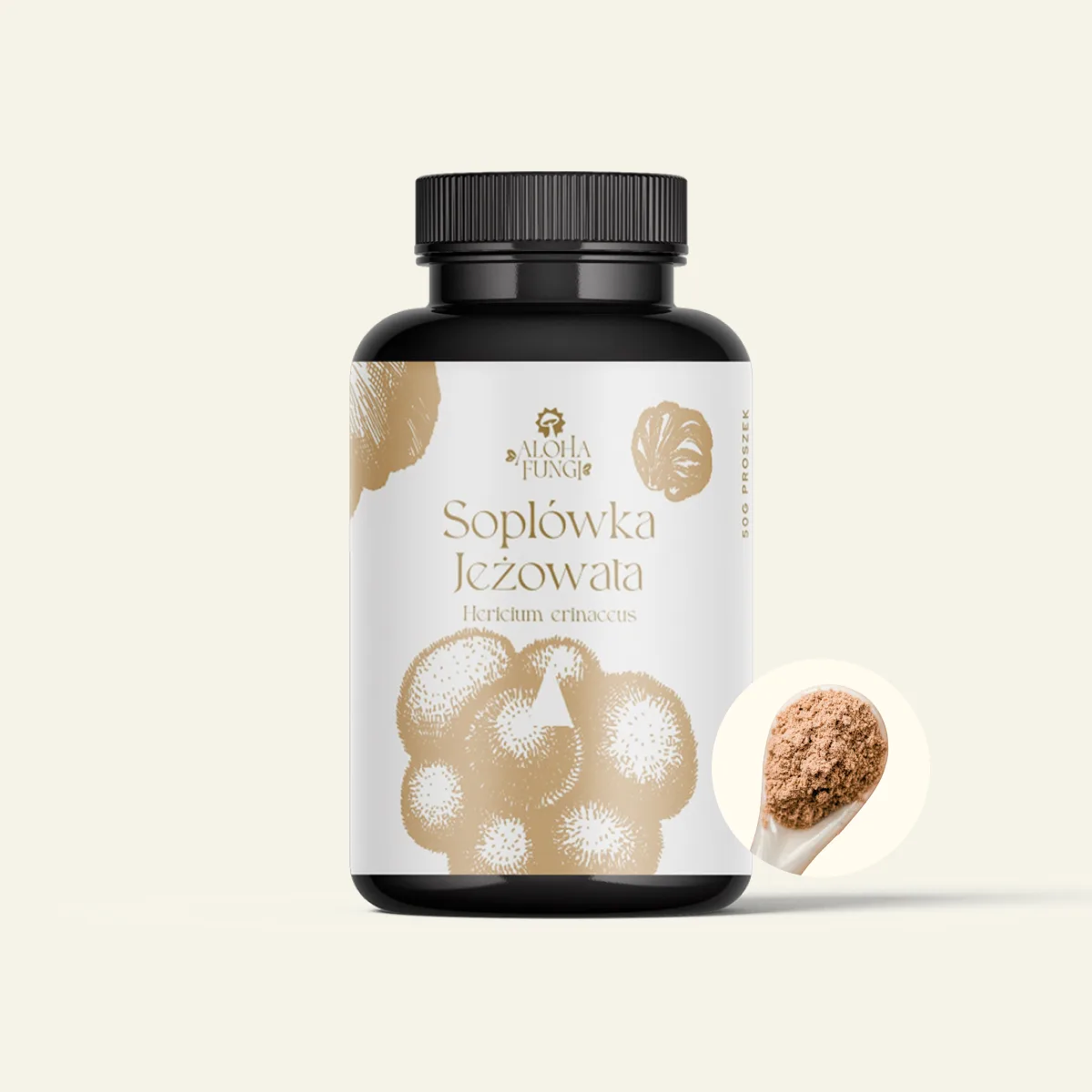
MushroomsSubscription −15%
Lion's Mane
Hericium erinaceus
Powders · LONGEVITY119 zł
Below you will find every available product for this species. Each tile opens the product page with the selected format and line preselected.
Version 4.0 · Updated: 12 September 2026 · Subject-matter reviewer: Mateusz Rosa, founder of Aloha Fungi, TCM therapist, Doctor of Acupuncture (WFAS).
Lion’s Mane in 60 seconds
Lion’s mane is the English name of Hericium erinaceus. In Polish it is „soplówka jeżowata”; online you will also see „lion mane”, „lions mane” and the misspelling „soplowka jezowata”. It is sometimes confused with „jeżówka” (Echinacea, a different plant entirely). In Japan it is known as yamabushitake, in China as hou tou gu. All of these names refer to the same fruiting body we offer as powder, capsules and drops.
Soplówka jeżowata is the Polish name for Hericium erinaceus, a species in the Hericiaceae family. Lion’s Mane, yamabushitake and hou tou gu are names for the same species used in other languages and traditions.
The mushroom occurs on deciduous wood in forests of the northern hemisphere. Its fruiting body is white, with hanging spines that resemble a mane or icicles. The origin of commercial raw material and contaminant test results should come from documentation for the specific batch.
The name yamabushitake is associated with the Japanese yamabushi tradition. Chinese descriptions of hou tou gu use the context of Stomach and Spleen Qi. We present this as a history of use and language, not as evidence for a modern supplement.
In 1991 Hirokazu Kawagishi’s team described hericenones isolated from fruiting bodies and NGF measurements in cell culture. Later work described erinacines, mainly in mycelial material. The type of research material matters when interpreting a result.
Hericenones and erinacines are different groups of compounds described in Hericium erinaceus research. Publications most often associate hericenones with fruiting bodies and erinacines with mycelium, but the profile depends on strain, cultivation, extraction and analytical method.
Hericenones A-K are aromatic compounds studied in cell cultures, among other models. A result from such a model does not describe bioavailability or an outcome after consuming a finished product.
Erinacines A-K are diterpenoids studied mainly in mycelial materials and animal models. Blood-brain barrier data come from those models, not from a study of an Aloha Fungi product in humans.
Publications have also analysed β-glucans, ergosterol and ergothioneine. Their presence and quantity in a specific product should be established from the current label and batch documentation.
A fruiting body, pure mycelium and mycelium grown on grain are different raw materials. When comparing products, check the mushroom part, carriers, extraction method, declared standardisation and a document matched to the batch number.
The fruiting body is the mature, visible part of the mushroom, the same one you know from the forest, from photos, and from tradition, meaning in practice a small part of the mushroom's whole life cycle. Mycelium on grain is a network of fungal threads grown on grain (rice, oats, sorghum), then dried and milled together with that substrate. As a result, the powder contains a mix of mycelium and starch from the grain.
Picture an apple tree. The fruiting body is the apple, the mature result of growth. Mycelium is the roots and shoots growing in the soil, harvested together with the soil they grew in. Both parts come from the same plant, but what ends up in the jar is two completely different stories.
Mycelium on grain is not automatically worthless or useless. It is simply cheaper and faster to produce, because it skips the long growth stage of the fruiting body. The problem appears when the label does not say this plainly and suggests a full-value mushroom extract, while a significant part of the weight is grain.
The label plainly says "fruiting body extract", states the beta-glucan percentage separately from general "polysaccharides", and ideally provides a batch certificate of analysis (COA). The absence of these three pieces of information is a signal to ask the producer directly before you buy.
Full comparison with a label checklist: fruiting body vs mycelium on grain. Batch test reports for our lion’s mane are available in the batch passport archive.
Kawagishi 1991 described hericenones isolated from fruiting bodies and NGF measurements in glial cell cultures. This is an in vitro finding, not a study of an oral supplement in humans.
A cellular study does not answer questions about absorption, metabolism, the amount reaching human tissue or relevance to everyday cognitive function.
Lai 2013 discusses erinacines, NGF and Hericium erinaceus material in preclinical research, including rat models. BDNF also appears mainly in animal literature.
These data help generate research hypotheses. They do not establish a cognitive outcome in humans or the superiority of a fruiting body, mycelium or extraction method without a direct clinical comparison.
Dectin-1, TLR4, the microbiota and the gut-brain axis appear in β-glucan research and preclinical models. Brown and Gordon 2003 describe fungal β-glucans generally, not the efficacy of a Lion’s Mane product.
It has not been established whether or to what degree these observations translate into a meaningful human outcome. The presence of β-glucans on a label does not establish a particular cognitive result.
Lion’s Mane does not cure Alzheimer’s disease or other neurodegenerative diseases. NGF and BDNF data come mainly from preclinical models and do not establish product efficacy. Lion’s Mane does not replace antidepressant or anxiolytic medicines. Research also does not establish higher IQ or a universal memory improvement in healthy adults.
Comparing powder, capsules and drops? See how to choose a Lion’s Mane extract: check the ingredients, serving size and batch documentation.
Different forms and batches may have different instructions. Use the serving, timing and preparation method on the current product label.
Do not convert quantities from scientific studies into Aloha Fungi capsules, drops or powder yourself. The studies concerned other preparations. Do not exceed the recommended daily serving.
If the label for the relevant form allows it, the product can be served with water, coffee, cacao, a plant drink or a meal. The choice of addition does not replace the manufacturer’s instructions.
There are no reliable data establishing one schedule for every product and person. This page does not set a cycle or a timeline for an expected result.
Do not treat a single change in concentration, mood or digestion as proof that the product works. Many other factors affect such observations.
If an unwanted symptom appears, stop use and discuss the next step with a doctor or pharmacist. The safety section below identifies situations requiring particular care.
No clinical study establishes a particular benefit from this combination. Using several supplements also makes it harder to attribute tolerance or an unwanted symptom to one ingredient.
The popularity of this pairing is not evidence of synergy. Check the label and warnings for each product separately, especially if you take medicines.
Both raw materials appear in preclinical NGF literature, but no clinical study establishes synergy from combining them or a memory-related outcome.
There is no basis for calling Chaga the strongest choice or promising a cognitive outcome from the pairing. Each ingredient needs a separate safety assessment.
No clinical study establishes a particular benefit from this combination. Do not select a supplement stack as a response to a previous health problem without consulting a doctor.
Traditional Chinese and Japanese descriptions associate Lion’s Mane with Stomach and Spleen Qi and Shen. These are historical categories in a traditional system.
This is a cultural framework, not a medical diagnosis or evidence of product efficacy. Concepts such as Qi, Shen or meridian do not correspond one to one with Western anatomy or physiology.
| Taste | sweet, bland (淡 dàn) |
| Nature | neutral to slightly cooling |
| Meridians | Stomach, Spleen, Lung, Heart |
| Category | tonic of Middle Burner Qi and Shen (补气安神) |
Known allergy to mushrooms of the Hericiaceae family (a single case of a respiratory reaction is described in the literature, Nakatsugawa 2003).
Status after organ transplant with active immunosuppression (cyclosporine, tacrolimus, mycophenolate).
Children under 18, and pregnancy and breastfeeding (no adequate studies in these groups).
Autoimmune diseases (β-glucans activate Dectin-1 and TLR4; during a flare it is better to stop).
Anticoagulant and antiplatelet medicines (possible mild effect on platelet aggregation, monitoring).
Antidiabetic medicines (a mild hypoglycaemic effect was observed in animal models).
Antidepressants (SSRI, SNRI): no significant interactions are described, but given the influence on neurotransmission a consultation is advised.
Planned surgery: stop at least 14 days before the procedure.
Reported rarely: mild gastrointestinal discomfort in the first week (prebiotic effect), skin reactions in people hypersensitive to mushrooms, mild insomnia with an afternoon serving.
Serving, timing and preparation are given on the current product label. Do not convert amounts from scientific studies into a supplement serving yourself.
Evidence verdict
We also show what is not proven. This is a dietary supplement, not a medicine.
0
Strong evidence
confirmed composition
7
Preliminary
in vitro and animal studies
3
Not proven
no human studies
Reviewed by
Mateusz Rosa · Doctor of Acupuncture (WFAS)
Version 4.0 · Updated: 12 September 2026 · Subject-matter reviewer: Mateusz Rosa, founder of Aloha Fungi, TCM therapist, Doctor of Acupuncture (WFAS).
Based on 11 verified sources
See sources ↓| Claim | Type of evidence | Strength |
|---|---|---|
| NGF measurement after exposing glial cells to selected hericenones | in vitro model (Kawagishi 1991), without a clinical outcome | PRELIMINARY |
| Erinacines and NGF in preclinical material | animal models and review of preclinical data (Lai 2013) | PRELIMINARY |
| Relationships between fungal β-glucans, Dectin-1 and TLR4 | mechanistic research, not a Lion’s Mane product outcome (Brown and Gordon 2003) | PRELIMINARY |
| HDS-R results in one study of a specific dried mushroom preparation | small RCT n=30 (Mori 2009), needs independent replication | PRELIMINARY |
| Changes in selected questionnaire results among women | small RCT n=30 using cookies containing H. erinaceus (Nagano 2010) | PRELIMINARY |
| Selected cognitive and mood results in a pilot study | small RCT n=41 of a specific preparation (Docherty 2023) | PRELIMINARY |
| No significant difference in global cognition or mood measures after a single dose | small crossover RCT n=18 of a specific extract (Surendran 2025) | PRELIMINARY |
| „Cures" or „prevents" Alzheimer’s disease | none, claim prohibited by regulation | NONE |
| „Raises IQ" in healthy adults | no large RCTs with intelligence tests | NONE |
| „Replaces" antidepressant or anxiolytic medicines | none, claim prohibited by regulation | NONE |
STRONG = solid evidence · PRELIMINARY = moderate or preliminary · NONE = unsupported or prohibited by regulation.
Lion's mane co to jest po polsku? It's soplowka jezowata, the mushroom Hericium erinaceus. See the names, the look, and its place in East Asian tradition.
Soplówka jeżowata dawkowanie: what doses of lion's mane were used in clinical studies, for how many weeks, and why that's not a recommendation for you.
Soplowka jezowata gdzie kupic i cena: pharmacy, brand shop or marketplace, and which label data on the lion's mane extract explains the price gap.
Soplowka jezowata jak wyglada, gdzie rosnie: a rare, protected mushroom in Poland, growing on old deciduous trees. See its look, habitat, and legal status.
Soplówka jeżowata na co? Lion's mane is studied for memory, mood and gut comfort. See exactly what the studies checked and their limits.
Soplowka jezowata opinie search results mix two things: subjective lion's mane customer reviews and studies on small, controlled samples. See how they differ.
Want to understand the topic first? Read: Lion’s Mane and cognitive research
Have a different lion’s mane on hand? Compare its price per serving and per gram of extract with ours. Compare two lion’s mane supplements
The educational content on this page does not replace medical advice. A dietary supplement is not a medicine and should not replace a varied diet or medical consultation. Before starting supplementation, especially with chronic conditions, pregnancy, breastfeeding or when taking medication, consult a doctor. Aloha Fungi does not claim therapeutic efficacy for any product; the mechanisms described are based on the current state of the literature. All products are dietary supplements notified to the Polish Chief Sanitary Inspectorate (GIS).
© 2026 Aloha Fungi™


