MushroomsSubscription −15%
Cordyceps
Cordyceps militaris
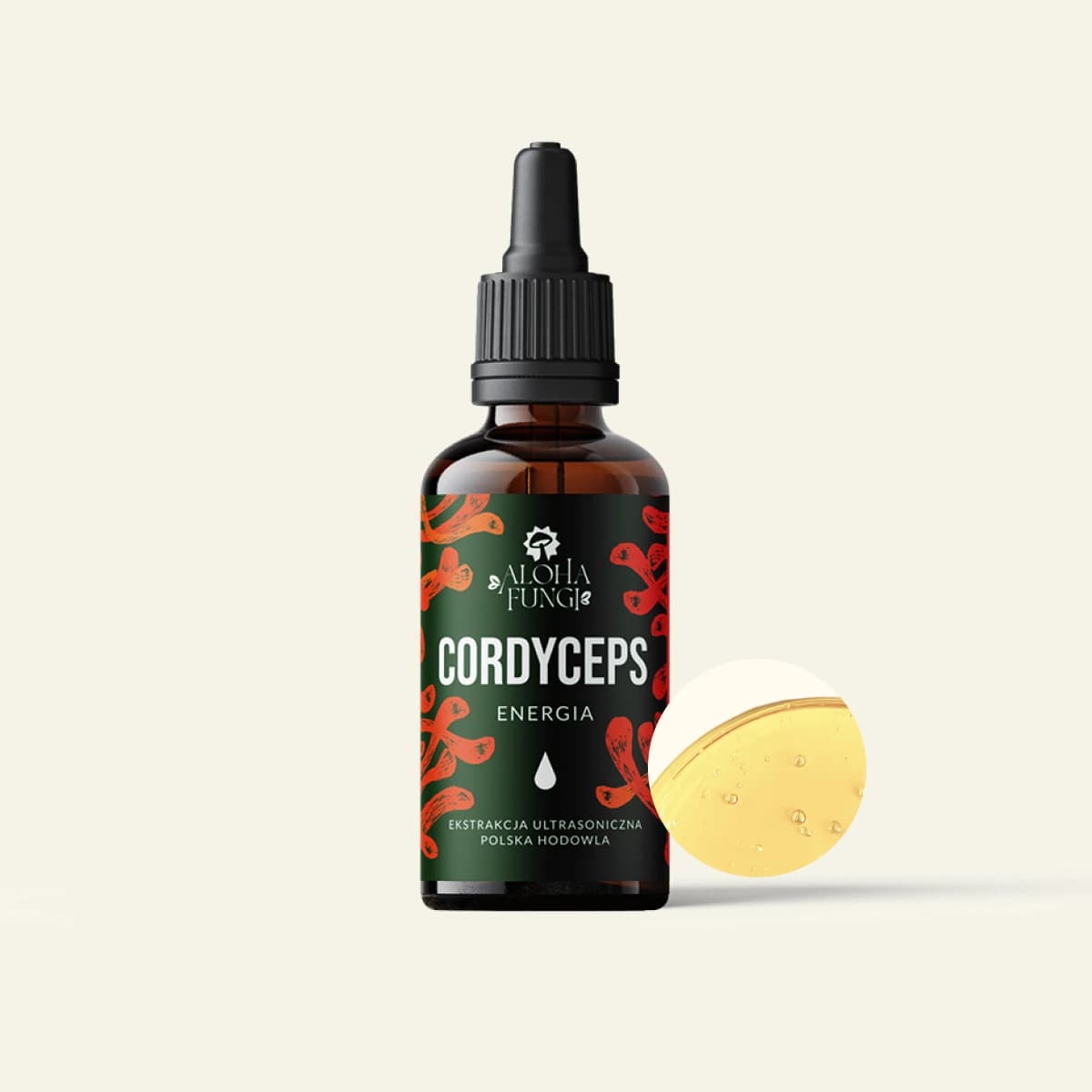
Drops · PRIME169 zł
Below you will find every available product for this species. Each tile opens the product page with the selected format and line preselected.
Version 1.0 · Updated: 21 June 2026 · Subject-matter reviewer: Mateusz Rosa, founder of Aloha Fungi, international TCM therapist (8 years of therapeutic practice, Doctor of Acupuncture, Level A certificate issued by WFAS, an NGO in official relations with the WHO, 2018; author of the books „Przebudzenie Zdrowia" and „Suplementacja grzybów Funkcjonalnych").
Cordyceps in 60 seconds
Cordyceps is a genus name covering several hundred species of parasitic fungi of the Cordycipitaceae family. Two of them are of therapeutic significance: Cordyceps militaris (in Polish maczużnik bojowy, today dominant in the global supplement market) and Cordyceps sinensis (reclassified in 2007 as Ophiocordyceps sinensis, wild, Tibetan).
These are insect-parasitic fungi. In nature they attack butterfly larvae (C. sinensis feeds on Thitarodes caterpillars on the Tibetan plateaus above 3000 m a.s.l., C. militaris on the pupae of several species). After infection the fungus grows inside the host body and in spring sends out an orange, club-shaped structure with a fruiting body. It is this that holds the highest concentration of bioactive compounds.
Wild C. sinensis is threatened by overexploitation, and its market price exceeds 50,000 EUR/kg. This is why the modern supplement market relies on C. militaris from controlled cultivation, which eliminates the risk of heavy-metal contamination and gives a repeatable cordycepin content. Aloha Fungi works only with C. militaris from controlled cultivation.
The oldest documented use of Cordyceps comes from Tibet, Bhutan and Nepal, where yak herders observed that animals eating the wild sinensis had more energy and better reproduction.
The first written mention in a Chinese medical text is Ben Cao Cong Xin (1757) by Wu Yiluo, where Cordyceps was described as a tonic tonifying the Lung and Kidney, recommended for chronic fatigue and weakness after a long illness.
Modern endurance interest was reinforced by a 12-week RCT in 20 healthy older volunteers (aged 50-75), which showed a 10.5% rise in the ventilatory threshold (p=0.02) after supplementation with the Cs-4 preparation (Chen et al. 2010).
Cordycepin (3′-deoxyadenosine), the key nucleoside, an adenosine analogue. Standardised in our extract to above 0.3%.
Adenosine, a natural nucleoside. Together with cordycepin it forms the basis of the energetic (ATP) and regulatory (adenosine receptors) mechanism.
β-1,3/1,6-glucans, polysaccharides activating Dectin-1 and TLR4. Standardised in our extract to above 30%.
CPS-2 and CMP polysaccharides, peptidopolysaccharide fractions specific to C. militaris.
Cordycepic acid (D-mannitol), ergosterol, cordysinins, sterols. Essential amino acids and trace elements (zinc, selenium, manganese).
In Park et al. 2020 an ethanol extract of C. militaris (containing 2.33 mg/g of cordycepin) given to mice for 12 weeks raised ATP and phosphocreatine levels and activated the AMPK and PGC-1α pathways, the key regulators of mitochondrial biogenesis.
AMPK is the cellular „energy sensor" and PGC-1α regulates the formation of new mitochondria. Together they describe why Cordyceps is associated in the literature with the energy economy of exercise, not with acute stimulation.
Cordycepin (3′-deoxyadenosine) is a structural analogue of adenosine and binds to four adenosine receptors: A1, A2A, A2B and A3 (Du et al. 2021).
Modulation of the adenosine receptors touches the regulation of blood flow, metabolic signalling and the anti-inflammatory response. This is a pathway described in the literature, not a clinical pharmacological intervention.
In a 12-week RCT (Chen et al. 2010, n=20, aged 50-75) the Cs-4 preparation (C. sinensis) increased the ventilatory threshold (VT) by 10.5% compared with placebo (p=0.02).
Hirsch et al. 2017 confirmed a similar trend for C. militaris after 3 weeks of supplementation. Animal models (Kumar 2011, Nicodemus 2001) additionally point to a delay in lactic-acid accumulation, but this direction needs larger clinical studies.
Cordyceps does not have an immediate, stimulating effect like caffeine or ephedrine. It does not bind to adrenergic receptors, does not raise the heart rate, does not increase blood pressure. It is a tonifying mushroom with a delayed action; the first changes appear after 2-4 weeks of regular use, the full effect after 8-12 weeks. Cordyceps does not replace cardiac, hormonal, anticoagulant or antidiabetic medicines. All current research points to a supporting action, not a therapeutic one in the medical sense.
Cordyceps works in the morning and before noon, up to around 2 pm. In the evening it may make it harder to fall asleep. Exception: sublingual drops, 15-20 drops, can be taken 30-60 minutes before planned exercise at any time of day.
Prevention: 1 g of extract as powder (1 teaspoon) or drops (30 drops) once a day in the morning, and in capsules the standard serving is 3. Endurance (sports protocol): 2-3 g of extract in two servings, in the morning and 30-60 minutes before training. In clinical studies effective doses are 3-4 g a day with chronic use over 3 weeks. Do not exceed the recommended daily serving.
Cordyceps absorbs best 20-30 minutes before a meal on a slightly empty stomach (with warm water or coffee). Drops sublingually under the tongue for 30-60 seconds, then swallow. With gastric discomfort it can be taken with a light meal.
The 5/2 rhythm: five days of use, two days off (usually the weekend), which helps preserve the responsiveness of the adenosine receptors. Duration: prevention 8-12 weeks, then a 2-4 week break and another cycle; sports protocol 4-12 weeks; recovery after overload 12-16 weeks (under a therapist’s care).
Weeks 1-2: subtle effects, sometimes better tolerance of morning exercise, getting up more easily.
Weeks 3-6: more stable energy through the day without afternoon „crashes", better tolerance of long aerobic efforts.
Weeks 8-12: a cumulative effect; in athletes a delay of the fatigue threshold, in people with an overloaded HPA axis a more stable circadian rhythm.
Cordyceps in the morning (tonifies Kidney Yang, strengthens ATP), Reishi in the evening (Liver Yin, calms Shen). Cordyceps 1 g in the morning, Reishi 1 g in the evening. Duration: 12 weeks. A protocol for people with an overloaded HPA axis and chronic fatigue.
For people doing mental work. Cordyceps 0.5-1 g in the morning on an empty stomach, Lion’s Mane 0.5-1 g in the morning or in two servings. Duration: 8-12 weeks. Both mushrooms are best taken before noon.
Cordyceps 0.5-1 g in the morning on an empty stomach, Chaga 1 g in the morning or before noon. Duration: 8-12 weeks. Note: both mushrooms are tonifying, do not use after 2 pm.
Cordyceps 1 g in the morning, Tremella 1 g in the evening with dinner. Duration: 12 weeks.
Cordyceps 1 g in the morning, Coriolus 1 g before noon. Duration: 8 weeks.
Cordyceps entered the official TCM canon relatively late (the 18th century), although in the folk tradition of Tibet and the Chinese-Tibetan borderland it was used much earlier. The first written mention comes from Ben Cao Cong Xin (1757) by Wu Yiluo.
This is a frame of cultural observation, not a medical diagnosis. Concepts such as Qi, Jing, Yang or meridian do not correspond one to one with Western anatomy or physiology.
| Taste (味, Wèi) | sweet (甘, gān) |
| Nature (性, Xìng) | warm to neutral (溫, wēn) |
| Meridians (歸經, Guījīng) | Lung (肺), Kidney (腎) |
| Action | tonifies Kidney Yang, strengthens Jing (the essence), tonifies Lung Yin, reinforces Wei Qi, „stops bleeding from the lungs" |
Pregnancy and breastfeeding (insufficient clinical data).
Active immunosuppressive medicines (after organ transplants).
Children under 18.
Active autoimmune diseases during a flare (RA, lupus, multiple sclerosis, Hashimoto).
Anticoagulant medicines (warfarin, acenocoumarol, apixaban, rivaroxaban). Cordycepin and adenosine may affect platelet aggregation.
Antidiabetic medicines. As a precaution monitor blood glucose; a possible risk of hypoglycaemia in combination with the medicines.
Blood-pressure-lowering medicines. Possible potentiation of the effect.
Immunomodulatory and adenosine medicines (dipyridamole, regadenoson, xanthine derivatives such as theophylline).
Before planned surgery, stop Cordyceps at least 14 days before the procedure.
Transient stimulation and difficulty falling asleep when used after 2 pm.
Mild gastric discomfort on an empty stomach.
A cleansing reaction in the first 5-7 days (hot flushes, sweating); then reduce the serving.
Allergic reactions (rarely); with itching and a rash stop immediately.
In people with „liver fire" a transient intensification of symptoms may occur.
Evidence verdict
We also show what is not proven. This is a dietary supplement, not a medicine.
3
Strong evidence
confirmed composition
3
Preliminary
in vitro and animal studies
2
Not proven
no human studies
Reviewed by
Mateusz Rosa · Doctor of Acupuncture (WFAS)
Version 1.0 · Updated: 21 June 2026 · Subject-matter reviewer: Mateusz Rosa, founder of Aloha Fungi, international TCM therapist (8 years of therapeutic practice, Doctor of Acupuncture, Level A certificate issued by WFAS, an NGO in official relations with the WHO, 2018; author of the books „Przebudzenie Zdrowia" and „Suplementacja grzybów Funkcjonalnych").
Based on 12 verified sources
See sources ↓| Claim | Type of evidence | Strength |
|---|---|---|
| Cordyceps increases the ventilatory threshold (VT) and tolerance of aerobic exercise | RCT (Chen 2010, n=20, 12 wks; Hirsch 2017, n=28, 3 wks), needs larger replications | STRONG |
| Cordycepin modulates the A1, A2A, A2B, A3 adenosine receptors | in vitro + pharmacological models, many independent works (Du 2021 review) | STRONG |
| Cordyceps activates AMPK and PGC-1α, supports mitochondrial biogenesis | animal models (Park 2020, Kumar 2011), in vitro | STRONG |
| Cordyceps delays lactic-acid accumulation during exercise | animal models (Nicodemus 2001, Kumar 2011) + signals from RCTs | PRELIMINARY |
| Support of respiratory function in COPD and exercise-induced asthma | small RCTs, animal models, used as a complement to standard therapy | PRELIMINARY |
| Hypoglycaemic action and support of insulin sensitivity | animal models, small clinical studies, needs large RCTs | PRELIMINARY |
| Cordyceps „cures" cancer in humans | none; only in vitro and animal models; claim prohibited by regulation | NONE |
| Cordyceps „raises testosterone" or treats erectile dysfunction in humans | single animal models, no human RCTs; claim abused in marketing | NONE |
STRONG = solid evidence · PRELIMINARY = moderate or preliminary · NONE = unsupported or prohibited by regulation.
Cordyceps contraindications: immunosuppressants, diabetes and blood-thinning medication, pregnancy, autoimmune disease. When to ask a doctor before you start.
Cordyceps sinensis is a wild fungus from Tibet, almost absent from supplements. Cordyceps militaris is cultivated as fruiting bodies. How to read the label and not get misled by the name.
Which mushroom for energy? Meet Cordyceps: TCM tradition, cordycepin, adenosine, ATP and how it fits into a daily activity ritual.
A practical, step by step morning ritual with cordyceps: timing, form, pairing with a meal. No promise of an effect, just a concrete plan for the week.
Cordyceps contains cordycepin, cordycepic acid and polysaccharides studied for the adenosine axis, mitochondria, HPA and immunity. Mechanism, not a promise.
Grzyby funkcjonalne w liczbach: functional mushroom doses, extract composition, and regulation, sourced from PubMed. Updated Sept 12, 2026.
Want to understand the topic first? Read: Cordyceps, energy and stamina
The educational content on this page does not replace medical advice. A dietary supplement is not a medicine and should not replace a varied diet or medical consultation. Before starting supplementation, especially with chronic conditions, pregnancy, breastfeeding or when taking medication (particularly anticoagulant, antidiabetic or hypotensive), consult your treating doctor. Aloha Fungi does not claim therapeutic efficacy for any product; the mechanisms described are based on the current state of the literature and may change as research advances. All products are dietary supplements notified to the Polish Chief Sanitary Inspectorate (GIS).
© 2026 Aloha Fungi™


