MushroomsSubscription −15%
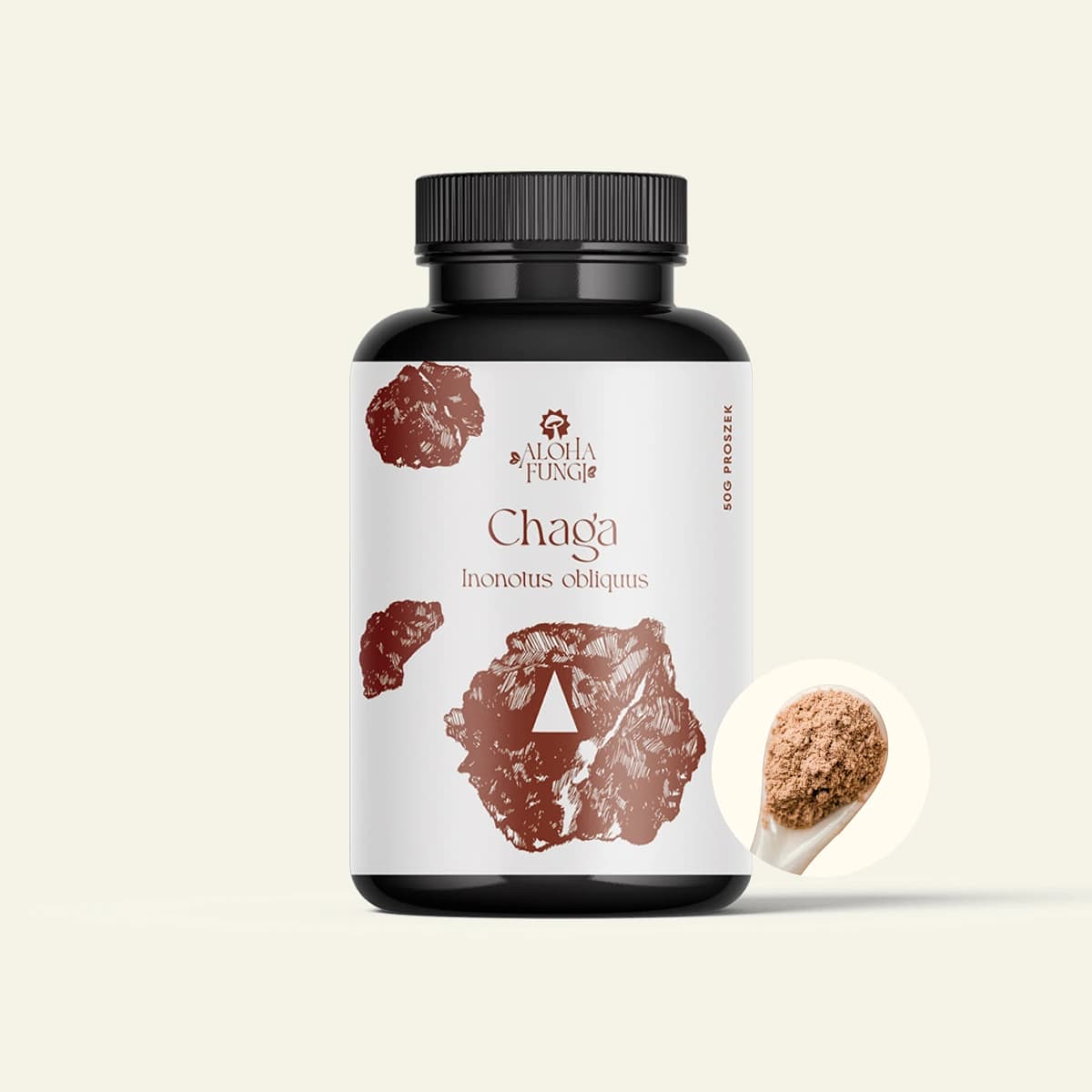
Chaga
Inonotus obliquus
Powders · LONGEVITY119 zł
Below you will find every available product for this species. Each tile opens the product page with the selected format and line preselected.
Version 2.0 · Updated: 24 August 2026 · Subject-matter reviewer: Mateusz Rosa, founder of Aloha Fungi, TCM practitioner, Doctor of Acupuncture (WFAS).
Chaga in 60 seconds
Inonotus obliquus is a fungal species in the Hymenochaetaceae family. NCBI Taxonomy lists this as the current name and identifies chaga as a common name. In Polish, the species is called błyskoporek podkorowy.
The black growth visible on a living tree is a sterile conk. Micromorphological research describes it as a complex material with a substantial woody component, a dark outer layer and brown-rust inner layers. The spore-producing fruiting body is a separate structure.
This distinction matters when assessing a supplement. The word Chaga or a photograph of the conk does not by itself confirm the material part, extraction method, standardisation or purity of a specific product.
A consultation published in November 2024 classified Chaga conk as novel food for the proposed food use. The document also notes that a history of Chaga use in food supplements had already been confirmed and was outside that consultation.
A separate consultation from February 2025 concerned an extract powder made from material described as fruiting body/conk using hot-water and ultrasound-assisted extraction. That specifically described material was found not novel in food supplements.
The practical conclusion is narrow: the status of one material and use should not be transferred to every beverage, food, extract or market. In Poland, Inonotus obliquus is under partial species protection under a regulation that remains in force. Wild collection is subject to prohibitions and statutory exceptions, so this page is not a foraging guide.
Studies of Chaga have analysed polysaccharides, phenolic compounds, pigments and triterpenoids. The presence of a compound-class name does not establish its amount, bioavailability or clinical relevance.
Wold and colleagues characterised heteropolysaccharides isolated from cultivated Inonotus obliquus material. This was a structural and laboratory-model study, not a human trial of a supplement.
Composition may depend on origin, the proportion of wood in the conk, the sampled zone, processing, solvent and batch. A result from one analysis should not be presented as a universal property of every Chaga product.
Beltrame and colleagues used NMR and FTIR spectroscopy to compare layers of a sterile conk. The outer layer was chemically closer to birch wood, while some inner layers were closer to fungal hyphae.
This helps describe raw-material heterogeneity. It does not answer questions about outcomes after consumption or the quality of a specific product batch.
Shen and colleagues tested different Chaga extracts in the murine RAW264.7 cell line. They measured cell viability, phagocytosis, nitric oxide and selected cytokines in different laboratory settings.
An in vitro result can identify a direction for further research. It does not establish efficacy, serving, time of use or supplement safety in humans.
The sources collected in this bibliography do not include a controlled clinical efficacy trial of the Aloha Fungi Chaga product. There is therefore no basis for promising an effect, a time to effect or a special benefit from combining Chaga with other mushrooms.
Two case reports of oxalate nephropathy concern prolonged consumption of large amounts of Chaga powder. A case report is a safety signal, but it does not determine risk frequency or make all product forms equivalent.
Chaga is not a medicine for cancer, diabetes, autoimmune disease, liver disease, infection or skin disease. Cell and animal studies do not establish clinical efficacy in humans. Chaga does not “flush toxins”, and traditional descriptions involving Qi, Yang and cleansing are not medical diagnoses. A supplement does not replace treatment or medical consultation.
Before comparing products, check the published batch test documents. Match the document’s batch number to the one on your packaging. A result for a different batch does not verify the composition of your product.
Powders, capsules and drops may differ in composition and instructions. Select the specific variant and read its current label before use.
Do not convert quantities from a scientific paper, another brand or another form into an Aloha Fungi product. Do not exceed the recommended daily serving stated on the label.
Record the batch number from the package. When reviewing a laboratory document, check the matching batch number, material name, tested parameter, method, unit, result, date and laboratory.
A laboratory logo or a general testing statement does not establish that the document covers the product in your hand or the parameter you need.
There is no reliable clinical study establishing a universal outcome schedule for Chaga. Do not interpret a change in energy, sleep, skin or digestion as stand-alone proof of a product effect.
If an unwanted symptom occurs, stop using the product and discuss the next step with a doctor or pharmacist.
This is a popular commercial and traditional pairing. No controlled clinical trial cited here confirms a special benefit from this combination.
Studies of each material separately are not evidence of synergy in the finished combination. Check the label and safety information for both products.
The presence of polysaccharides in both materials does not predict an outcome from combining them. Using several supplements also makes the source of an unwanted symptom harder to identify.
Do not turn traditional descriptions or preclinical findings into a promise for the combination. Each ingredient requires a separate product and market assessment.
There is no basis for promising a special skin or beauty outcome from this pairing. A history of use does not replace a clinical study of the combination.
Chaga is more firmly rooted in folk traditions from Siberia, Russia and parts of Northern Europe than in classical Chinese materia medica. Modern TCM interpretations assign it a bitter taste, a cool-to-neutral nature and associations with the Liver, Kidneys and Spleen.
This is cultural context, not a medical diagnosis or evidence of a product outcome. Terms such as Qi, Yang, Heat and meridian do not map one to one onto Western anatomy or physiology.
| Taste | bitter, slightly sweet |
| Nature | cool to neutral |
| Meridians | Liver, Kidneys, Spleen |
| Status of description | cultural context, not a clinical claim |
The literature contains reports of oxalate nephropathy after prolonged consumption of large amounts of Chaga powder. Case reports do not determine the risk of a typical serving or every extract, but they are a relevant safety signal.
If you have kidney disease, reduced kidney function, active kidney stones or a history of oxalate stones, do not start use without consulting a doctor.
Adequate clinical safety data are lacking for Chaga during pregnancy, breastfeeding and in people under eighteen years of age. Follow the restrictions on the current label.
If you take medication, particularly medicines affecting clotting, blood glucose, blood pressure or immune function, discuss the product with a doctor or pharmacist. Preclinical literature cannot establish a safe interval or justify changing treatment yourself.
If you use diabetes medication, discuss the decision with your treating doctor. Do not change medicines or their servings yourself.
If you have an active autoimmune disease, discuss the product separately with your treating doctor.
After a rash, swelling, breathing difficulty, severe pain, a change in urination or another concerning symptom, stop use and seek appropriate medical help.
Safety also depends on material identity, contaminants and batch conformity. Verify the current label and the laboratory document matching the batch number.
Evidence verdict
We also show what is not proven. This is a dietary supplement, not a medicine.
0
Strong evidence
confirmed composition
4
Preliminary
in vitro and animal studies
2
Not proven
no human studies
Reviewed by
Mateusz Rosa · Doctor of Acupuncture (WFAS)
Version 2.0 · Updated: 24 August 2026 · Subject-matter reviewer: Mateusz Rosa, founder of Aloha Fungi, TCM practitioner, Doctor of Acupuncture (WFAS).
Based on 10 verified sources
See sources ↓| Claim | Evidence type | Strength |
|---|---|---|
| The sterile Chaga conk is heterogeneous and contains a woody component | morphological and spectroscopic raw-material analysis, no efficacy test | PRELIMINARY |
| Heteropolysaccharides can be characterised in Inonotus obliquus material | isolation, structural analysis and laboratory models | PRELIMINARY |
| Selected extracts alter markers in murine RAW264.7 cells | in vitro, different extracts and laboratory conditions | PRELIMINARY |
| Chaga provides a defined clinical benefit in humans | no controlled clinical trial in the cited bibliography | NONE |
| Prolonged high consumption of powder may be associated with oxalate nephropathy | individual case reports, a safety signal without risk frequency | PRELIMINARY |
| Every Chaga product has the same composition, serving and testing scope | no evidence, parameters require variant and batch documentation | NONE |
WSTĘPNY = the source answers a narrow question or provides a signal requiring more data · BRAK = the source does not establish the clinical or product claim.
Chaga (Inonotus obliquus) is a black growth on birch in the cold north. An educational look at its origin, appearance and the tradition of brewing it.
China is the cultural home of functional mushroom tradition and the site of the most advanced extraction technology. How Aloha Fungi verifies every batch.
Light, temperature, moisture. How to store drops, capsules and powder from functional mushrooms so they keep their quality down to the last serving.
β-glucans are polysaccharides found in mushrooms and grains. We explain the Dectin-1 mechanism and how mushroom β-glucans differ from oat ones.
Cordycepin (3′-deoxyadenosine) is a natural adenosine analog discovered in 1950 in Cordyceps fungi. Receptor mechanism and in vitro research, no promises.
This educational content does not replace medical or legal advice. A food supplement is not a medicine and does not replace a varied diet. Before use, especially with kidney disease, another chronic condition, pregnancy, breastfeeding or medication, consult a doctor or pharmacist. Food status depends on the material, process, use and market. Check the Polish GIS notification status for the specific product. The studies described do not establish therapeutic efficacy for the Aloha Fungi product.
© 2026 Aloha Fungi™


