Journal
What are β-glucans? Functional mushrooms explained
β-glucans are polysaccharides found in mushrooms and grains. We explain the Dectin-1 mechanism and how mushroom β-glucans differ from oat ones.
TCM therapist · Doctor of Acupuncture (WFAS) · author of a book on functional mushrooms
5 min read
Contents
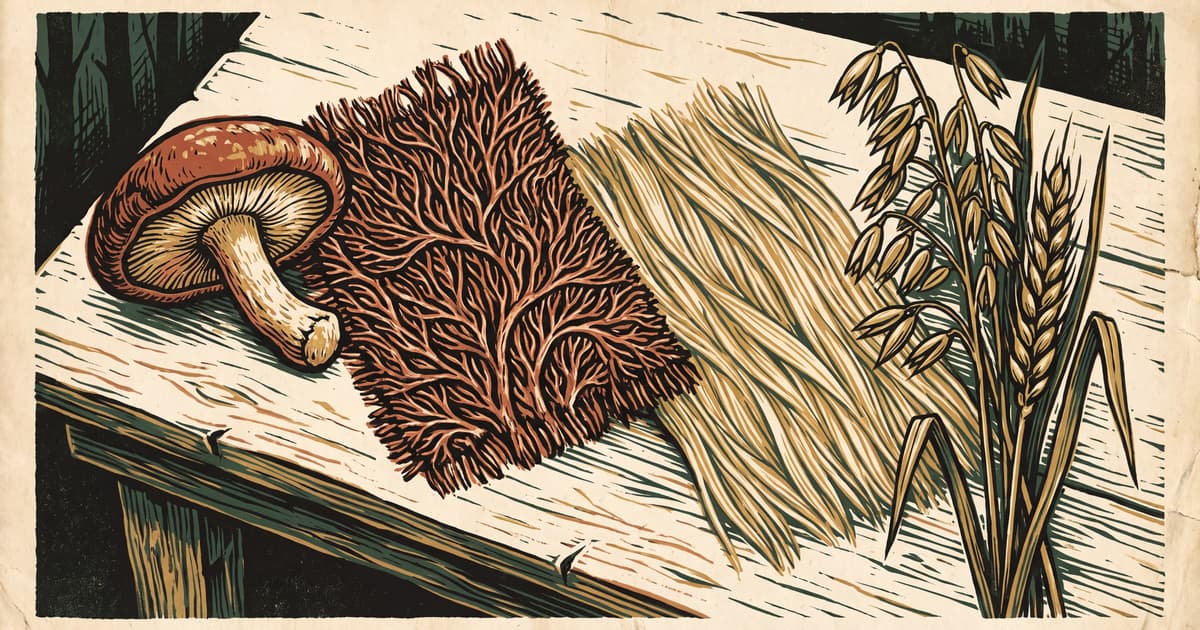
β-glucans are glucose-chain polysaccharides found in the cell walls of mushrooms, in oat and barley grains, and in baker's yeast. It's one of the most-cited, and most-oversimplified, topics in conversations about functional mushrooms. This article breaks the mechanism down piece by piece.
What exactly are β-glucans?
β-glucans are a group of structural polysaccharides built from D-glucose units, joined by a β-glycosidic bond. That bond is not digested by human enzymes, so β-glucans pass through the digestive tract largely intact, unlike starch (α-glucans).
There are three main types: β-1,3/1,6 from mushrooms (Reishi, Chaga, Shiitake, Maitake, Lion's Mane), which activate the Dectin-1 receptor; β-1,3/1,4 from oats and barley, with documented effects on LDL cholesterol (an approved EFSA health claim); and linear β-1,3 from baker's yeast, studied mainly in immunological models. This distinction has real regulatory weight: the approved EFSA claim applies only to oat and barley β-glucans at a 3 g daily portion. Mushroom β-glucans do not have a separate approved claim.
How do β-glucans work at the molecular level?
The best-described mechanism of mushroom β-glucans is activation of the Dectin-1 receptor (CLEC7A) on myeloid cells, mainly macrophages, neutrophils and dendritic cells. This receptor was identified in 2001 as the first C-type lectin receptor recognizing β-1,3-glucans [Brown & Gordon 2001, Nature 413: 36-37].
After β-glucan binds to Dectin-1, phagocytosis occurs, along with production of reactive oxygen species and activation of the Syk-CARD9-NF-κB pathway leading to cytokine production (IL-6, TNF-α, IL-10, IL-12) [Brown 2006, Nature Reviews Immunology 6: 33-43]. β-glucans also interact with TLR2/6 receptors and the CR3 complement receptor, broadening their immunomodulatory profile [Chan et al. 2009, Journal of Hematology & Oncology].
Prof. Gordon D. Brown, an immunologist at the University of Aberdeen and one of the discoverers of Dectin-1's role, describes it this way:
"Dectin-1 is the archetypal example of the C-type lectin receptor family, recognizing molecular patterns. Its role in recognizing β-glucans opened a new category of non-TLR pattern recognition receptors."
· Brown GD (2006). Dectin-1: a signalling non-TLR pattern-recognition receptor. Nature Reviews Immunology 6(1): 33-43.
This is a description of a mechanism from cell cultures and animal models. Translating these observations into a health effect for a specific person requires further clinical research in humans.
How much β-glucan is in different mushroom forms?
β-glucan content varies dramatically depending on the raw material form:
- 10:1 fruiting-body extract · above 30% β-glucans, trace starch.
- Raw fruiting-body powder · 7-15% β-glucans.
- Grain-grown mycelium (MOG) · 1-5% β-glucans, but 35-60% starch from the grain substrate.
This is a real chemical difference, not a marketing distinction. Standardization above 30% β-glucans gives a several-fold higher concentration of active compounds than a typical grain-mycelium product.
How should you read β-glucan research?
The β-glucan literature spans a wide range of methodologies, and it's worth distinguishing the level of evidence. In vitro studies (cell cultures) show mechanisms at the cellular level, not effects in a patient. Animal models, such as mice with the Dectin-1 gene knocked out [Taylor et al. 2007, Nature Immunology 8: 31-38], show the receptor's role in a specific model of immunity. RCTs with oat β-glucans underpin the approved EFSA cholesterol claim. RCTs with mushroom β-glucans are much rarer, usually with small n and heterogeneous doses.
Prof. Solomon P. Wasser, a mycologist at the University of Haifa and editor of the International Journal of Medicinal Mushrooms, points to one exception:
"Lentinan from Lentinula edodes is one of the best-studied naturally derived polysaccharide immunomodulators. Over 200 clinical papers in the PubMed database address its use."
· Wasser SP. (2017). International Journal of Medicinal Mushrooms 19(4): 279-317.
How do β-glucans differ from other compounds in mushrooms, like Reishi's triterpenes?
These are entirely different classes of compounds. β-glucans are polysaccharides, structural sugars, while triterpenes (as in Reishi) or hericenones (as in Lion's Mane) are small-molecule organic compounds from different biosynthetic pathways. Each class has a distinct receptor profile, and a single mushroom usually contains several classes at once. For more on Reishi's specific mechanisms, see our article How does Reishi work.
What does this topic NOT prove?
β-glucans are not an immunity pill. They are polysaccharides with a well-described molecular mechanism, whose clinical effect in a healthy person remains a subject of further research. At Aloha Fungi we work with mushroom β-glucans as a marker of extract quality and one element of regulatory support, not as a promise of a specific effect for a specific person.
A question that comes up regularly: do β-glucans "boost immunity" against viral infections? Individual in vitro studies showed cytokine modulation, but no clinical study has shown that β-glucan supplementation affects the course of a specific viral infection in humans. This is a classic example of a disallowed health claim in supplement advertising.
This content is for educational purposes only and does not constitute medical advice. A food supplement does not replace a varied diet or a healthy lifestyle. If in doubt, consult your doctor or pharmacist.