Journal
Fruiting body extract or mycelium on grain? How to read a mushroom extract label
Fruiting body or mycelium on grain? Check six things on a mushroom extract label before you compare price: beta-glucans, DER, origin and COA.
TCM therapist · Doctor of Acupuncture (WFAS) · author of a book on functional mushrooms
6 min read
Contents
You are buying a functional mushroom extract and two labels say something completely different, even though both write "reishi" or "lion's mane". One declares fruiting body extract, the other mycelium on grain. It is not the same part of the mushroom and not the same product, even though the price can be similar. This article teaches you to spot the difference on the label before you make a decision.
What is a fruiting body, and what is mycelium on grain?
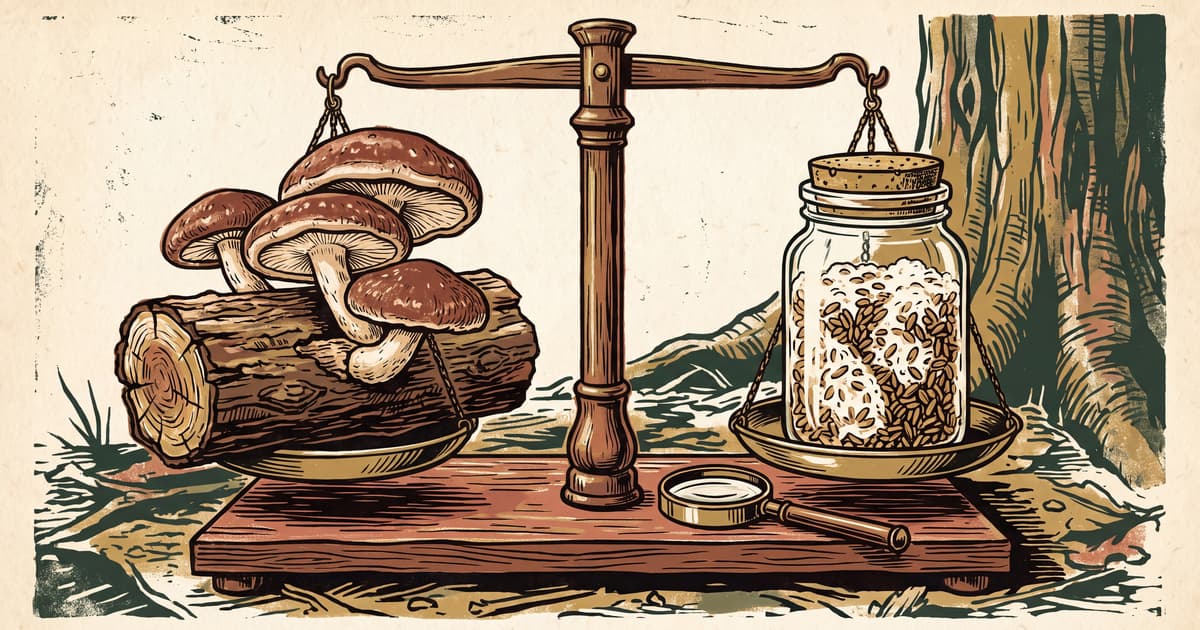
The fruiting body is the mature, visible part of the mushroom, the same one you know from the forest, from photos, and from tradition, meaning in practice a small part of the mushroom's whole life cycle. Mycelium on grain is a network of fungal threads grown on grain (rice, oats, sorghum), then dried and milled together with that substrate. As a result, the powder contains a mix of mycelium and starch from the grain.
Picture an apple tree. The fruiting body is the apple, the mature result of growth. Mycelium is the roots and shoots growing in the soil, harvested together with the soil they grew in. Both parts come from the same plant, but what ends up in the jar is two completely different stories.
Mycelium on grain is not automatically worthless or useless. It is simply cheaper and faster to produce, because it skips the long growth stage of the fruiting body. The problem appears when the label does not say this plainly and suggests a full-value mushroom extract, while a significant part of the weight is grain.
How do you spot the difference on the label? A checklist
You check six things on the label before you even get to comparing the price. No single item is decisive on its own, what counts is the full picture: the more "yes" answers, the more you actually know about the product in your hand. Another issue is that most producers are not even aware of what they are selling, and a large share sell maltodextrin at a ratio of 90% maltodextrin to... 10% extract.
- Origin declaration · the label plainly says "fruiting body extract", not just the species name. The absence of this information is itself an answer.
- Beta-glucans stated as a number · a concrete percentage of this compound group, not a general "rich in polysaccharides". Polysaccharides are a broad bucket that also includes starch from grain, so that number alone says little.
- Measurement method · a trustworthy label states how the standardization was measured (for example, spectrophotometric method), not just the percentage on its own.
- Extraction ratio (DER) · for example, "10:1" means 10 kilograms of dried raw material were used for 1 kilogram of finished extract. A higher ratio usually signals a stronger concentration, but on its own it says nothing about the quality of the raw material.
- Country of origin and cultivation · a specific place, not just "premium" or "natural".
- Batch testing (COA) · a certificate of analysis for the specific production batch, not a general marketing claim.
What is the favorite trick of mycelium-on-grain labels?
The most common trick is the word "polysaccharides" without a stated beta-glucan percentage. This matters because starch from grain (alpha-glucans) is also a polysaccharide and falls into the same total, even though it has nothing to do with the compounds you associate with functional mushrooms.
A mycelium-on-grain producer can therefore honestly write "40% polysaccharides" and the number will be true, even though most of that weight is starch from the substrate, not compounds from the mushroom itself. A label that breaks out the beta-glucan percentage separately tells you far more than a label with just the word "polysaccharides". The absence of that breakdown is a signal to ask the producer directly before you compare the price per package.
Other phrasings worth noticing on a label: "mycelial biomass", "full spectrum" without a stated fruiting body, "grown on grain" without information about the substrate's share in the finished product. None of these words are forbidden, but each one is a clue to what you are actually buying.
Fruiting body vs. mycelium on grain: comparison table
| Criterion | Fruiting body extract | Mycelium on grain |
|---|---|---|
| What it is | mature, visible part of the mushroom | network of threads grown on grain |
| Substrate in the finished product | none, just mushroom | grain (rice, oats) dried together with the mycelium |
| Beta-glucans | usually higher, measurable share | usually lower, diluted by starch |
| Starch (alpha-glucans) | low | high, comes from the substrate |
| Typical label wording | "fruiting body extract" | "mycelium on grain", "mycelial biomass", "full spectrum" |
| Time and cost of production | longer growth, higher raw material cost | faster cultivation, lower cost |
| Price per real mushroom content | higher price per package, more mushroom per serving | lower price per package, more filler |
FAQ
Is mycelium on grain worse than a fruiting body? It is not about "worse", it is about "a different part of the organism with a different composition". The problem appears when mycelium is dried together with the grain substrate and sold as a full-value extract without stating that on the label. Then you pay extract prices for a product that is largely grain.
How do I know I am buying a fruiting body extract? The label plainly says "fruiting body extract", states the beta-glucan percentage separately from general "polysaccharides", and ideally provides a batch certificate of analysis (COA). The absence of these three pieces of information is a signal to ask the producer directly before you buy.
Why are fruiting body extracts more expensive? The fruiting body grows longer and yields less finished extract per kilogram of raw material than mycelium grown on grain, which is harvested together with the substrate. A higher price usually reflects a greater real mushroom content per serving, not just the brand on the package. It is worth calculating price against beta-glucan percentage, not just package size.
Does a high "polysaccharides" percentage on the label guarantee anything? The polysaccharide percentage alone tells you less than it seems, because it is a category that also includes starch from the grain substrate. The beta-glucan percentage stated separately is far more informative, ideally with the measurement method. A label without that breakdown leaves room for a half-truth.
Want to see these two forms compared side by side in more detail? Check the fruiting body vs. mycelium on grain comparison or the product form comparison.