Skip to content
Super promo!Reishi−40%71.40 zł119 zł (regular price)
Only 82 left at 71.40 zł, then 83.30 złSee Reishi →
Free delivery in Poland from 299 PLN

What is in a lion's mane extract? A short summary of Yi's notes

What is in a lion's mane extract: drying carrier, ground mushroom or a narrow soluble fraction. A short summary, with the full article by Yi.

Mateusz Rosa

TCM therapist · Doctor of Acupuncture (WFAS) · author of a book on functional mushrooms

3 min read
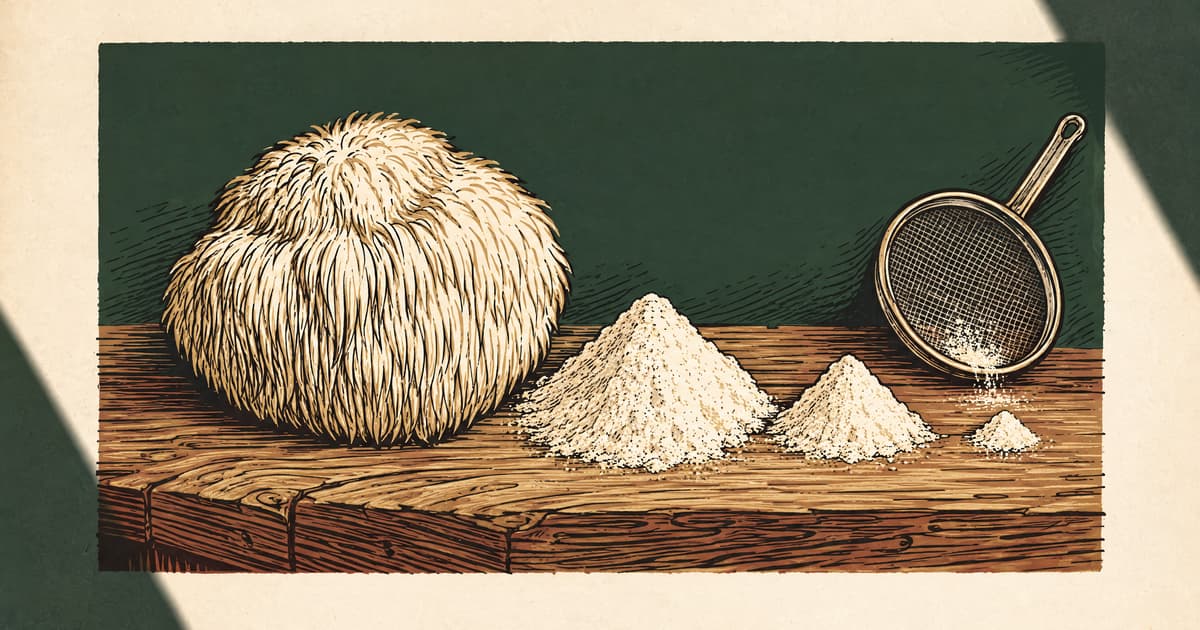
What is in a lion's mane extract? A short summary of Yi's notes
Contents

What is in a lion's mane extract? It depends on the recipe: a powder sold under that name can be largely drying carrier, extract blended with ground mushroom, or a selected soluble fraction. The word "extract" names the raw material, not what was added or removed.

This page is a short summary. The full article, with production numbers, tables and references, is written by Yi, who has worked with mushrooms since 2007: What is really in a Lion's Mane extract.

What does Yi's article show about lion's mane extract?

In Yi's production example, 100 kg of dried lion's mane fruiting body gave about 35 kg of water-extracted solids, still dissolved in liquid. Turning that liquid into a stable powder often needs a carrier: in one recipe, 35 kg of mushroom solids plus 52.5 kg of carrier, so 40% mushroom and 60% carrier.

A high beta-glucan number does not prove a fully soluble extract, because ground mushroom and extraction residue can score high too. A higher erinacine A percentage does not mean more erinacine A was made: removing other material raises the percentage even when some of the compound is lost.

Is the full article available in Polish?

Not in full. This English page and our Polish article summarize the main numbers and conclusions, but leave out Yi's charts, cost calculation and most references. If you buy extract for a business or want to check the test methods, read Yi's full article in English.

FAQ

Is lion's mane extract the same as lion's mane powder?

No. Powder is the dried, ground mushroom. Extract is material from which selected substances were drawn out. Many products blend both, so check the full composition.

Does a high beta-glucan percentage guarantee a pure extract?

No. The result depends on the method and on what is in the sample. Ground mushroom and extraction residue can also give a high number.

Is lion's mane extract from mycelium on grain a real extract?

No. Mycelium on grain is dried and milled together with what is left of the grain, without a separate extraction step. Part of the powder's weight is that leftover grain.

Where can I read more?

The links below lead to Yi's full article, which has all the tables and references, and to two of our related articles. They cover the difference between fruiting body and mycelium on grain, and how to read an extract label before you buy.

These are production observations from Yi's own materials and conditions. They do not establish any health benefit.


This content is for educational purposes only and is not medical advice. A food supplement is not a substitute for a varied diet and a healthy lifestyle. If in doubt, consult a doctor or pharmacist.

Lion's mane in scientific research

What was studied, on how many people and with what level of evidence. This overview describes studies, not the effects of a product.

8

human studies

6

placebo-controlled RCTs (incl. 1 pilot)

1991–2026

years of publication

  • Menon A. et al., 2025

    B

    systematic review

    26 studies, including only 5 RCTs · number of people: not reported

    The review collected studies on the use of Hericium erinaceus as a supplement in the context of cognitive function and reported adverse effects. The authors noted that adverse effects are usually not reported in the literature.

    PMID 40959699
  • Mori K. et al., 2009

    C

    RCT, double-blind, placebo-controlled

    30 people, 50 to 80 years, Japan

    The study examined the effect of taking Hericium erinaceus on a cognitive function scale score in a group of 30 Japanese people aged 50 to 80 with mild cognitive impairment. Very small sample from a single population, the differences faded within 4 weeks after discontinuation.

    PMID 18844328
  • Nagano M. et al., 2010

    C

    RCT, double-blind, placebo-controlled

    30 women

    The study examined the effect of 4 weeks of Hericium erinaceus intake on questionnaire scores for mood, perimenopausal symptoms and sleep quality in a group of 30 women. Very small sample, women only.

    PMID 20834180
  • Saitsu Y. et al., 2019

    C

    RCT, double-blind, placebo-controlled

    not reported

    The study examined the effect of 12 weeks of taking a Hericium erinaceus fruiting-body supplement on cognitive function test results in a group of adult participants. The authors noted that evidence regarding human health remains uncertain.

    PMID 31413233
  • Li I.C. et al., 2020

    D

    pilot RCT, placebo-controlled

    49 randomised, 41 completed

    The study examined the effect of 49 weeks of taking erinacine A-enriched Hericium erinaceus mycelia on cognitive test results and safety parameters in patients with mild Alzheimer's disease. Small, pilot sample size, larger studies needed.

    PMID 32581767
  • Docherty S. et al., 2023

    D

    pilot RCT

    41 healthy adults

    The study examined the effect of a single dose and 28 days of Hericium erinaceus supplementation on cognitive test results, perceived stress and mood in a group of 41 healthy adults. Small sample, null results alongside positive ones, replication needed.

    PMID 38004235
  • Surendran G. et al., 2025

    C

    crossover RCT, placebo-controlled, single dose

    18 healthy adults

    The study examined the effect of a single dose of a standardised Hericium erinaceus fruiting-body extract on cognitive test results and mood measured 90 minutes after administration in a group of 18 healthy young adults. Very small sample requiring replication.

    PMID 40276537
  • Spangenberg E.T. et al., 2025

    E

    systematic review of preclinical studies · preclinical studies (in vitro and rodent)

    not applicable, 23 studies

    The review collected preclinical studies (in vitro and in rodents) on the role of erinacines in neuroprotection models. No standardisation of erinacine measurement, inconsistent reporting of strains and extraction methods.

    PMID 40626304
  • Kawagishi H. et al., 1991

    E

    compound isolation + in vitro test · preclinical studies (in vitro and rodent)

    not applicable

    The study examined, through compound isolation from the fruiting body and an in vitro test, which substances (hericenones C, D, E) stimulate nerve growth factor (NGF) synthesis. Historical chemistry paper (1991).

    DOI 10.1016/0040-4039(91)80039-9
  • Friedman M., 2015

    E

    narrative review · preclinical studies (in vitro and rodent)

    not applicable

    The narrative review collected data on the chemical composition, nutritional value and reported health properties of lion's mane. The author emphasises that many properties come from preclinical studies.

    PMID 26244378
  • Lai P.L. et al., 2013

    E

    in vitro · preclinical studies (in vitro and rodent)

    not applicable

    The study examined the effect of an aqueous extract on nerve fibre outgrowth in an in vitro cell culture, alone and combined with NGF. The preparation did not protect cells from oxidative damage despite its neurotrophic effect.

    PMID 24266378
  • Nakatsugawa M. et al., 2003

    D

    case report, safety

    1 patient, 63-year-old man

    The case report documented acute respiratory failure (pneumonitis) in a 63-year-old man after taking a lion's mane extract 4 months earlier. Single case, safety data, not an efficacy study.

    PMID 14714963
  • Daoust J. et al., 2026

    C

    RCT, double-blind, placebo-controlled (preprint, not peer-reviewed)

    109 people (57+52), 40-75 years, 8 weeks

    The study (preprint, not peer-reviewed) examined the effect of 8 weeks of 2 g daily fruiting-body and mycelium biomass supplementation on visual attention, working memory, sleep quality and mood tests in 109 adults aged 40-75 with reported cognitive difficulties. The authors themselves describe the results as "modest". Preprint status means no scientific peer review.

    DOI 10.64898/2026.04.13.26350781
  • Cornford N., Charnley M., 2025

    E

    narrative review · preclinical studies (in vitro and rodent)

    not applicable (3 human studies + 13 animal studies discussed in the review)

    The narrative review analysed 3 human clinical studies and 13 animal studies on the prevention and delayed progression of Alzheimer's disease. The authors point to the need for additional human clinical studies.

    DOI 10.1017/S0954422425000058

Evidence levels: A · Cochrane review · B · systematic review · C · placebo RCT · D · pilot RCT · E · preclinical studies

What these studies don't say

  • Samples are usually small, most from a single population.
  • Results describe research interventions, not a dietary supplement.
  • The presence of a study is not a health claim.
  • 1 entry/entries are case reports about safety, not efficacy studies.

Source: Aloha Fungi literature review, 1 September 2026; entries verified via PubMed or by DOI (Crossref). See the research

Discover functional mushrooms

© 2026 Aloha Fungi™