MushroomsSubscription −15%
Shiitake
Lentinula edodes
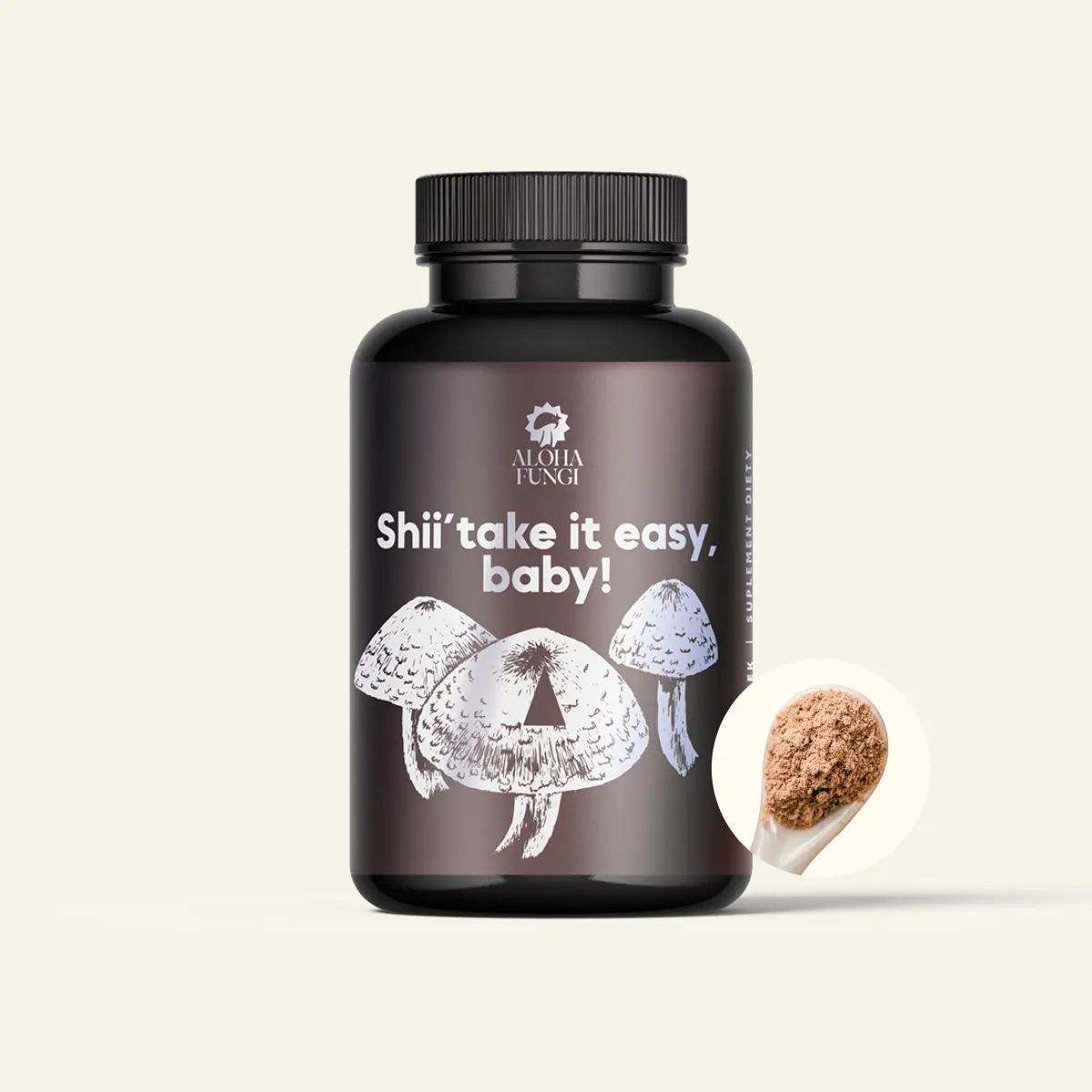
Powders · LONGEVITY119 zł
Below you will find every available product for this species. Each tile opens the product page with the selected format and line preselected.
Version 1.0 · Updated: 21 June 2026 · Subject-matter reviewer: Mateusz Rosa, founder of Aloha Fungi, TCM therapist, Doctor of Acupuncture (WFAS).
Shiitake in 60 seconds
Shiitake is the common name for the mushroom Lentinula edodes (Berk.) Pegler of the Omphalotaceae family, order Agaricales. Its official Polish names are twardnik japoński (from 1998, Władysław Wojewoda), twardziak jadalny and twardziak uprawny. The Japanese „shiitake" (椎茸) means a mushroom growing on the shii tree (Castanopsis), the Chinese „xiānggū" (香菇) is „fragrant mushroom", and „dōnggū" (冬菇) is „winter mushroom". English names include black forest mushroom and oak mushroom.
The species is native to East and Southeast Asia (China, Japan, Korea, Vietnam) and does not grow naturally in Poland. It is the second most cultivated mushroom in the world after the button mushroom, with Chinese production exceeding 7 million tonnes a year (FAO 2022). In controlled cultivation it is grown on oak-beech sawdust under stable conditions, which gives a repeatable compound profile and full control of contaminants. The extracts discussed here educationally come from certified raw material, not from culinary foraging.
In ancient China Shiitake was part of imperial and court cuisine. The first written Japanese mentions date to 199 AD, when a tribe from Kyushu offered Shiitake to the emperor. During the Yuan dynasty (14th century) Wu Rui described Shiitake in the „Daily Use Materia Medica" as a longevity tonic, and Wu Sangong documented the traditional cultivation method of rhythmically striking dead oak logs with an axe to induce fruiting. In the Edo period (1603-1868) in Japan the mushroom was a luxury good, sold at a price comparable to high-grade tea.
In the classical Chinese Materia Medica Shiitake was categorised as shang yao (上藥, „superior herbs"), alongside Reishi and Poria, the group of remedies serving longevity and safe for long-term use. Li Shizhen in „Bencao Gangmu" (本草綱目, 1578) described Shiitake as strengthening Qi, dispersing Wind and supporting longevity. In Japanese kampo medicine, adopted from the Chinese tradition, it was used in formulas for recovery after chronic illness and for weakness in the elderly.
Shiitake has an unusual profile: it combines a rich set of immunoactive polysaccharides with one compound structurally unique to the species, eritadenine. This matters for understanding how it differs from other functional mushrooms:
Lentinan, a β-1,3 glucan with β-1,6 side branches of about 500-1000 kDa and a triple-helix structure. Isolated by Goro Chihara in 1969 and since then studied intensively as an injectable form in clinical settings.
Eritadenine [2(R),3(R)-4-(9-adenyl)-butyric acid], an adenosine analogue structurally unique to Shiitake. It inhibits the enzyme S-adenosylhomocysteine hydrolase (SAHH) and modifies the metabolism of methionine and hepatic phospholipids. A mechanism completely different from statins.
Ergosterol and provitamin D₂, up to 9.61 mg/g of dry mass, one of the highest contents among functional mushrooms. Under UV ergosterol converts to vitamin D₂. In addition LEM (a low-molecular-weight mycelium extract), lentin (a protein with in vitro antibacterial activity), B vitamins (B₂, B₃, B₅, B₆), selenium, copper and zinc, and glutamic acid responsible for umami.
β-1,3/1,6-glucans from the fruiting body activate innate immune receptors and act as a prebiotic. Standardised in our extract to above 30%. A fruiting-body extract and mycelium on grain are two different products: the fruiting body delivers a fuller β-glucan profile, mycelium on grain is largely grain substrate, which dilutes the profile. Aloha Fungi works with the fruiting body.
Twardziak japoński (shiitake) has a brown, umbrella-shaped cap usually 5-20 cm across, with an inward-rolled margin and lighter, flake-like scales on the surface when young. Underneath the cap sit dense, white gills, and the short, slightly lateral or off-centre stem is fibrous and firmer than the cap.
In the wild it grows on dead broadleaf wood in East Asia; in controlled cultivation, the source of our fruiting-body extract, it grows on oak-beech sawdust under repeatable conditions.
The best-described mechanism and historically the first. Lentinan, a β-1,3 glucan with β-1,6 branches, binds as an agonist to the Dectin-1 receptor and secondarily to CR3 (complement receptor 3, integrin CD11b/CD18) on dendritic cells, macrophages and monocytes. It triggers a signalling cascade through Syk and NF-κB, leading to dendritic cell maturation, Th1 lymphocyte activation and stimulation of NK cell activity. The triple-helix structure of lentinan is key to its biological activity.
Isolated lentinan in injectable form has been the subject of clinical research (the Yin 2015 meta-analysis, 12 RCTs, n=950). An important caveat: this concerns lentinan in injectable form, studied in hospital settings, not a supplement. An oral Shiitake extract has a much weaker immune effect, described as immune support in healthy people (Dai 2015 RCT).
A mechanism unique to Shiitake. Eritadenine, an adenosine analogue, binds in the active site of the SAHH enzyme, which catalyses the hydrolysis of S-adenosylhomocysteine to adenosine and homocysteine. Inhibiting SAHH shifts the SAM:SAH ratio and modifies the metabolism of methionine and of phospholipids in hepatic membranes, changing the ratio of phosphatidylcholine to phosphatidylethanolamine and the transport of cholesterol from the liver to the plasma.
The described effect is a reduction of total cholesterol, LDL and triglycerides without a significant effect on HDL in animal models (Sugiyama 1995; Yang 2013). The mechanism is completely different from statins, which inhibit HMG-CoA reductase. In animal studies an eritadenine dose of about 0.005% in the diet (equivalent to roughly 30-50 g of dried Shiitake a day in humans) was enough for a measurable cholesterol reduction. Human data are limited and require larger studies.
The third mechanism is less spectacular than lentinan but practically important. Shiitake delivers ergosterol (the highest content among functional mushrooms), which under UV converts to vitamin D₂. B vitamins (especially B₂, B₃, B₅) support energy metabolism.
β-glucans from the fruiting body act as a prebiotic, fermenting in the large intestine into short-chain fatty acids (butyrate, acetate, propionate) that support the gut epithelium and stabilise the microbiota. This is the axis in which Shiitake works as a classic example of „medicine and food share a common source", combining culinary and supplemental value.
Shiitake does not cure cancer and does not replace oncological therapy. An oral extract does not replace chemotherapy, radiotherapy or immunotherapy. Nor does it cure severe hypercholesterolemia or hereditary familial hypercholesterolemia. Mild support for the lipid profile is not the same as pharmacological therapy, and Shiitake does not replace statins or other lipid-lowering medicines in people with a diagnosed dyslipidemia requiring treatment. It also does not cure viral infections.
In the morning or before noon, ideally with a light meal containing fat. Lentinan and β-glucans absorb well regardless of food, but eritadenine and ergosterol are lipophilic, so the presence of fat increases bioavailability. In Japanese cuisine Shiitake was classically eaten in miso soup at breakfast or in broth.
Daily support for immunity and the lipid profile: 500-1000 mg of extract a day (or 5-10 g of dried Shiitake in cooking, in line with the Dai 2015 RCT). An intensive protocol: 1500-2000 mg a day. Above 3000 mg without consultation is not recommended. Do not exceed the recommended daily serving.
Good carriers are warm miso soup or broth with added powder (the classic Japanese use), dishes with stewed Shiitake and a little sesame oil, warm water with ginger for winter prevention, or a smoothie with oat milk and nuts on a plant-based diet. Fat in the meal supports the absorption of eritadenine and ergosterol.
Shiitake belongs to the shang yao category of classical TCM, so it is a mushroom for daily, long-term use, closer to Reishi and Poria than to course-based mushrooms like Polyporus. The immune effect is visible after 4 weeks (Dai 2015), and the lipid-profile effect requires 8-12 weeks of regular use.
1-2 weeks: changes in digestion and stool quality (prebiotic effect), sometimes a mild feeling of energy after the morning serving.
4 weeks: the first measurable immune changes (improved γδ T-cell function, lower CRP) in line with the Dai 2015 RCT; subjectively better tolerance of seasonal infections.
8-12 weeks: the first measurable changes in the lipid profile (total cholesterol, LDL, triglycerides), if previously elevated.
3-12 months: long-term support for immunity and the lipid profile, the prevention phase for people with a family history. It is worth noting subjective indicators: digestion, tolerance of infections, and for metabolic goals checking the lipid profile in the lab.
A traditional combination across the entire Far Eastern tradition, described together in Li Shizhen’s „Bencao Gangmu" (1578) as two treasures of longevity. Shiitake through lentinan supports innate immunity and the lipid profile, Reishi through β-glucans and triterpenes regulates the HPA axis and calms Shen. Shiitake 1-1.5 g in the morning, Reishi 1-2 g in the evening. Duration: from 12 weeks to long-term.
Both mushrooms are strong modulators of the microbiota and innate immunity. Coriolus through PSP supports the microbiota, Shiitake through lentinan activates Dectin-1 and CR3, working complementarily on the gut-immune axis. For people after antibiotic therapy and with recurrent upper-respiratory infections. Shiitake 1 g in the morning, Coriolus 2 g before noon. Duration: 8-12 weeks.
Shiitake through eritadenine supports the lipid profile, Maitake through the SX-fraction supports insulin sensitivity. For people with a metabolic component (raised LDL, insulin resistance) and a family history of cardiovascular disease. Shiitake 1 g in the morning, Maitake 1-1.5 g in the morning or before lunch. Duration: from 12 weeks to long-term.
Chaga is the strongest antioxidant among functional mushrooms, Shiitake regulates the lipid profile and supports immunity. For people with raised cardiovascular risk and oxidative stress. Shiitake 1 g in the morning, Chaga 1-2 g before noon. Duration: 12 weeks.
Shiitake supports immunity and regeneration, Lion’s Mane through hericenones and erinacines supports cognitive function. For people recovering after a long illness, especially viral, and after antibiotic therapy. Shiitake 1 g in the morning, Lion’s Mane 1-1.5 g in the morning or at noon. Duration: 12-16 weeks.
Shiitake in the classical Chinese Materia Medica occupies a place between food and medicine, in the spirit of yi shi tong yuan (醫食同源, „medicine and food share a common source"). It is classified as shang yao (上藥, „superior herb"), a category reserved for herbs and mushrooms with no adverse effects, suitable for long-term use.
This is a frame of cultural observation, not a medical diagnosis. Concepts such as Qi, Wei Qi or meridian do not correspond one to one with Western anatomy or physiology.
| Taste | sweet (甘 gān), with an umami note |
| Nature | neutral to slightly warming (平 píng to 微温 wēi wēn) |
| Meridians | Liver, Stomach, Lung |
| Category | tonic of Qi and Blood in the shang yao class (補氣養血) |
Known allergy to mushrooms of the Omphalotaceae family or documented shiitake dermatitis (a skin reaction after eating Shiitake).
Status after organ transplant with active immunosuppression (cyclosporine, tacrolimus, mycophenolate, everolimus, sirolimus), because lentinan activates innate immunity.
Active autoimmune diseases in a flare (systemic lupus, severe rheumatoid arthritis, active ulcerative colitis).
Children under 18 (no adequate RCTs for standardised extracts in this group).
Anticoagulant and antiplatelet medicines (warfarin, NOACs, clopidogrel, ASA): β-glucans may mildly affect platelet aggregation, with INR monitoring on warfarin.
Statins and other lipid-lowering medicines: Shiitake acts by a different mechanism (SAHH rather than HMG-CoA reductase), and a cardiologist decides on any change of treatment.
Chemotherapy and radiotherapy in progress: an oral extract requires individual consultation with the treating oncologist.
Immunosuppressive medicines (methotrexate, biologics anti-TNF, JAK inhibitors) and autoimmune diseases in remission.
Hyperhomocysteinemia (eritadenine affects homocysteine metabolism, with monitoring in the first weeks), pregnancy and breastfeeding (no adequate RCTs for the extract), and planned surgery (stop at least 14 days before the procedure).
Shiitake dermatitis after eating raw or undercooked Shiitake (2-3% of the population): a striped, itchy rash on the torso that resolves on its own in 1-2 weeks. Prevention: always cook it. Also reported are mild bloating or loose stools in the first week (prebiotic effect) and single allergic reactions in people hypersensitive to mushrooms.
Culinary use 5-15 g of dried Shiitake a day with no known upper limit. A standardised 10:1 extract: 500-2000 mg a day for typical indications, up to 3000 mg under a therapist’s supervision in intensive protocols.
Evidence verdict
We also show what is not proven. This is a dietary supplement, not a medicine.
4
Strong evidence
confirmed composition
4
Preliminary
in vitro and animal studies
3
Not proven
no human studies
Reviewed by
Mateusz Rosa · Doctor of Acupuncture (WFAS)
Version 1.0 · Updated: 21 June 2026 · Subject-matter reviewer: Mateusz Rosa, founder of Aloha Fungi, TCM therapist, Doctor of Acupuncture (WFAS).
Based on 12 verified sources
See sources ↓| Claim | Type of evidence | Strength |
|---|---|---|
| Lentinan activates Dectin-1 and CR3 on macrophages | in vitro and animal models (Chihara 1969 → Xu 2016) | STRONG |
| Lentinan triggers the Syk and NF-κB signalling cascade and dendritic cell maturation | in vitro and animal models (mechanistic studies of β-glucans) | STRONG |
| Improved γδ T-cell function and lower CRP in healthy adults | RCT Dai 2015 (n=52, 4 wks, 5-10 g dried per day) | STRONG |
| Eritadenine inhibits SAHH and lowers cholesterol in animal models | in vitro and animal models (Sugiyama 1995 → Yang 2013) | STRONG |
| An oral Shiitake extract lowers cholesterol in humans | animal models solid, limited human RCTs, larger studies needed | PRELIMINARY |
| Hepatoprotection by LEM in chronic hepatitis B | in Japan LEM is an adjuvant, limited data outside Japan | PRELIMINARY |
| Ergosterol as provitamin D₂ after UV irradiation | chemical mechanism certain, dietary relevance in humans limited | PRELIMINARY |
| Antibacterial and antiviral action | in vitro against MRSA, B. subtilis, E. coli, limited human evidence | PRELIMINARY |
| „Cures" cancer as a monotherapy | none, claim prohibited by regulation | NONE |
| „Replaces" statins in hypercholesterolemia | none, claim prohibited by regulation | NONE |
| „Cures" viral infections (HIV, HBV, HPV) | none, claim prohibited by regulation | NONE |
STRONG = solid evidence · PRELIMINARY = moderate or preliminary · NONE = unsupported or prohibited by regulation.
Shiitake, the oak mushroom of East Asian kitchens. An educational look at umami, wood cultivation, TCM tradition and its place in a kitchen and brew ritual.
Why half of our serving is the whole, ground mushroom, not just the extract
Coriolus, or turkey tail (Trametes versicolor). On TCM tradition, appearance, supplement forms, label-based dosage and choosing a standardized extract.
Ergothioneine is a rare amino acid your body cannot make on its own. Where it comes from, what OCTN1 is, and which mushrooms hold the most of it.
Auricularia, or wood ear mushroom, is one of the four most cultivated mushrooms in the world. Educational look at cuisine, TCM tradition and polysaccharides.
β-glucans are polysaccharides found in mushrooms and grains. We explain the Dectin-1 mechanism and how mushroom β-glucans differ from oat ones.
The educational content on this page does not replace medical advice. A dietary supplement is not a medicine and should not replace a varied diet or medical consultation. Shiitake is at once a food with a long culinary history and a dietary supplement. Before starting supplementation, especially with hypercholesterolemia, autoimmune diseases, immunosuppression, pregnancy, breastfeeding, documented shiitake dermatitis or when taking medication (especially lipid-lowering, anticoagulant, immunosuppressive or chemotherapeutic), consult a doctor. Aloha Fungi does not claim therapeutic efficacy for any product; the mechanisms described are based on the current state of the literature. All products are dietary supplements notified to the Polish Chief Sanitary Inspectorate (GIS).
© 2026 Aloha Fungi™

