Skip to content
Super promo!Reishi−50%59.50 zł119 zł (regular price)
Only 18 left at 59.50 zł, then 71.40 złSee Reishi →
Free delivery in Poland from 299 PLN

Coriolus: capsules, powder, or drops? Which form for which ritual

Coriolus capsules, coriolus powder, or drops. The same raw material in three forms: we compare convenience, taste, and dosage, so you can pick what fits your ritual.

Mateusz Rosa

TCM therapist · Doctor of Acupuncture (WFAS) · author of a book on functional mushrooms

5 min read
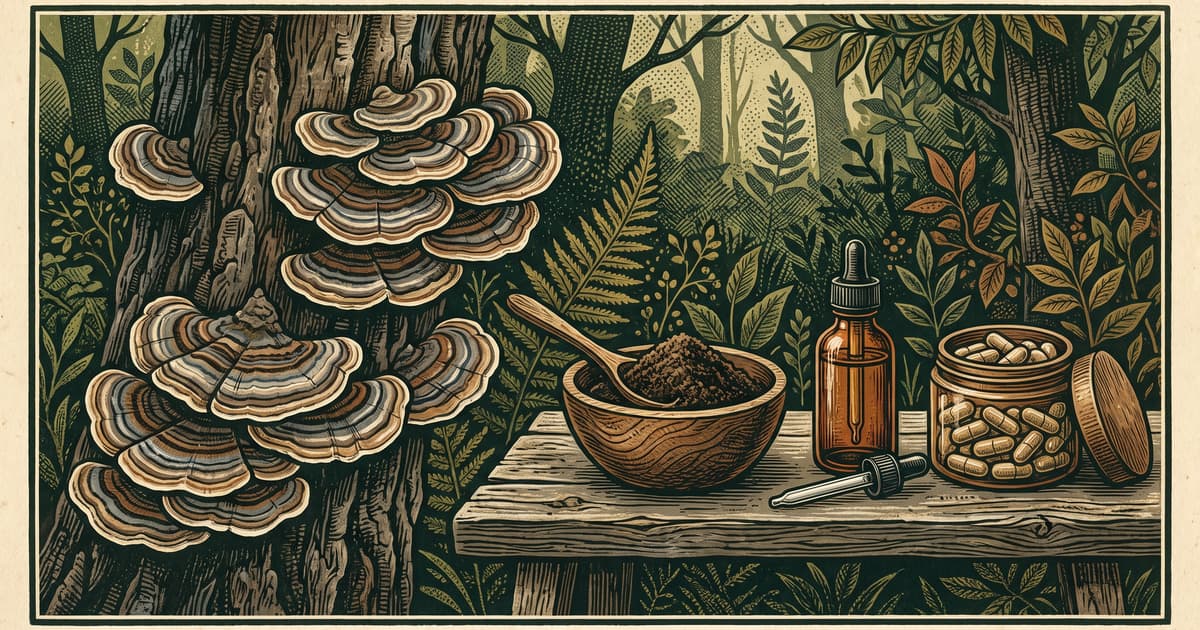
Coriolus: capsules, powder, or drops? Which form for which ritual
Contents

You're choosing between coriolus capsules, coriolus powder, and drops, and you don't know how these forms are actually different, since it's the same mushroom. The answer is simpler than it seems: it's the same raw material, different ease of use. This post shows when each format of coriolus fits your day best.

How do the three coriolus forms differ?

Coriolus capsules and powder contain the same standardized fruiting-body extract, the difference is how you take it. Drops are a separate product: a liquid extract after triple extraction, available exclusively in the PRIME line. A capsule seals the serving in a shell to swallow, powder needs mixing with a liquid, and drops go straight into a drink or are taken directly.

This choice doesn't change what's inside, it changes how easily you fit the supplement into your day. A capsule has no taste and needs no preparation, powder gives you control over what you add it to, and drops are the fastest to dose, since they don't need measuring with a scoop. In our LONGEVITY line, capsules and powder are made from 10:1 extract blended in equal parts with powdered fruiting body; in PRIME the ratio is 80% extract to 20% fruiting body, while PRIME drops are pure liquid extract, without the 80/20 blend.

When capsules?

Coriolus capsules work best when precise dosing and zero taste matter to you, for example while traveling, at work, or when the earthy, slightly bitter flavor of the fruiting body simply doesn't suit you.

There's nothing to measure or mix, just swallow with water, which makes this form convenient when you want the ritual as simple as possible. The recommended serving is 3 capsules daily, 0.5 g of extract each (1.5 g total), on an empty stomach or 30 minutes before a meal. The capsule shell is vegan (HPMC, plant-derived), without fillers or magnesium stearate. Capsules are a good choice if you travel often or want a stash that won't spill in a bag.

When powder?

Coriolus powder makes sense when you want to work the mushroom into a specific drink or dish, for example your morning coffee, cocoa, tea, or a smoothie, and the slightly bitter, earthy taste of the fruiting body doesn't bother you.

One practical rule: don't pour boiling water over the powder, use warm, not boiling water, tea, coffee, or cocoa instead, or add it to a smoothie. The recommended serving is 1-2 teaspoons daily, the scoop is included in the package. Powder also gives you flexibility, since you can adjust the amount day to day within the recommended serving.

When drops?

Coriolus drops are the fastest way to fit the mushroom into a ritual, since you just count out the serving and add it to a drink, no scoop and no water needed. This form is available exclusively in the PRIME line, as a liquid extract after triple extraction, without the 80/20 blend used for that line's capsules and powder.

The recommended serving is 20 drops, 3-4 times a week, less often than the daily serving of capsules or powder. This form is for people who value simplicity and speed, but not necessarily a daily rhythm. Always check the exact serving and concentration on the label of your specific package, not general tips from the internet.

Comparison table of the three forms

FormConvenienceTasteRhythmAvailable in
CapsulesHighest, swallow with waterNoneDaily, 3 capsulesLONGEVITY and PRIME
PowderNeeds mixingEarthy, bitterishDaily, 1-2 teaspoonsLONGEVITY and PRIME
DropsVery high, no water neededMild in a drink20 drops, 3-4 times a weekPRIME only

How to choose in 3 questions

Instead of reading other people's opinions, answer three questions about your own day, since that's what decides which form actually sticks long-term.

  • Do you want zero taste and zero prep? Choose capsules.
  • Do you already have a morning drink habit that's easy to add something to? Choose powder.
  • Do you want the fastest possible ritual, a few times a week, with no scoop needed? Choose drops.

Frequently asked questions about coriolus forms

Does powder work differently than capsules from the same extract? No, it's the same standardized coriolus extract in a different physical form within the same line. The difference is in how you take it, not in the extract's composition.

Why shouldn't coriolus powder be poured over with boiling water? High water temperature can affect the structure of some compounds in the extract, so it's safer to add the powder to a cooler liquid or to food, not straight into boiling water.

Why do drops get used less often than capsules or powder? Because that's the dosing rhythm specific to this form: 20 drops 3-4 times a week, instead of a daily serving. Stick to the rhythm stated on your package's label.

Which form is best to start with if you've never taken coriolus before? Capsules are usually the simplest entry point, since they remove questions about taste, mixing, and measuring, they just give you a serving to swallow.

For exactly how much coriolus to take daily and when, see our detailed post coriolus dosage. If you want to know what the numbers on an extract label actually mean, check out coriolus extract 10:1, and for the species itself and its tradition, read coriolus, turkey tail. Read about Coriolus (Trametes versicolor) properties and tradition in our species guide.


This content is for educational purposes only and does not constitute medical advice. A food supplement does not replace a varied diet or a healthy lifestyle. If in doubt, consult your doctor or pharmacist.

Turkey tail (Coriolus) in scientific research

What was studied, on how many people and with what level of evidence. This overview describes studies, not the effects of a product.

10

human studies

2

placebo-controlled RCTs

2003–2026

years of publication

  • Pilkington K. et al., 2022

    A

    Cochrane review with meta-analysis (PSK, drug)

    7 RCTs, 1569 people

    The Cochrane systematic review with meta-analysis collected 7 RCTs (1569 people) on the effect of PSK (a pharmaceutical drug, not a supplement) on adverse effects of chemotherapy/radiotherapy in colorectal cancer.

    PMID 36445793
  • Oba K. et al., 2006

    A

    meta-analysis of RCTs (PSK, drug)

    8 RCTs, 8009 patients

    The meta-analysis of RCTs collected 8 studies (8009 patients) on PSK (a drug) as adjunct therapy in gastric cancer.

    PMID 17106715
  • Ma Y. et al., 2017

    B

    network meta-analysis (PSK, drug)

    23 studies, 10,684 patients

    The network meta-analysis collected 23 studies (10,684 patients) on PSK (a drug) in gastrointestinal cancers.

    PMID 29179503
  • Zhong L. et al., 2019

    B

    meta-analysis of RCTs

    23 studies, 4246 people

    The meta-analysis of RCTs collected 23 studies (4246 people) on Coriolus versicolor and Ganoderma lucidum preparations used as adjunct therapy in oncology patients.

    PMID 31333449
  • Tsang K.W. et al., 2003

    C

    pilot RCT, placebo-controlled (PSP, drug)

    68 people

    The pilot placebo-controlled RCT examined PSP (a drug) in non-small cell lung cancer (NSCLC) in 68 people.

    PMID 12814145
  • Torkelson C.J. et al., 2012

    D

    phase I, dose escalation (whole extract, not a drug)

    11 recruited, 9 completed

    The phase I dose-escalation study examined the safety and tolerability of a whole Trametes versicolor extract (not the purified PSK/PSP drug) in women after radiotherapy for breast cancer. 11 recruited, 9 completed.

    PMID 22701186
  • Pallav K. et al., 2014

    C

    RCT (PSP, drug)

    24 recruited, 22 completed

    The RCT examined the effect of PSP (a drug) combined with amoxicillin on the gut microbiome of healthy people. 24 recruited, 22 completed.

    PMID 25006989
  • Koda K. et al., 2003

    C

    RCT (PSK, drug)

    558 people

    The RCT examined PSK (a drug) added to postoperative chemotherapy in 558 people.

    PMID 12792790
  • Yu Z.T. et al., 2013

    E

    in vitro (human faecal fermentation, PSP) · preclinical studies (in vitro and rodent)

    number of donors not specified

    The in vitro study examined the fermentation of PSP by human faecal microbiota cultured outside the body (bacterial composition, pH) compared with fructooligosaccharides.

    PMID 23435630
  • Saleh M.H. et al., 2017

    E

    narrative review (PSP) · preclinical studies (in vitro and rodent)

    not applicable

    The narrative review discussed the immunomodulatory mechanisms of PSP (cytokines, tumour microenvironment) in the context of adjuvant therapy in Asia.

    PMID 28932226
  • Wenner C.A. et al., 2012

    E

    animal (mice, PSK) · preclinical studies (in vitro and rodent)

    not specified

    The mouse study examined PSK (a drug) combined with docetaxel (tumour size, lymphocyte infiltration, NK cell activity).

    PMID 22159900
  • Standish L.J. et al., 2008

    E

    narrative review (PSK) · preclinical studies (in vitro and rodent)

    not applicable

    The review synthesised Asian RCTs on PSK (a drug: gastric, colorectal, oesophageal, breast cancer) and immunological mechanisms. No data on the effect of the whole extract as distinct from PSK.

    PMID 19087769
  • Wong E.L.Y. et al., 2012

    B

    systematic review with meta-analysis (PSK, drug)

    13 clinical studies

    The meta-analysis examined the effect of PSK (a drug) preparations added to standard treatment on survival of cancer patients, based on 13 clinical studies.

    PMID 22185453
  • Habtemariam S., 2020

    E

    narrative review (PSP and PSK) · preclinical studies (in vitro and rodent)

    not applicable

    The review synthesised in vitro, in vivo and clinical evidence for commercial PSP and PSK preparations as adjunct therapy.

    PMID 32466253
  • Cui J., Chisti Y., 2003

    E

    narrative review, bioprocess-focused (PSP) · preclinical studies (in vitro and rodent)

    not applicable

    The narrative review focused on the biotechnological production of PSP, with a brief discussion of biological activity.

    PMID 14499133
  • Knežević A. et al., 2018

    E

    in vitro, 3 Trametes species · preclinical studies (in vitro and rodent)

    not applicable

    The in vitro study examined antioxidant, antifungal, cytotoxic activity and acetylcholinesterase/tyrosinase inhibition for extracts of three Trametes species from Serbia.

    PMID 30169542
  • Muszyńska B. et al., 2018

    E

    general review (not specifically about Coriolus) · preclinical studies (in vitro and rodent)

    not applicable

    General review of the anti-inflammatory properties of edible mushrooms; does not specifically concern Coriolus, a source shared across multiple species hubs.

    PMID 29146352
  • Saxe G. et al., 2026

    C

    RCT, double-blind, placebo-controlled (combined FoTv preparation, not Coriolus alone)

    90 (52 FoTv, 38 placebo)

    The RCT examined the safety and feasibility of administering the FoTv mycelium preparation (Fomitopsis officinalis + Trametes versicolor) as an adjunct to COVID-19 vaccination, with observation up to 6 months. A combined preparation of two species; results cannot be attributed to Trametes versicolor alone.

    PMID 41620671
  • Ziaja-Sołtys M., Jaszek M., 2025

    E

    review (no full PRISMA protocol), mostly preclinical · preclinical studies (in vitro and rodent)

    11 studies, including 1 phase I study (= 5.6)

    The review collected 11 studies (2010-2025) on Coriolus versicolor in breast cancer, mostly cell lines and mice, plus one phase I study. Larger placebo-controlled studies are needed.

    DOI 10.3390/cimb47100808

Evidence levels: A · Cochrane review · B · systematic review · C · placebo RCT · D · pilot RCT · E · preclinical studies

What these studies don't say

  • Samples are usually small, most from a single population.
  • Results describe research interventions, not a dietary supplement.
  • The presence of a study is not a health claim.

Source: Aloha Fungi literature review, 1 September 2026; entries verified via PubMed or by DOI (Crossref). See the research

Discover functional mushrooms

© 2026 Aloha Fungi™