Journal
Wood ear mushrooms (Auricularia). More than an Asian kitchen staple
Auricularia, or wood ear mushroom, is one of the four most cultivated mushrooms in the world. Educational look at cuisine, TCM tradition and polysaccharides.
TCM therapist · Doctor of Acupuncture (WFAS) · author of a book on functional mushrooms
3 min read
Contents
Wood ear mushroom, also known as jelly ear or Judas's ear, is one of the four most widely cultivated mushrooms in the world. Best known from Asian cuisine, its history reaches far deeper than a bowl of soup.
What is Auricularia and where does its name come from?
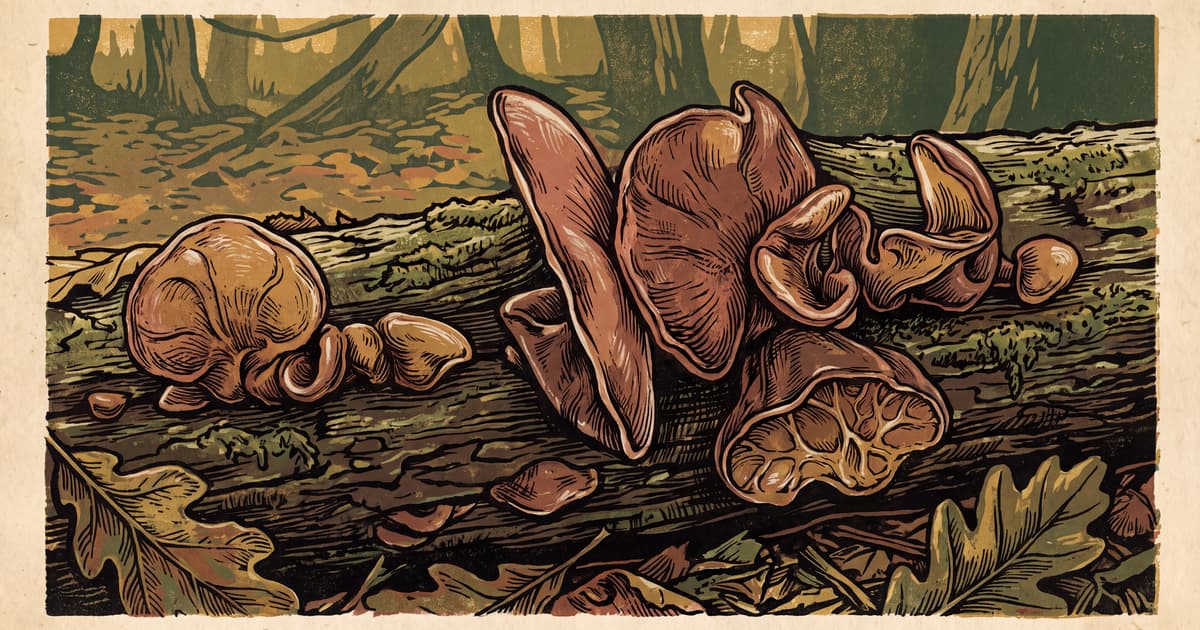
Auricularia (Auricularia auricula-judae) owes its look to a distinctive, jelly-like ear shape, hence its common name. It grows on dead wood, mostly elder, and has accompanied Chinese cuisine for centuries thanks to its distinctive, crunchy texture.
The mushroom appeared on Chinese tables long before it became popular in Europe, and today its cultivation is among the most widespread in the world, alongside button mushroom, oyster mushroom and shiitake.
What does TCM tradition say about Auricularia?
In traditional Chinese medicine, wood ear mushrooms were described as an element supporting "movement" within the body, in the old framing associated with circulation. This is a cultural description recorded in classical herbal texts, not a modern claim about effect on the circulatory system. Read it as a story about the place of Auricularia in traditional diets, not as a promise of effect.
As with Reishi, it is worth separating the symbolism of old texts from modern knowledge of composition. One tells a story, the other describes chemical facts.
What composition of wood ear mushroom is worth knowing?
Auricularia is a rich source of polysaccharides, including beta-glucans with β-(1→3) and β-(1→4) bonds, the main studied component of this species. The fruiting body also contains protein (over 19 g per 100 g dry weight), melanin responsible for its dark color, phenolic compounds and B vitamins.
This is compositional data about the fruiting body, confirmed by laboratory analysis. For how to read extract ratios like "10:1" on a label, see how to read an extract label.
How does wood ear mushroom find its place at the table and in a ritual?
Beyond the kitchen, where Auricularia is added to soups and stir-fries for its signature crunch, this mushroom also appears as a fruiting body extract supplement.
- Culinary · dried or fresh, added to soups and braised dishes in Chinese cuisine.
- Traditional · in TCM described as supporting "movement" in the old framing.
- Compositional · a source of polysaccharides, protein and phenolic compounds in the fruiting body.
If you take medication (especially blood thinners), are pregnant or breastfeeding, consult a doctor or pharmacist before use.
This content is for educational purposes only and does not constitute medical advice. A food supplement does not replace a varied diet or a healthy lifestyle. If in doubt, consult your doctor or pharmacist.