Journal
What is the difference between fruiting body powder and mushroom extract? How mushroom fruiting body powders affect the body
Why half of our serving is the whole, ground mushroom, not just the extract
TCM therapist · Doctor of Acupuncture (WFAS) · author of a book on functional mushrooms
6 min read
Contents
- Two ingredients, two different jobs
- What happens to the powder in the gut
- Whole fruiting body powder studied as a prebiotic
- Ergothioneine: what extract loses the most of
- Chitin: a gentle broom
- This is how mushrooms have been eaten in China for centuries
- What we still don't know
- What this means for you
- Bibliography
At Aloha Fungi you'll find two product lines - PRIME and LONGEVITY. LONGEVITY is "50% 10:1 extract and 50% powdered fruiting body", and PRIME is 20% fruiting body powder together with 80% multi-fraction extract. What does that actually mean?
In short:
Extract pulls substances out of the mushroom that aren't active on their own. Water extraction pulls out substances soluble in water, alcohol extraction pulls out those soluble in alcohol.
Fruiting body powder (simply the dried and ground mushroom): contains chitin, fiber, fats, minerals, ergothioneine. It also has a prebiotic effect - mushroom fiber (chitin + beta-glucans) doesn't digest in the stomach, lands in the large intestine and feeds your bacteria there.
Combining the two gives our supplements their effective action.
Two ingredients, two different jobs
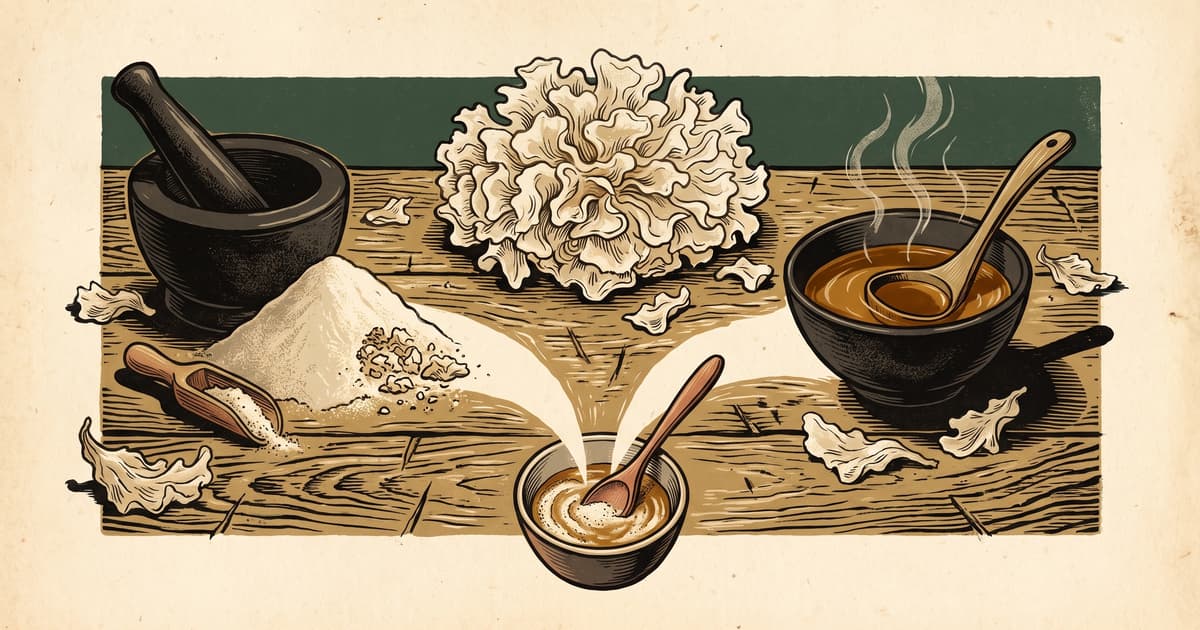
Our extract comes from a dual water-alcohol extraction: the fruiting bodies are boiled in water, then extracted with alcohol, and whatever dissolves gets concentrated. From 10 kg of mushrooms you're left with 1 kg of extract. That's concentrated β-glucans, mainly the water-soluble ones. Water doesn't pull out everything, though: the insoluble β-glucan fraction, chitin, part of the fatty compounds and minerals stay behind in the squeezed-out raw material (LWT 2022).
Powdered fruiting body is the same mushroom, just dried and ground. We don't extract anything out of it, we don't throw anything away. The powder keeps the full mushroom fiber: chitin, β-glucans and hemicelluloses (Journal of Fungi 2023). This fiber doesn't disappear in digestion: a study on button mushroom powder showed that after simulated passage through the stomach and small intestine, the β-glucan content in the powder didn't drop, and even concentrated slightly (Frontiers in Nutrition 2024).
Extract is the power of condensed active substances, powder gives the full profile.
What happens to the powder in the gut
Mushroom fiber is different from plant fiber. In a mushroom's cell wall, chitin and β-glucans are covalently bound together, while in plants they're mostly held by physical entanglement. That's why β-glucans from mushrooms release gradually, with the largest part only after full digestion, right where gut bacteria live (Journal of Functional Foods 2021).
And that's exactly where the magic starts. Bacteria ferment the fiber into short-chain fatty acids (SCFAs), mainly butyrate. Butyrate is the main fuel for the cells lining the large intestine; more than 70% of the oxygen those cells use goes toward burning it (Frontiers in Immunology 2019). Newer work adds that butyrate isn't the only fuel, but it remains a key one (Trends in Microbiology 2024).
Whole fruiting body powder studied as a prebiotic
The most interesting study for us came out in 2025. In a simulator of the human gut (the SHIME model), powders from whole mushroom fruiting bodies were compared to inulin, the best-studied prebiotic on the market. The mushroom powders gave a comparable effect: an increase in SCFA production and enrichment of beneficial bacterial species, alongside a drop in some pathogenic ones (Journal of Functional Foods 2025).
For Tremella there's a separate study: its polysaccharides, fermented with human fecal flora, increased SCFA production and the abundance of Faecalibacterium, a bacterium considered a marker of a healthy gut (Food Research International 2022).
Test tube, not human. Keep that in mind with every paragraph like this: a demonstrated mechanism doesn't guarantee it will work for you, though at Aloha Fungi we believe mushrooms work wonders...
Ergothioneine: what extract loses the most of
There's one more compound that almost nobody talks about, and that's a shame: ergothioneine. It's an amino acid the human body can't produce, and mushrooms are its richest dietary source, accounting for about 95% of total intake (Food Chemistry 2017). Researchers from Singapore called it "an underappreciated micronutrient for healthy aging" and propose treating it like a vitamin (British Journal of Nutrition 2023). A 10:1 water extract retains very little of it, fruiting body powder keeps it all.
Chitin: a gentle broom
Chitin is the same material shrimp shells are made of. It doesn't digest or get absorbed in the gut. Studies on chitosan, its derivative, showed increased excretion of fat and bile acids in animals (Food Chemistry 2012), and button mushroom fiber bound cholesterol and bile salts in a test tube (Food Chemistry: X 2025).
This is how mushrooms have been eaten in China for centuries
Tremella appears in the Shennong Bencao Jing, the oldest Chinese herbal (2nd-3rd century CE), and in Li Shizhen's Bencao Gangmu from 1578 (Amazonian Journal of Plant Research 2020). Through all those centuries, nobody made a 10:1 extract out of it. It was cooked and eaten whole: as a soup, a dessert, a tonic. The same for shiitake, maitake, wood ear. The mushroom was food.
That's where our 50/50 comes from. We wanted to draw out the mushroom's power of active compounds through the concentration that extraction gives, without throwing away what was eaten whole for centuries. FULL SPECTRUM!
What we still don't know
Nobody has studied in humans exactly this setup: 750 mg of powder plus 750 mg of extract in one serving. All the studies above concern individual components, not our product. We have data from test tubes, gut models and animals, and for ergothioneine and mushroom intake also large observational studies: 30,000 Americans eating mushrooms regularly had lower all-cause mortality (Nutrition Journal 2021).
What this means for you
If you take our powder, each 1.5 g serving gives you two things: 750 mg of extract with β-glucans measured on every batch using the Megazyme method, and 750 mg of the whole, ground fruiting body, with the fiber, chitin and ergothioneine that water doesn't pull out. The first works fast. The second travels further, to the large intestine, and feeds what lives there.
The ritual runs for 90 days. That's how long Chinese medicine gives to assess a protocol, and how long bacteria need to change their composition.
Got a question about the powder or a specific mushroom? Write to me, I answer personally.
Mateusz Rosa Doctor of Acupuncture (WFAS), founder of Aloha Fungi
See also: how to read a mushroom extract label · research on functional mushrooms.
A dietary supplement is not a substitute for a varied diet. The studies cited in this text concern mushroom components, not Aloha Fungi products.
Bibliography
- LWT 2022 · 10.1016/j.lwt.2022.113895
- Journal of Fungi 2023 · 10.3390/jof9101028
- Frontiers in Nutrition 2024 · 10.3389/fnut.2024.1346706
- Journal of Functional Foods 2021 · 10.1016/j.jff.2021.104543
- Frontiers in Immunology 2019 · 10.3389/fimmu.2019.00277
- Trends in Microbiology 2024 · 10.1016/j.tim.2023.07.014
- Journal of Functional Foods 2025 · 10.1016/j.jff.2025.107030
- Food Research International 2022 · 10.1016/j.foodres.2022.111185
- Food Chemistry 2017 · 10.1016/j.foodchem.2017.04.109
- British Journal of Nutrition 2023 · 10.1017/S0007114522003592
- Food Chemistry 2012 · 10.1016/j.foodchem.2012.02.211
- Food Chemistry: X 2025 · 10.1016/j.fochx.2025.102657
- Amazonian Journal of Plant Research 2020 · 10.26545/ajpr.2020.b00077x
- Nutrition Journal 2021 · 10.1186/s12937-021-00738-w