MushroomsSubscription −15%
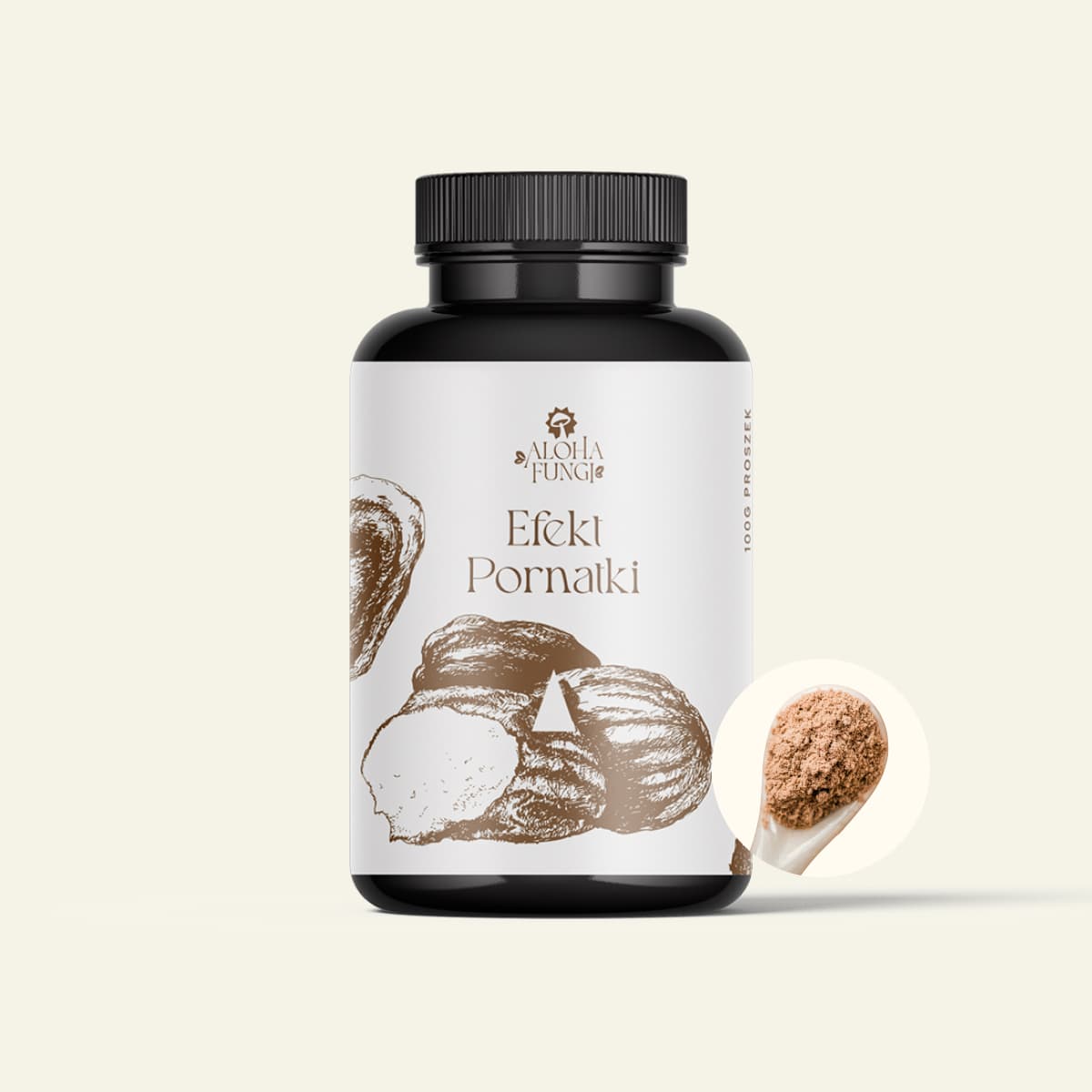
Pornatka
Wolfiporia cocos
Powders · LONGEVITY279 zł
Below you will find every available product for this species. Each tile opens the product page with the selected format and line preselected.
Version 1.0 · Updated: 21 June 2026 · Subject-matter reviewer: Mateusz Rosa, founder of Aloha Fungi, international TCM therapist (8 years of practice), Doctor of Acupuncture Level A (WFAS 2018).
Poria in 60 seconds
Pornatka kokosowa is the official Polish name for the mushroom Wolfiporia cocos (formerly Poria cocos, Wolfiporia extensa, Pachyma cocos), in Chinese Fu Ling (茯苓), in Japanese bukuryō, in English Hoelen, Tuckahoe or China Root. The medicinal part is not the classic fruiting body but the sclerotium, an underground, hard structure storing the resources of the mycelium, growing in symbiosis with the roots of pines (Pinus massoniana, Pinus tabuliformis).
A single sclerotium reaches up to 1 kg in mass and up to 30 cm in diameter. The species is Asian and does not occur naturally in Poland. The highest-quality raw material comes from the Chinese province of Yunnan (Chinese Yun Ling), with Anhui as a second location. Annual harvests in China amount to 10-13 thousand tonnes, and because wild populations are depleted, controlled cultivation dominates. Poria is also cultivated in Korea and Japan.
The first written mention of poria appears in the Shen Nong Ben Cao Jing (2nd century BCE to 2nd century CE), where it is classified as shang yao (上藥), a superior, life-sustaining herb, safe for long-term use without side effects. It is one of the most frequently used ingredients of the classical Materia Medica.
Poria is part of classical TCM formulas such as Si Jun Zi Tang, Liu Wei Di Huang Wan, Wu Ling San, Suan Zao Ren Tang and Gui Pi Tang. In Japanese kampo medicine it appears in formulas such as Bukuryō-in, in Korean sasang medicine in tonic constitutions. Traditionally it was also used as functional food, among others in the Beijing cakes fu ling jia bing. Modern RCTs confirming the effects known from tradition have appeared only in the last few years (from around 2020), against more than two thousand years of classical practice.
Poria is a mushroom in which two classes of compounds work together: lanostane triterpenes and polysaccharides. This matters for understanding why a good extract requires a dual water-alcohol extraction.
Lanostane triterpenes, including pachymic acid (a specific marker for W. cocos), dehydrotumulosic acid, dehydrotrametenolic acid, tumulosic acid, poricoinic acids A and B, and eburicoic acid. Over 40 lanostane derivatives have been described in total, responsible for the sedative-hypnotic, anti-inflammatory and metabolic activity.
Polysaccharides: pachyman (the main β-1,3-D-glucan), pachymaran (its soluble derivative), and broadly branched β-1,3/1,6-glucans. Standardised in our extract to above 30%. In addition ergosterol (provitamin D₂), polyphenols and trace elements (potassium, selenium, iron, magnesium, phosphorus).
Triterpenes are poorly soluble in water, which is why traditional TCM increased their bioavailability by combining poria with licorice (glycyrrhiza). Our 10:1 sclerotium extract is produced in a dual water-alcohol extraction, without maltodextrin, with β-glucan verification at EUROFINS.
Poria (Fu Ling, 茯苓) is a foundation of the Chinese Materia Medica and appears in 60-80% of classical formulas. It is classified as shang yao (上藥), a superior, life-sustaining herb, safe for many years of use. In TCM it drains Dampness and promotes urination (利水滲濕), strengthens the Spleen (健脾) and calms Shen, the mind (安神).
This is a frame of cultural observation, not a medical diagnosis. Concepts such as Shen, Pi-Wei (Spleen-Stomach) or Dampness describe functional patterns observed in practice, not symptoms defined by modern science. They do not correspond one to one with Western anatomy or physiology.
Poria has one of the best safety profiles in the entire Materia Medica, but classical TCM points to situations where it is not the first choice.
Extreme Kidney Yin deficiency with strong internal dryness (burning palms and soles, night sweats, a red tongue): poria as a mild diuretic may deepen the dryness, so Yin tonics (Tremella, Reishi) are preferable.
Frequent passing of clear urine with Kidney coldness (Yang deficiency): poria alone is not enough, a combination with Cordyceps is indicated.
Pregnancy: although classical TCM used poria in prenatal formulas in low servings, modern practice advises stopping due to a lack of contemporary RCTs.
Poria drains water (利水) less intensely than Polyporus, but at the same time strengthens the Middle Burner (Pi-Wei, Spleen-Stomach). The literature describes modulation of aquaporins and the renin-angiotensin-aldosterone axis, weaker than with Polyporus.
The pachyman polysaccharides show a prebiotic effect, increasing Lactobacillus and Bifidobacterium, which supports nutrient absorption. The traditional TCM term is „drains without depleting": a synergistic combination of mild diuresis with tonification of digestion.
Lanostane triterpenes, mainly pachymic acid, show sedative-hypnotic activity in animal models. Hong 2003 described modulation of the serotonin 5-HT3A receptor; Kim 2022 (rats with PCPA-induced insomnia) showed a shortened sleep latency and an increase in NREM.
In the RCT Hao 2024 (n=70 women, PSQI at least 7, 4 weeks, a Poria + Ziziphus + GABA combination) the PSQI score fell by 59.94% (p below 0.001) and total sleep time rose by 12.96% (p=0.006). In an actigraphy study (PMID 37836526, n=21, the poria extract alone) total sleep time rose from 327 to 357 minutes (p=0.014). These are still preliminary data, requiring larger, randomised studies of poria itself.
Pachyman acts as a prebiotic on the microbiome, which in observations translates into digestion, regularity of stool and fewer bloating episodes. This is the classic Pi-Wei function described in TCM, today interpreted through the gut-brain axis.
The triterpene dehydrotrametenolic acid shows, in laboratory studies, an affinity for the PPAR-γ receptor, and its activity has also been described in animal models (Li 2011). Pachymic acid inhibits the NF-κB and AP-1 pathways in macrophages, modulating low-grade inflammation. This is a description of a research mechanism, not a pharmacological intervention.
Poria does not cure depression, anxiety disorders or insomnia requiring a psychiatric diagnosis. Mild support for calm and sleep is a physiological mechanism described in studies of the raw material, not a substitute for psychotherapy or psychiatric medicines. Nor is it a medicine for diabetes: mild support for insulin sensitivity is not the same as treating type 2 diabetes, and it does not replace metformin or insulin. Poria does not cure cancers and does not replace oncological therapy. It is also not an acute sleep medicine; the effects described accumulate over weeks.
In the evening, 2-3 hours before sleep, for support of sleep and calm, or before meals (15-30 minutes earlier) for support of digestion. Poria is not a stimulant, so an evening time is natural here.
Everyday support for calm and sleep: 1000-1500 mg per day (a single evening serving or split). Pi-Wei tonic and metabolic support: 1500-2500 mg per day (two servings before meals). An intensive protocol for menopause with insomnia and anxiety: 2000-3000 mg per day (split into 2-3 servings). Above 3000 mg only under the supervision of a therapist. Do not exceed the recommended daily serving.
The lanostane triterpenes (pachymic acid) are poorly soluble in water, so take poria with a light meal containing fat (nuts, avocado, olive oil) or with a licorice tea, which increases bioavailability.
Rhythm: daily, without breaks, long-term. Poria belongs to the category of tonic herbs for many years of use (TCM: shang yao). It is a mushroom where regularity yields observation and occasional use does not.
1-2 weeks: more regular stool, less bloating, the first calming effects, calmer sleep.
2-4 weeks: a shorter time to fall asleep, fewer night-time awakenings, a better morning appetite, less tension.
8-12 weeks: a fuller manifestation of the effect, improved sleep quality (PSQI), better stress tolerance, stabilised appetite.
3-12 months: long-term support in menopause and after nervous exhaustion, emotional stability. It is worth noting subjective indicators: time to fall asleep, number of night-time awakenings, quality of morning appetite and digestion.
Poria (Fu Ling) drains Dampness from the Middle Burner and strengthens the Spleen, Polyporus (Zhu Ling) drains Dampness from the Lower Burner and the urinary channels. Comprehensive water draining with a digestive tonic. Poria 1-1.5 g in the evening, Polyporus 1 g in the morning. Duration: 4-8 weeks for the intensive protocol, longer with poria only.
Poria calms Shen and strengthens the Spleen, Reishi tonifies Liver Yin, regulates the HPA axis and acts GABA-ergically. A protocol for exhaustion after stress, insomnia with waking between 1 and 3 at night, generalised anxiety and menopause. Poria 1.5 g in the evening, Reishi 1-2 g in the evening. Duration: 8-12 weeks.
Cordyceps tonifies Kidney Yang and supports energy economy, poria calms Shen and strengthens Pi-Wei. A protocol for deep exhaustion (burnout, chronic illness, convalescence), where tonifying energy and calming the psyche are both needed. Cordyceps 1 g in the morning, poria 1.5 g in the evening. Duration: 12 weeks.
Maitake (the SX fraction) is sometimes combined with poria (triterpenes), whose compounds have been studied in the laboratory for the PPAR-γ receptor. This pairing, with a calming layer, is sometimes chosen for PCOS with anticipatory anxiety and insomnia. Maitake 1-1.5 g in the morning, poria 1.5 g in the evening. Duration: 12 weeks.
Tremella tonifies Lung and Stomach Yin and supports the fluids (Jin Ye), poria calms Shen, strengthens Pi-Wei and drains gently. A protocol for menopause and the postmenopausal period with insomnia, hot flushes, dryness and night-time anxiety. Tremella 1 g in the morning, poria 1.5 g in the evening. Duration: 12-16 weeks.
Poria (Fu Ling) holds a unique place in the classical Materia Medica as a „universal complement": sweet, neutral, draining without depleting and tonifying without burdening. That is why it harmonises with almost any herb and appears in the majority of classical formulas.
This is a frame of cultural observation, not a medical diagnosis. Concepts such as Qi, Shen, Dampness or meridian do not correspond one to one with Western anatomy or physiology.
| Taste | sweet (甘), bland (淡) |
| Nature | neutral (平) |
| Meridians | Heart, Spleen, Lung, Kidney |
| Category | herb draining Dampness and tonifying the Spleen (利水健脾), shang yao |
| Actions | water draining (利水滲濕), strengthens the Spleen (健脾), calms Shen (安神) |
Status after organ transplant with active immunosuppression (cyclosporine, tacrolimus, mycophenolate): pachyman activates macrophages and may weaken immunosuppression.
Active autoimmune diseases during a flare.
Children under 18 (no adequate studies on standardised extracts) and a known allergy to mushrooms of the polypore family.
Medicines for insomnia and anxiety (zolpidem, eszopiclone, mirtazapine, SSRI, SNRI, benzodiazepines): a possible mild summation of the sedative-hypnotic effect.
Antidiabetic medicines (metformin, sulfonylureas, gliptins, GLP-1, insulin): a mild effect on glycaemia, glucose monitoring advised for the first 4 weeks.
Antihypertensive medicines and diuretics (blood-pressure monitoring) and anticoagulant and antiplatelet medicines (β-glucans may mildly affect platelet aggregation).
Chemotherapy and radiotherapy (consultation with an oncologist), pregnancy and breastfeeding (no adequate RCTs).
Planned surgery: stop at least 14 days before the procedure.
Reported rarely: looser stool in the first week (usually resolving within 5-7 days), very rarely allergic reactions (itching, rash), possible excessive sedation when combined with other anti-anxiety supplements (reduce the serving), mild morning drowsiness with a high evening serving (reduce or split).
The safe serving is 1000-3000 mg of standardised extract per day; above 3000 mg only under the supervision of a therapist.
Evidence verdict
We also show what is not proven. This is a dietary supplement, not a medicine.
2
Strong evidence
confirmed composition
4
Preliminary
in vitro and animal studies
3
Not proven
no human studies
Reviewed by
Mateusz Rosa · Doctor of Acupuncture (WFAS)
Version 1.0 · Updated: 21 June 2026 · Subject-matter reviewer: Mateusz Rosa, founder of Aloha Fungi, international TCM therapist (8 years of practice), Doctor of Acupuncture Level A (WFAS 2018).
Based on 11 verified sources
See sources ↓| Claim | Type of evidence | Strength |
|---|---|---|
| Lanostane triterpenes show sedative-hypnotic activity | in vitro and animal models (Wei 2022 review; Kim 2022; Hong 2003, 5-HT3A modulation) | STRONG |
| Pachyman and its derivatives have prebiotic and immunomodulatory effects | in vitro and animal models (Chao 2021; Rios 2011 review) | STRONG |
| Improved subjective sleep quality (PSQI) in a Poria + Ziziphus + GABA combination | RCT n=70, 4 wks, double-blind (Hao 2024), combination, not monotherapy | PRELIMINARY |
| Increased total sleep time after poria monotherapy | actigraphy study n=21 (PMID 37836526), no randomisation or placebo, needs an RCT | PRELIMINARY |
| Mild metabolic action (PPAR-γ, dehydrotrametenolic acid) | animal models (db/db mice) and in vitro mechanism; no large human RCTs | PRELIMINARY |
| Mild diuretic and Dampness-draining action | classical TCM over 2000 years, Chinese pharmacopoeia, animal models; no modern human RCTs | PRELIMINARY |
| „Cures" depression, anxiety disorders or insomnia clinically | none, claim prohibited by regulation; a supplement is not psychiatry | NONE |
| „Cures" liver, breast or colorectal cancers in monotherapy | none; in vitro cytotoxicity does not translate to monotherapy in humans | NONE |
| „Cures" type 2 diabetes or replaces metformin | none; mild support for insulin sensitivity is not treatment of diabetes | NONE |
STRONG = solid evidence · PRELIMINARY = moderate or preliminary · NONE = unsupported or prohibited by regulation.
The educational content on this page does not replace medical advice. A dietary supplement is not a medicine and should not replace a varied diet or medical consultation. Before starting supplementation, especially with chronic conditions, pregnancy, breastfeeding or when taking medication, consult a doctor. Aloha Fungi does not claim therapeutic efficacy for any product; the mechanisms described are based on the current state of the literature. All products are dietary supplements notified to the Polish Chief Sanitary Inspectorate (GIS).
© 2026 Aloha Fungi™