MushroomsSubscription −15%
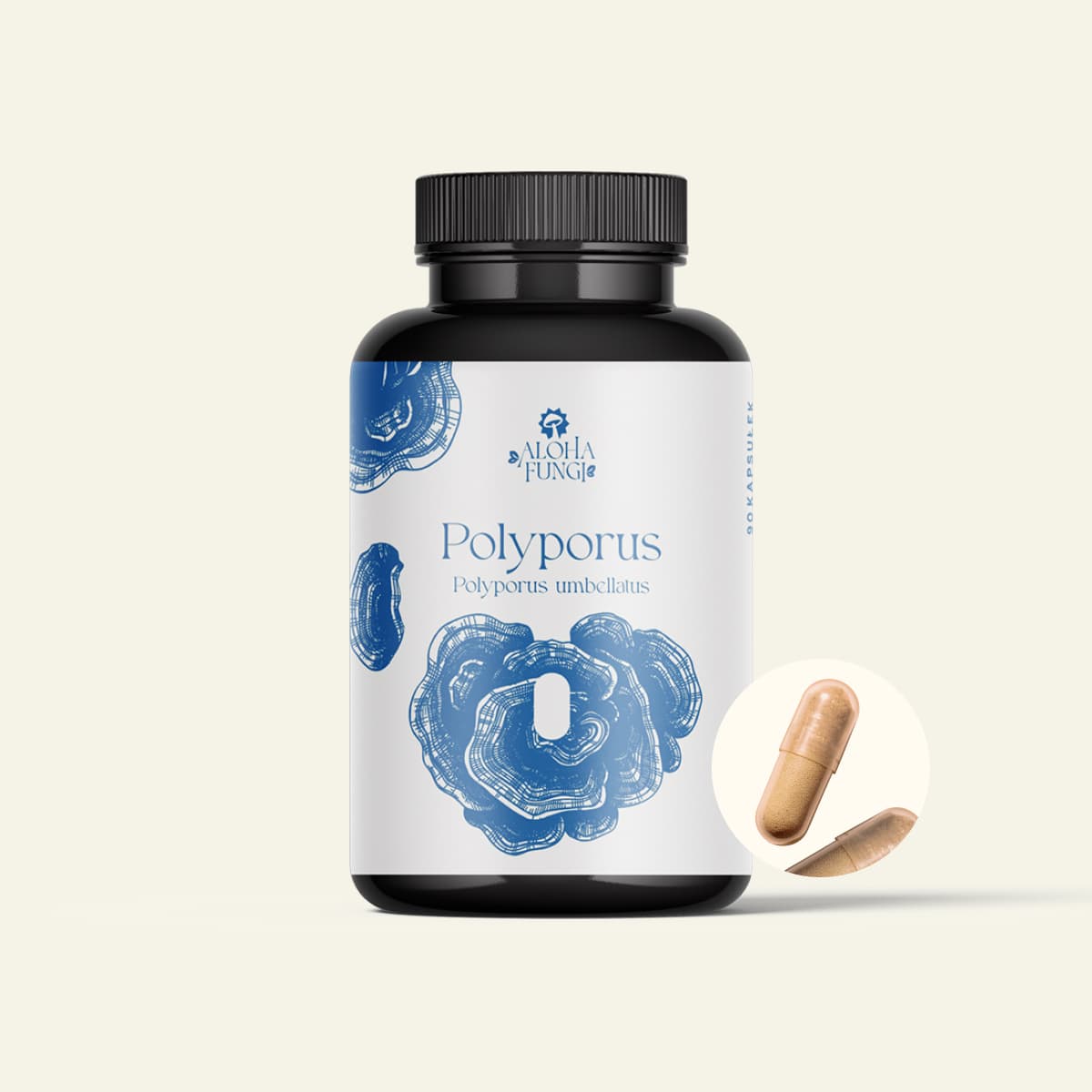
Polyporus
Polyporus umbellatus
Capsules · LONGEVITY129 zł
Below you will find every available product for this species. Each tile opens the product page with the selected format and line preselected.
Version 1.0 · Updated: 21 June 2026 · Subject-matter reviewer: Mateusz Rosa, founder of Aloha Fungi, international TCM therapist (8 years of therapeutic practice, Doctor of Acupuncture, Level A certificate issued by WFAS, an NGO in official relations with the WHO, 2018; author of the books „Przebudzenie Zdrowia" and „Suplementacja grzybów Funkcjonalnych").
Polyporus in 60 seconds
Polyporus is the common name for the mushroom Polyporus umbellatus (synonym Grifola umbellata) of the Polyporaceae family. In Polish żagiew wielogłowa (the official name in the checklist of Polish fungi), also żagwica wielogłowa, chropiatka wielogłowa, huba okółkowa. In Chinese Zhu Ling (猪苓, „pig mushroom", from the sclerotium resembling a piece of pigskin), in Japanese chorei, in English „umbrella polypore" or „lumpy bracket".
In Poland żagiew wielogłowa is a rare, protected species, like the leafy polypore (Maitake) from the same family. The practical consequence: wild Polyporus in Poland is out of the question for supplementation.
All raw material on the market comes from controlled cultivation in China and some European countries, carried out in symbiosis with honey mushrooms of the genus Armillaria. Without this symbiosis the sclerotium (the underground part of the mycelium, the medicinal raw material) does not form properly.
The phytotherapeutic raw material is the sclerotium, a hard, underground, tuber-like structure in which the mycelium stores reserves. The sclerotium is dug up in autumn or early spring, sliced and dried.
The first written mention of Zhu Ling comes from the Shen Nong Ben Cao Jing (The Classic of Materia Medica of the Divine Farmer), dated to the Han dynasty (2nd c. BCE to 2nd c. CE), where it was placed in the category of „water-draining" mushrooms.
Zhu Ling Tang (Polyporus Decoction, described in the „Shang Han Lun" by Zhang Zhongjing, c. 220 CE) was used for „Damp-Heat of the Lower Burner" manifesting as urine retention, urinary tract infections with burning urination, and kidney stones.
Wu Ling San (Five Ingredients with Hoelen, known in the West as the „Hoelen Five Herb Formula"), a classical formula for disorders of fluid circulation: oedema, bloating, hydrocephalus, motion sickness, mild hypertension.
Polyporus is present in the current edition of the Chinese Pharmacopoeia (2020) as an official herbal medicine with indications for hypertension, kidney failure, urolithiasis and oedema.
A modern mechanistic study (Zhang G et al., 2010) in Wistar rats showed that oral administration of an aqueous extract of P. umbellatus sclerotium increases urine production without causing the loss of potassium and sodium typical of loop diuretics.
The P. umbellatus sclerotium extract contains several groups of bioactive compounds whose activity has been characterised separately:
Polyporus Polysaccharide (PPS), a β-1,3 and β-1,6 glucan-peptide complex with a molecular mass in the range of 30-100 kDa. The main immunomodulatory compound, it activates TLR4 on macrophages.
Polyporusterones A-G, sterols specific to the species, described in 1992 (Ohsawa). Polyporusterones C, D, E, F and G show cytotoxic activity in vitro against the L1210 leukaemia line.
Ergone (ergosta-5,7,22-trien-3-one), a steroid with described antialdosterone activity in vitro.
Ergosterol and provitamin D₂. Biotin, in exceptionally high concentration for a mushroom. The β-1,3/1,6-glucans in our extract are standardised to above 30%.
This is the best-described and most characteristic mechanism of Polyporus. The aqueous sclerotium extract increases diuresis in animals and humans but, unlike pharmacological loop diuretics (furosemide) or thiazide diuretics (hydrochlorothiazide), it does not cause hypokalaemia or significant loss of sodium.
The mechanism is twofold: ergone shows antialdosterone activity (it inhibits sodium reabsorption in the distal tubules); polyporusterones and the aqueous fraction modify the expression of aquaporins AQP1, AQP2 and AQP3 in the kidney medulla and the activity of the V2 vasopressin receptor.
In practice: diuresis is gentler and more „physiological" than with pharmacological diuretics, which is why Polyporus is classically recommended for mild oedema, seasonal water retention, and post-operative lymphatic stasis.
PPS (Polyporus Polysaccharide) binds as an agonist to the TLR4 receptor on dendritic cells and macrophages (Li X et al. 2010, Cell Immunol 265(1):50-56; Li X & Xu W 2011, J Ethnopharmacol 135(1):1-6).
This triggers the NF-κB and MyD88 cytokine cascades, leading to polarisation of macrophages towards the M1 phenotype (pro-inflammatory, „attacking") and increased production of IL-1β, TNF-α, iNOS.
This immunomodulatory mechanism is the subject of scientific research. PPS, as a polysaccharide fraction, has been studied in vitro and in animal models for its immunological activity.
Polyporus shows a protective effect on the nephron in animal models of nephrotoxicity (ischaemia, nephrotoxic drugs), probably through modulation of inflammatory cytokines and oxidative stress in the renal tubules.
In Italy therapeutic mycology uses Polyporus for post-operative lymphoedema (especially after mastectomy), for lower-limb oedema and for mild premenstrual water retention.
Polyporus does not replace diuretics in heart failure, in hypertension requiring pharmacological treatment, or in oedema from renal or hepatic causes at an advanced stage. Polyporus does not cure cancers and does not replace oncological therapy. It also does not replace antibiotics in an active urinary tract infection. Support yes, replacement no.
In the morning and at noon, never in the evening. Polyporus is a diuretic, so an evening serving may disturb sleep through night-time trips to the toilet.
Mild seasonal drainage support (water retention, heavy legs, post-winter detox): 500-1000 mg/day. Intensive drainage protocol (post-operative, lymphoedema, predisposition to urinary tract infections): 1500-2000 mg/day. Short courses (4-8 weeks) rather than long-term supplementation.
Polyporus is a polysaccharide-steroid mushroom, so it absorbs well both with water and with a light meal. Best pairings: warm water or green tea, a light meal (breakfast without fatty proteins, which slow the absorption of fungal steroids).
Hydration matters for Polyporus, less so for other mushrooms. If you use Polyporus as a diuretic, drink more water than usual (1.5-2 L a day), because the draining action without adequate hydration can concentrate the urine and increase the risk of urolithiasis.
3-7 days: the first diuretic effects (greater diuresis, a lighter colour of urine), a reduction of „heavy legs" at the end of the day.
2-4 weeks: a stable improvement in drainage, a reduction of post-operative oedema (if relevant), less premenstrual water retention.
4-8 weeks: a full drainage and nephroprotection protocol. After 8 weeks you should stop for 2-4 weeks and assess whether to continue.
Above 8 weeks: only under the supervision of a TCM therapist or phytotherapist.
This is the most traditional combination in the whole classical Materia Medica. Zhu Ling (Polyporus) drains Dampness from the Lower Burner, Fu Ling (Poria) drains Dampness from the Middle Burner and strengthens the Spleen.
Modern indication: comprehensive water drainage, ankle oedema, heavy legs, premenstrual retention, post-operative lymphoedema. Polyporus 1 g in the morning, Poria 1-1.5 g in the morning or in two servings. Duration: 4-8 weeks.
Cordyceps tonifies Kidney Yang and supports energy economy, Polyporus clears Dampness from the urinary tract. Together they form a classic protocol for people with weakened kidneys in the TCM sense (chronic fatigue, frequent urination, cold extremities, mild water retention).
Cordyceps 1 g in the morning, Polyporus 500-1000 mg before noon. Duration: 8 weeks.
Chaga is the strongest antioxidant among the Aloha Fungi mushrooms (SOD, phenolic acids), Polyporus supports kidney function. Together they work in the Cleansing phase of the OOTI™ methodology.
Polyporus 1 g in the morning, Chaga 1-2 g before noon. Duration: 4-8 weeks.
Reishi regulates the HPA axis and acts mildly hypotensively through the autonomic nervous system, Polyporus supports diuresis and mildly lowers blood pressure through the renin-angiotensin system.
Polyporus 1 g in the morning, Reishi 1-2 g in the evening. Duration: 8-12 weeks.
Coriolus, through PSP, activates immunity and supports the microbiota, Polyporus, through PPS, activates TLR4 and supports urinary-tract drainage. Together for people with recurrent mild urinary tract infections (especially women after menopause).
Polyporus 1 g in the morning, Coriolus 2 g before noon. Duration: 8-12 weeks.
Polyporus (Zhu Ling 猪苓) has been a classical ingredient of the Chinese Materia Medica for over 2000 years. In the OOTI™ methodology its main indication is the Cleansing phase: Polyporus is the mushroom of first choice in elimination and drainage (1-2 g/day, 4-8 weeks). In the Nourishing phase it is sometimes a supporting aid when there is simultaneous Dampness in the Middle Burner, in the Transformation phase we select it in nephrological protocols, and in the Integration phase we use it cyclically 2-3 times a year, most often in spring and early autumn.
TCM does not recommend Polyporus in Kidney Yin Deficiency (dry mouth, night sweats, burning palms and soles, a red tongue without coating, frequent passing of dry, dark urine), in dryness without water retention (older people with dehydration, menopause with hot flushes and thirst), and in pregnancy, because of its intense draining action. This is a frame of cultural observation, not a medical diagnosis; concepts such as Qi, Dampness or meridian do not correspond one to one with Western anatomy or physiology.
| Taste | sweet (甘 gān), bland (淡 dàn) |
| Nature | neutral to slightly cooling (平 píng to 微寒 wēi hán) |
| Meridians | Kidney, Bladder, Spleen |
| Action | drains Dampness and promotes urination (利水滲濕 lì shuǐ shèn shī), clears Heat from the Lower Burner |
| Category | draining Dampness and promoting diuresis (利水滲濕藥 lì shuǐ shèn shī yào) |
Pregnancy and breastfeeding. Classical TCM advises against Polyporus in pregnancy because of its strong draining action. There are no adequate RCTs in this population.
Kidney failure stage 3 and higher (eGFR below 60 ml/min/1.73 m²). Polyporus increases the filtration load on the nephron, which a weakened kidney may not tolerate.
Active heart failure with oedema requiring pharmacological treatment.
Children under 18 (no safety studies in this age group), known allergy to mushrooms of the Polyporaceae family, and status after organ transplant with active immunosuppression.
Antihypertensive and diuretic medicines (ACE inhibitors, sartans, beta-blockers, thiazides, furosemide). Polyporus adds to pharmacological diuretics, which can lead to excessive diuresis, orthostatic hypotension and electrolyte disturbances.
Anticoagulant and antiplatelet medicines (warfarin, NOAC, clopidogrel, ASA). Polysaccharides may mildly affect platelet aggregation.
Chemotherapy and radiotherapy in progress. Antidiabetic medicines (single studies describe a mild hypoglycaemic effect of Polyporus). Autoimmune diseases in remission.
Predisposition to kidney stones of a particular type. Planned surgery: stop 14 days before the planned surgical procedure.
Excessive diuresis and nocturia (passing urine at night) with too high a serving or with evening intake. Orthostatic hypotension (dizziness on standing) when combined with antihypertensive medicines without supervision. Mild electrolyte disturbances (rarely, mainly with long-term use at high servings or in combination with loop diuretics). Single allergic reactions (itching, rash) in people hypersensitive to mushrooms.
In classical TCM the raw-material serving is 6-15 g/day, most often in a decoction with other herbs. For a standardised extract (10:1, above 30% β-glucans) we recommend 500-2000 mg/day. A cycle of 4-8 weeks, then a 2-4 week break. We do not go above 2000 mg or above 8 weeks of use without a clinical indication and the supervision of a therapist.
Evidence verdict
We also show what is not proven. This is a dietary supplement, not a medicine.
2
Strong evidence
confirmed composition
4
Preliminary
in vitro and animal studies
3
Not proven
no human studies
Reviewed by
Mateusz Rosa · Doctor of Acupuncture (WFAS)
Version 1.0 · Updated: 21 June 2026 · Subject-matter reviewer: Mateusz Rosa, founder of Aloha Fungi, international TCM therapist (8 years of therapeutic practice, Doctor of Acupuncture, Level A certificate issued by WFAS, an NGO in official relations with the WHO, 2018; author of the books „Przebudzenie Zdrowia" and „Suplementacja grzybów Funkcjonalnych").
Based on 11 verified sources
See sources ↓| Claim | Type of evidence | Strength |
|---|---|---|
| Diuretic action through modulation of aquaporins and ergone (antialdosterone) | animal models (Zhang 2010), the official Chinese Pharmacopoeia, classical TCM over 2000 years | STRONG |
| PPS activates TLR4 and polarises M1 macrophages | in vitro and animal models, repeatedly confirmed (Li 2010, 2011) | STRONG |
| Mild support of diuresis in humans in states of water retention | classical clinical observation in TCM, no modern RCTs, but consistency with the animal mechanism | PRELIMINARY |
| Support for post-operative lymphatic drainage and lymphoedema | Italian therapeutic mycology, open clinical observations, no RCTs | PRELIMINARY |
| PPS modulates the activity of immune cells (dendritic cell maturation) | in vitro and animal models, single mechanistic studies | PRELIMINARY |
| Hepatoprotection in chronic hepatitis B | in China injectable PPS is registered as a supporting medicine, insufficient data outside China | PRELIMINARY |
| „Cures" bladder cancers as monotherapy | none, claim prohibited by regulation | NONE |
| „Replaces" pharmacological diuretics in heart failure or hypertension | none, claim prohibited by regulation | NONE |
| „Cures" recurrent urinary tract infections | none, claim prohibited by regulation | NONE |
STRONG = solid evidence · PRELIMINARY = moderate or preliminary · NONE = unsupported or prohibited by regulation.
The educational content on this page does not replace medical advice. A dietary supplement is not a medicine and should not replace a varied diet or medical consultation. Before starting supplementation, especially with chronic conditions, kidney disease, pregnancy, breastfeeding or when taking medication, consult a doctor. Aloha Fungi does not claim therapeutic efficacy for any product; the mechanisms described are based on the current state of the literature. All products are dietary supplements notified to the Polish Chief Sanitary Inspectorate (GIS).
© 2026 Aloha Fungi™