Skip to content
Super promo!Reishi−50%59.50 zł119 zł (regular price)
Only 65 left at 59.50 zł, then 71.40 złSee Reishi →
Free delivery in Poland from 299 PLN

A morning ritual with cordyceps: step by step for a whole week

A practical, step by step morning ritual with cordyceps: timing, form, pairing with a meal. No promise of an effect, just a concrete plan for the week.

Mateusz Rosa

TCM therapist · Doctor of Acupuncture (WFAS) · author of a book on functional mushrooms

3 min read
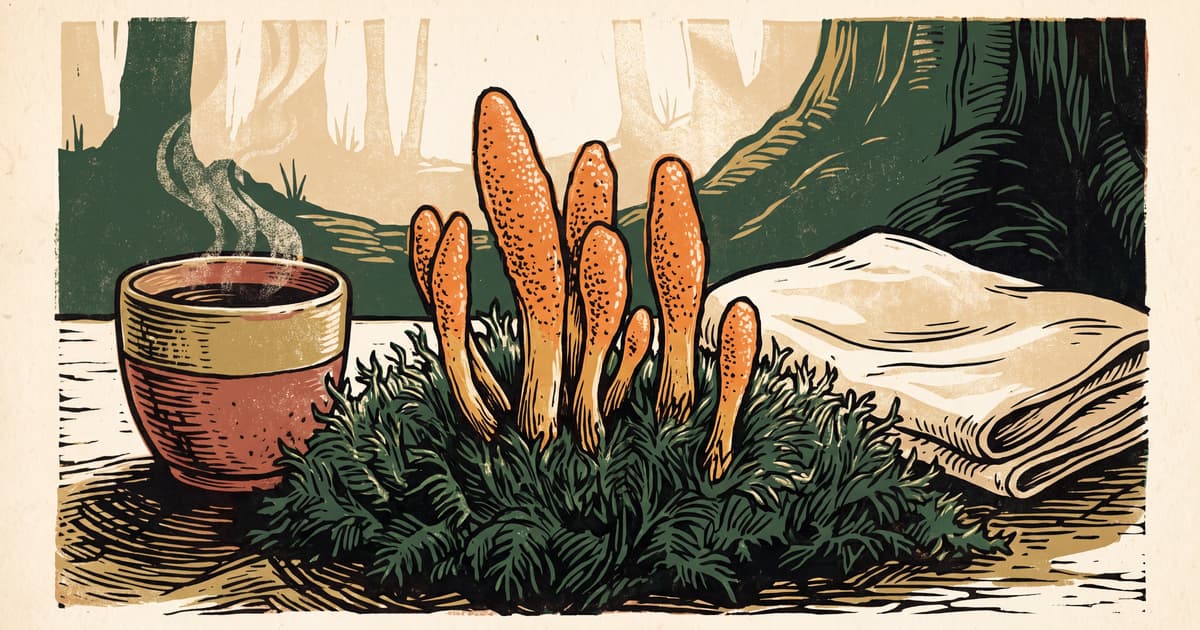
A morning ritual with cordyceps: step by step for a whole week
Contents

You have cordyceps in the cupboard, but you are not sure how to weave it into your morning so the ritual survives longer than a week. Below is a concrete, step by step plan, not a promise of an effect.

Step 1: pick one fixed time

A ritual sticks to a habit, not willpower. Pick a moment that already repeats every day: brewing coffee, brushing your teeth, the first breakfast. Cordyceps is traditionally linked to the hours of activity, so it fits the start of the day rather than the evening.

Step 2: match the form to your morning pace

  • Powder · stir into a smoothie or porridge when you have time to prepare.
  • Capsules · swallow with water when mornings are fast and kitchen-free.
  • Drops · add to a warm (not boiling) drink if you enjoy the brewing ritual.

Step 3: pair it with a meal, not an empty stomach

Many functional mushroom users prefer to take the extract together with food, so the ritual folds into an existing breakfast habit. It is also a simpler way not to forget it.

Step 4: observe a week, not one day

A ritual is judged over days, not a single serving. Note briefly when you took it and what your morning looked like. This lets you see whether the ritual even holds before you judge anything beyond that.

Can you combine cordyceps with Lion's Mane in one morning?

You can, and many people do, because tradition assigned both mushrooms to the same time of day. Cordyceps was associated with the hours of activity, Lion's Mane with the hours of mental work. So both go into the same morning cup, rather than one in the morning and the other at night.

Practical advice for beginners: do not start with both at once. First week, one mushroom, one form, one time of day. Once the ritual holds, add the second. That way you know which part of the morning actually stuck and which one dropped out after three days. Timing and serving for Lion's Mane are covered separately in five questions about the ritual.

The evening is a different story. If you want to close the day as deliberately as you open it, in our stories that role belongs to Reishi. Three different mushrooms at three different moments of the day, not one cocktail for everything.

When to ask a specialist

If you take medication regularly, are pregnant or breastfeeding, confirm cordyceps use with your doctor or pharmacist before adding it to your morning ritual.

See also: How does Cordyceps work · functional mushroom rituals.

Cordyceps in scientific research

What was studied, on how many people and with what level of evidence. This overview describes studies, not the effects of a product.

9

human studies

3

placebo-controlled RCTs

2000–2026

years of publication

  • Zhou J. et al., 2021

    C

    RCT, double-blind, placebo-controlled

    59 people

    The study examined Cordyceps militaris as an add-on to duloxetine for insomnia associated with depression, in a group of 59 people, using a double-blind, placebo-controlled RCT design.

    PMID 34858228
  • Ontawong A. et al., 2024

    C

    RCT

    40 healthy adults

    The study examined the effect of a Cordyceps militaris beverage on immune response in 40 healthy adults, using an RCT design.

    PMID 38580687
  • Dubhashi S. et al., 2023

    C

    RCT, double-blind, placebo-controlled

    65 enrolled, 58 evaluated

    The study examined Cordyceps militaris in mild-to-moderate COVID-19, using a double-blind, placebo-controlled RCT, with 65 people enrolled (58 evaluated).

    PMID 37727187
  • Yang E.-J. et al., 2026

    E

    narrative review · preclinical studies (in vitro and rodent)

    not applicable

    The narrative review collected in vitro, in vivo and clinical data on Cordyceps militaris.

    PMID 41432716
  • Shu M.-Y. et al., 2025

    B

    systematic review with meta-analysis

    14 RCTs, 528 athletes

    The systematic review with meta-analysis collected 14 RCTs (528 athletes) on functional mushroom supplementation in athletes; the review covers multiple mushroom species at once, not only Cordyceps militaris.

    PMID 41280379
  • Choi E. et al., 2020

    E

    animal study (mice) · preclinical studies (in vitro and rodent)

    not applicable

    The mouse study examined the effect of Cordyceps militaris on physical performance.

    PMID 33312018
  • Hirsch K.R. et al., 2017

    C

    RCT, double-blind, placebo-controlled (mushroom blend, not an isolated species)

    28 (acute phase), 10 (chronic phase)

    The study examined the effect of a mushroom blend containing C. militaris (4 g/day) on VO2max, time to exhaustion, ventilatory threshold and power in a cycle ergometer test, using 1-week and 3-week protocols in trained adults. Limitations: n=10 in the chronic phase, a multi-ingredient preparation not isolating the species.

    PMID 27408987
  • Jędrejko M. et al., 2026

    E

    narrative review of human studies · preclinical studies (in vitro and rodent)

    5 studies, 321 participants aged 16-35

    The narrative review collected 5 intervention studies (2017-2024) on ergogenic effects and post-exercise recovery with supplementation in humans. Small samples, heterogeneous participants and protocols, incomplete randomisation reporting, most studies not registered.

    PMID 41829950
  • Tuli H.S. et al., 2014

    E

    narrative review · preclinical studies (in vitro and rodent)

    not applicable

    The review discussed the pharmacological potential of the genus Cordyceps, with particular focus on cordycepin, based on in vitro/in vivo data.

    DOI 10.1007/s13205-013-0121-9
  • Olatunji O.J. et al., 2018

    E

    narrative review (whole genus Cordyceps) · preclinical studies (in vitro and rodent)

    not applicable

    The review collected traditional uses, phytochemistry and pharmacology of the entire genus Cordyceps without separating species.

    PMID 29775778
  • Du J. et al., 2021

    E

    narrative review · preclinical studies (in vitro and rodent)

    not applicable

    The paper discussed mechanisms of cordycepin interaction with adenosine receptors and hypothetically linked this to brain protection and COVID-19. Purely theoretical, with no original data.

    DOI 10.26502/jbb.2642-91280035
  • Ko K.M., Leung H.Y., 2007

    E

    narrative review · preclinical studies (in vitro and rodent)

    not applicable

    The review discussed TCM tonic herbs (Cordyceps as one of several) in the context of ATP, antioxidation and immunomodulation. Does not isolate Cordyceps.

    PMID 17386115
  • Chen S. et al., 2010

    D

    pilot RCT

    20 enrolled, 15 completed

    The pilot randomised study examined the effect of the Cs-4 preparation (a fermented Cordyceps sinensis product) on physical performance in older adults, 20 enrolled, 15 completed.

    PMID 20804368
  • Parcell A.C. et al., 2004

    C

    RCT, double-blind

    22 cyclists

    The double-blind RCT examined the effect of the CordyMax Cs-4 preparation (Cordyceps sinensis) on performance in 22 cyclists.

    PMID 15118196
  • Yu X. et al., 2019

    B

    systematic review with meta-analysis

    14 RCTs, 1192 people

    The systematic review with meta-analysis collected 14 RCTs (1192 people) on Cordyceps sinensis in stable chronic obstructive pulmonary disease (COPD).

    PMID 31073318
  • Wu F. et al., 2025

    B

    systematic review with meta-analysis of RCTs

    15 RCTs, 1310 people

    The meta-analysis collected RCTs on oral Cordyceps sinensis as adjunct therapy in patients with renal dysfunction (creatinine, oliguria duration, urine osmolality). Small samples, short observation periods, predominance of studies from China.

    PMID 39839641
  • Kumar R. et al., 2011

    E

    animal study (rats) · preclinical studies (in vitro and rodent)

    not applicable

    The rat study examined exercise endurance capacity and skeletal muscle metabolic regulators after Cordyceps sinensis administration.

    PMID 21549819
  • Chiou W.F. et al., 2000

    E

    animal (rats) + in vitro (aorta) · preclinical studies (in vitro and rodent)

    not applicable

    The study in anaesthetised rats and isolated aortic rings examined the effect of a Cordyceps sinensis protein fraction on arterial pressure (intravenous administration) and vascular relaxation. Animal model, intravenous administration, does not translate to an oral supplement.

    PMID 10755473

Evidence levels: A · Cochrane review · B · systematic review · C · placebo RCT · D · pilot RCT · E · preclinical studies

What these studies don't say

  • Samples are usually small, most from a single population.
  • Results describe research interventions, not a dietary supplement.
  • The presence of a study is not a health claim.

Source: Aloha Fungi literature review, 1 September 2026; entries verified via PubMed or by DOI (Crossref). See the research

Discover functional mushrooms

© 2026 Aloha Fungi™