Journal
Mushroom coffee: what it is, how it tastes and what is inside
Mushroom coffee is coffee with an extract of functional mushrooms, not chanterelles. See which mushrooms go into it, how it tastes and how to read the label.
TCM therapist · Doctor of Acupuncture (WFAS) · author of a book on functional mushrooms
7 min read
Contents
What is mushroom coffee?
Mushroom coffee is ordinary coffee with an added extract of functional mushrooms such as lion's mane, reishi or cordyceps. There are no porcini or chanterelles in it, and your cup does not taste like mushroom soup. Coffee is the base; the extract is an addition measured in milligrams.
You will see it under a few names: mushroom coffee, coffee with mushrooms, functional coffee. They all mean the same thing. Mushrooms also go into cacao and matcha, which we cover in mushrooms in the kitchen.
Which mushrooms go into coffee?
Producers most often reach for a handful of species, and one coffee usually contains two or three of them. Each has its own history in the kitchen and in Asian tradition. Below we describe what each mushroom is and which compounds it contains. You can read more about each species on its own page, for example lion's mane.
- Lion's mane (Hericium erinaceus). A white mushroom with long "spines", eaten in Asia for a long time. It contains compounds called hericenones and erinacines.
- Reishi (Ganoderma lucidum). A hard, glossy fruiting body that is not eaten but extracted. It contains triterpenoids and polysaccharides.
- Cordyceps (Cordyceps militaris). A slender orange mushroom; in extracts it is valued for cordycepin.
- Shiitake (Lentinula edodes). The same mushroom you buy at the shop for a stir-fry, rich in beta-glucans.
- Chaga (Inonotus obliquus). A growth on birch trees, common in Scandinavian and Polish blends.
How to read a mushroom coffee label?
This is where mushroom coffees differ the most. Two things say more about quality than the species names on the front of the pack: which part of the mushroom the extract was made from and how much of it is in one serving. You will find both in the ingredient list, if the producer gives them.
Fruiting body or mycelium. The fruiting body is the part of the mushroom you see in the forest. Mycelium is the underground network of threads that is easy to grow on cereal grain. If the mycelium grew on oats or rice, a lot of plain grain stays in the powder. On the label, look for the words "fruiting body".
How much extract per serving. "With lion's mane" means nothing without a number next to it. A good label gives milligrams of extract per serving and its concentration, e.g. 10:1. A 10:1 concentration means that about 10 g of dried fruiting bodies make 1 g of extract.
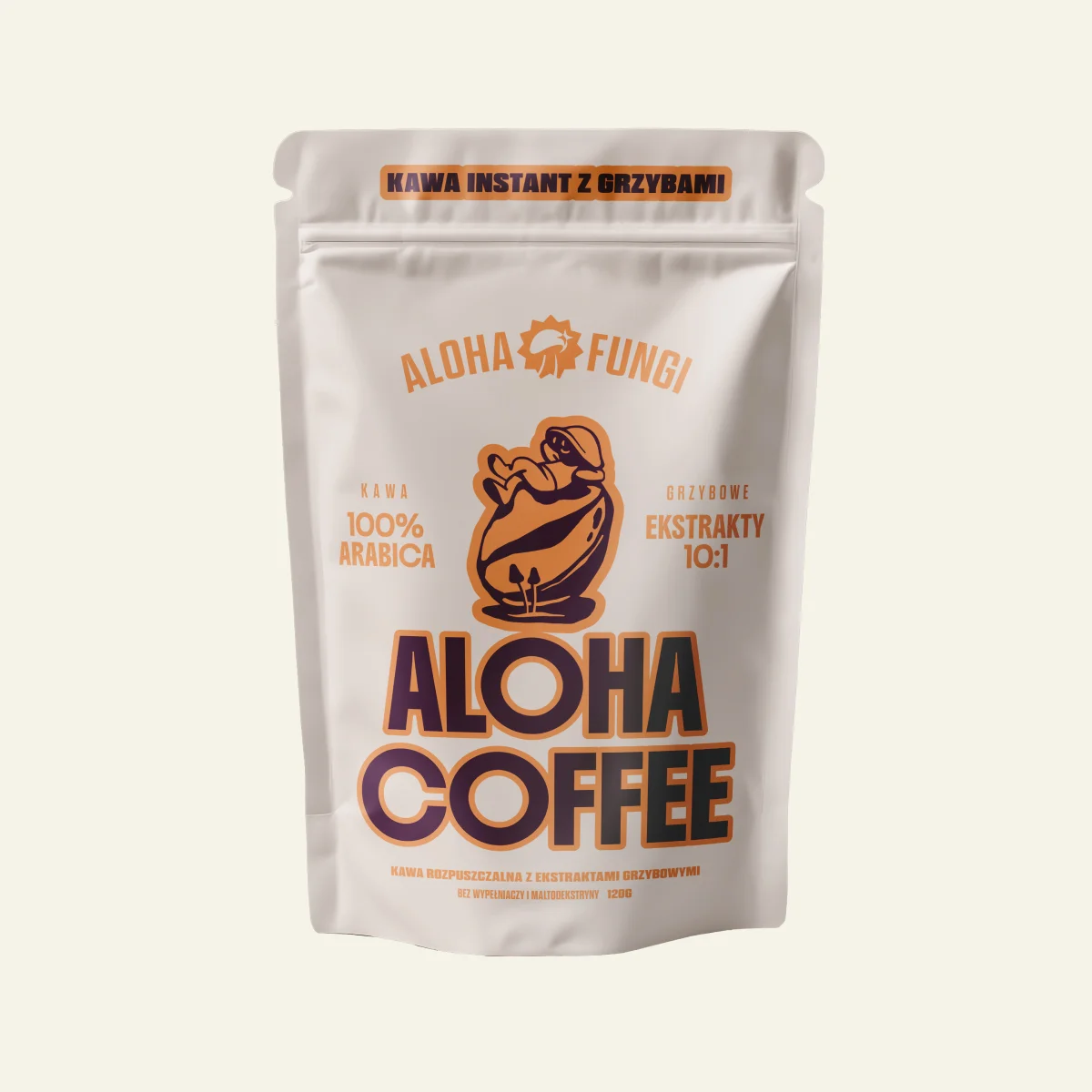
Take our Aloha Coffee as an example: a 4 g serving contains 96 mg of shiitake extract and 48 mg of each of the other two mushroom extracts, all 10:1 from fruiting bodies, standardised to 60% beta-glucans. We test every batch of extracts at the Eurofins laboratory and confirm the species with a DNA test.
How does mushroom coffee taste?
Mostly like coffee. The extract is a small fraction of the serving (in our Aloha Coffee about 192 mg per 4 g of powder), so the coffee taste clearly dominates. Some people notice a slightly earthy aftertaste. With milk or a plant-based drink it gets milder, so it is a good start for people wary of a mushroom taste.
If you want a drink that tastes of mushrooms rather than coffee, you are looking for an infusion of mushrooms alone, without coffee. We write about it in what to drink instead of coffee in the morning.
Does mushroom coffee contain caffeine?
Yes, if the base is real coffee. Mushrooms neither add caffeine nor take it away: there is as much caffeine as in the coffee used for the blend. So when judging caffeine, look at the coffee in the ingredients, not at the mushrooms. The amount is best checked in the producer's data or in batch test results.
According to batch testing, our Aloha Coffee contains 1% caffeine, which is about 40 mg per 4 g serving. Regular instant coffee usually contains about 1.3 to 3% caffeine, so ours is on the milder side. It is still coffee with caffeine: if coffee in the evening spoils your sleep, drink this one before the afternoon too.
The European Food Safety Authority (EFSA) considers up to 400 mg of caffeine a day from all sources safe for adults, and up to 200 mg during pregnancy.
How to make mushroom coffee?
The same way as coffee without additions, because the mushroom extract does not change how you brew it. What matters is the form you buy: instant only needs hot water, ground coffee needs brewing. Just stick to the serving on the label, because it decides how much extract and caffeine ends up in your cup.
- Instant, like Aloha Coffee: pour hot, not boiling, water or warm plant-based milk over a serving and stir.
- Ground: brew it like regular coffee, in a drip machine, moka pot or French press.
When should you be careful with mushroom coffee?
In Poland, mushroom coffee with extracts is usually a food supplement, not ordinary coffee from the shop shelf. That is why the pack carries warnings, as with other supplements, and they are worth reading before your first serving. Talk to your doctor before drinking it if:
- you are pregnant or breastfeeding,
- you take anticoagulant, antidiabetic or blood-pressure-lowering medication,
- you have surgery scheduled,
- you have an active autoimmune disease.
A food supplement is not a substitute for a varied diet and a healthy lifestyle.
Frequently asked questions
Does mushroom coffee taste of mushrooms? Not really. The coffee taste dominates, and the extract may give a slightly earthy aftertaste.
Does mushroom coffee have less caffeine than regular coffee? It depends on the coffee in the base, because the mushrooms themselves do not lower caffeine. Our Aloha Coffee has about 40 mg of caffeine per 4 g serving (1% according to batch testing), which is less than most instant coffees.
How is mushroom coffee different from grain coffee? Grain coffee contains no coffee, only roasted grains and chicory. Mushroom coffee is coffee with an added extract.
Can I drink mushroom coffee every day? Yes, in the serving given on the label, counting the caffeine together with other coffees during the day.
Which mushroom in coffee for the morning, and which for the afternoon? Traditionally cordyceps goes with the morning and reishi with a calmer part of the day. Caffeine is still caffeine, though, so both versions are best before the afternoon.
Is mushroom coffee for children? No. It is coffee with caffeine and a food supplement for adults.
How do I recognise a good mushroom coffee? By three things on the label: fruiting body instead of mycelium, milligrams of extract per serving and its concentration. We go into more detail on the page mushroom coffee: how to choose.
Sources
Show sources (2)Hide sources (2)
- EFSA Panel on Dietetic Products, Nutrition and Allergies. Scientific Opinion on the safety of caffeine. EFSA Journal 2015;13(5):4102. https://doi.org/10.2903/j.efsa.2015.4102
- Aloha Fungi: Aloha Coffee batch test (caffeine content 1%), product label (composition and 4 g serving).