
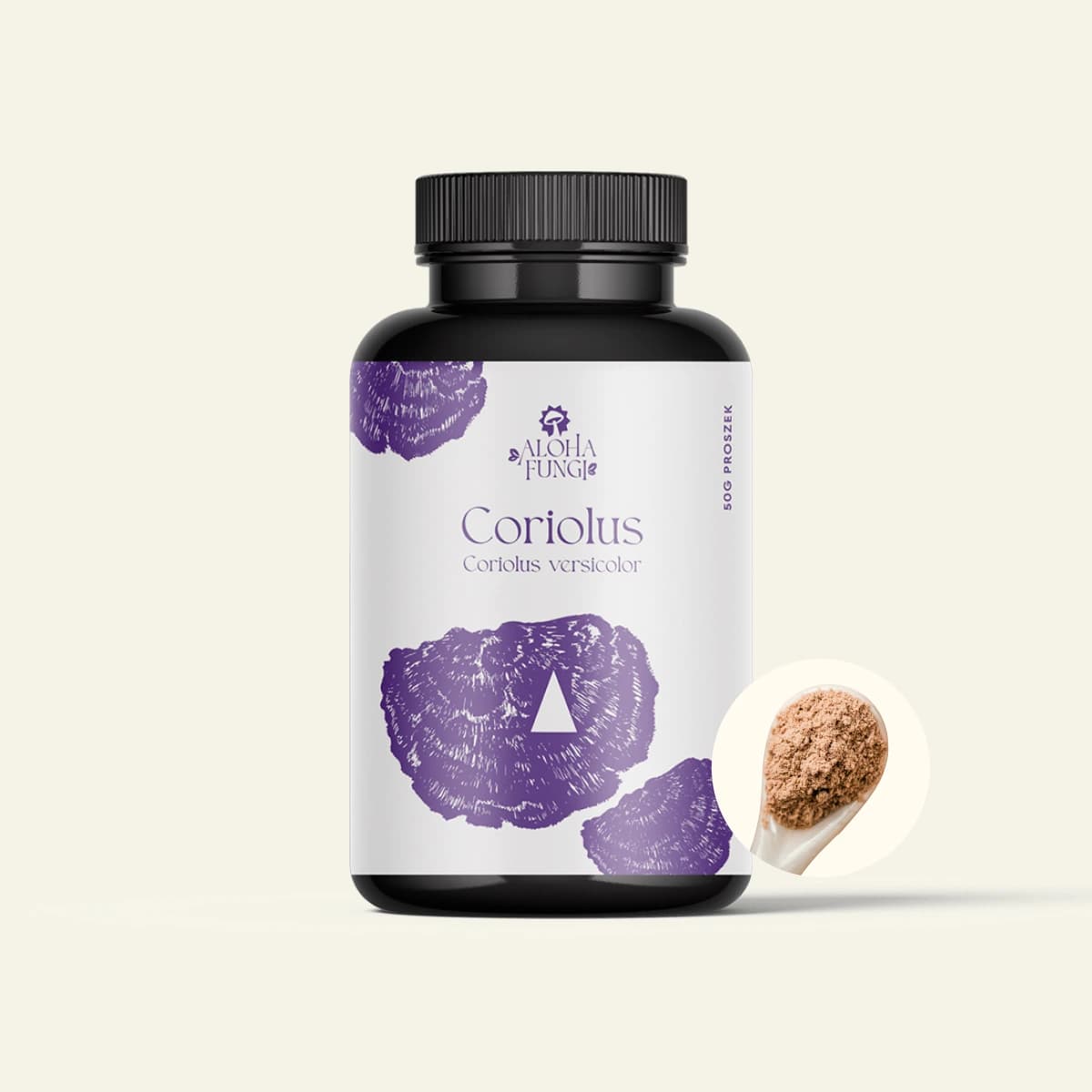
Immunity
Coriolus(Turkey Tail)
Turkey tail. Your microbiome likes this.
from 129 zł
from 110 zł · −15%
© 2026 Aloha Fungi™
Line LONGEVITY · ritual Balance
Maitake · extract · capsules
Żagwica Listkowata · Hen of the Woods
A ritual for a daily meal: take 3 capsules with water during a meal. Fruiting body from controlled cultivation, not grain-grown mycelium, every batch tested.
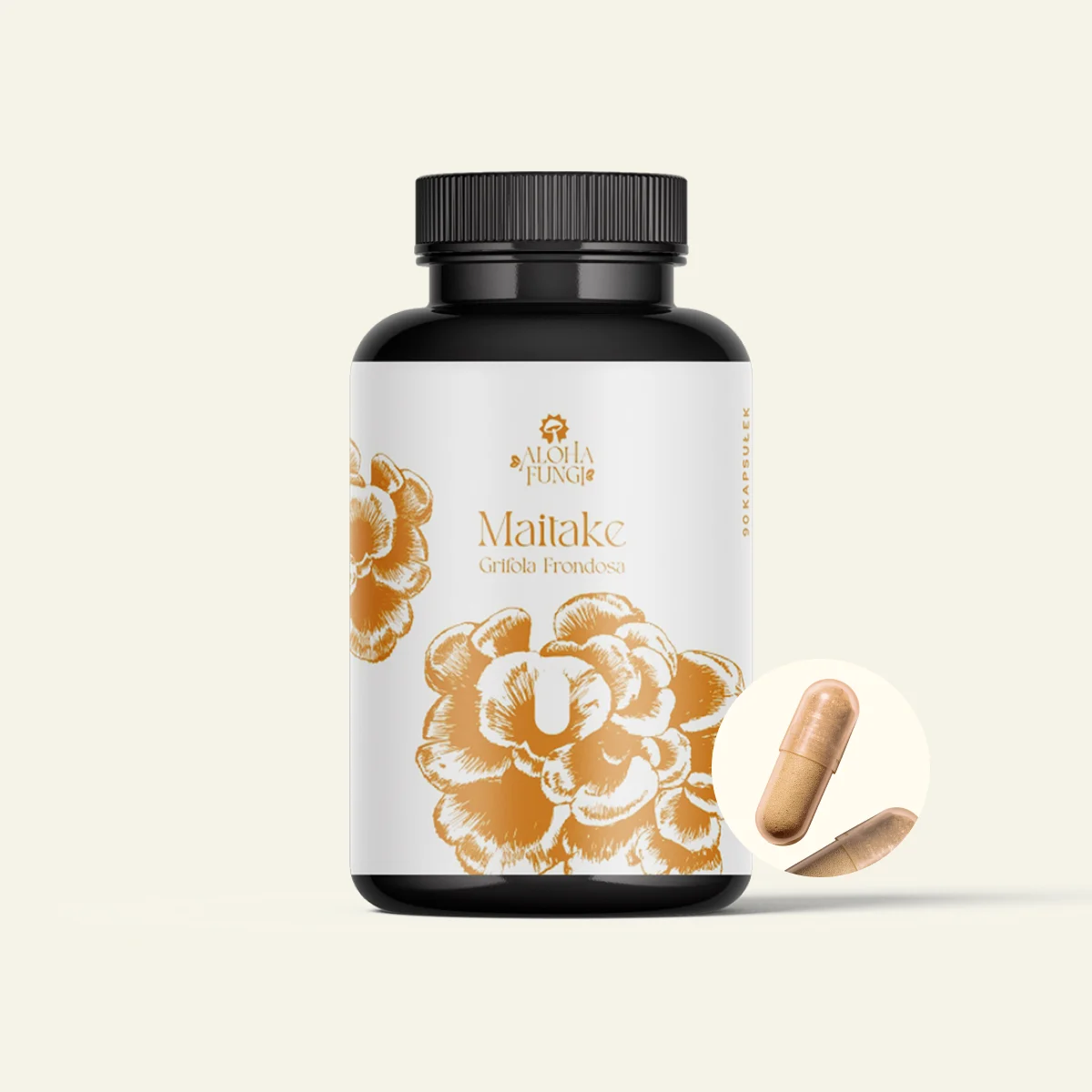
A ritual for a daily meal: take 3 capsules with water during a meal. Fruiting body from controlled cultivation, not grain-grown mycelium, every batch tested.
In stock
170 zł away from free shipping
With a subscription you save 19.35 zł on every delivery
A 30-day ritual. Your pack arrives automatically. Cancel anytime.
2 pcs −4%, 3+ pcs −8%
100% fruiting body · 10:1 extract · Every batch lab-tested
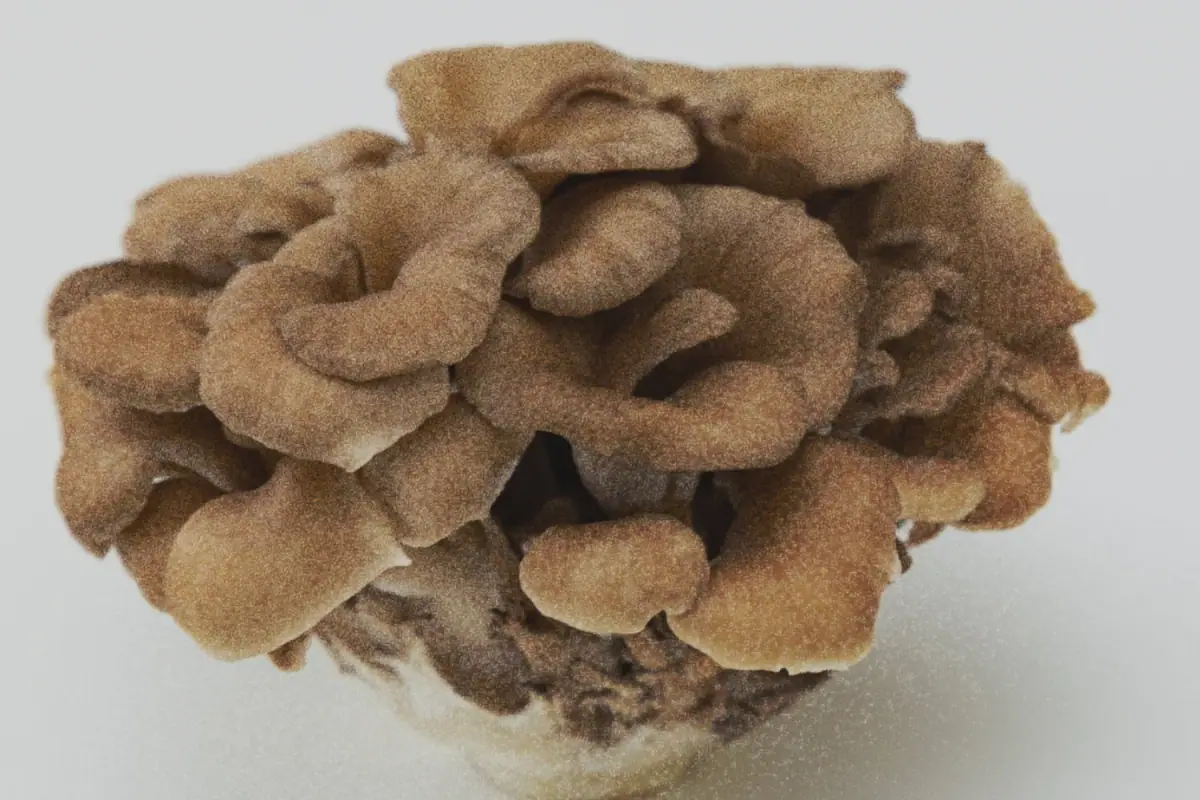
A grey-brown rosette of overlapping caps, soft to the touch and forest-umami in flavour, emerging at the base of old oaks and beeches in the mountain forests of Japan. It grows rarely and demandingly, hence the Japanese name Maitake, the dancing mushroom, because foragers would dance with joy at the sight of it. It is cultivated on beech and oak sawdust and harvested before sporulation.
Recommended serving for consumption during the day: 3 capsules, taken with water, preferably during the day with a meal. Five days a week, with a weekend break. We suggest a minimum of 90 days of consistency. If you are working on metabolism under the care of a doctor or therapist, adjust the timing and number of capsules to their recommendations. You will find detailed advice and synergies with other mushrooms in the Maitake category description.
For prevention, 1-2 capsules a day, 3-4 times a week, is enough. Store the capsules in a dry place, at room temperature, away from direct light. Each capsule is a fixed, repeatable serving, so you do not need to weigh or measure anything.
Consistency matters most: it is an everyday addition, not a one-off “shot”. Maitake is a mushroom we run in cycles in our portfolio, more in courses than as a daily, year-round mushroom. A full cycle is a minimum of 90 days, the amount of time Eastern medicine gives to assess a protocol. After the cycle you decide, together with the person guiding your supplementation: you continue, take a break, return cyclically or change your approach. Do not exceed the recommended daily serving, and remember that a food supplement does not replace a varied diet or a healthy lifestyle.
A few hundred reviews, five stars, and we have only been collecting them for a few months. Ask why customers come back. The answer is simple and impossible to fake: what is inside the package is real. It has spirit. Most of the market sells the name on the label. We sell what truly stands behind that name.
We do not take the easy road most of the world takes: give people just anything, wrap it nicely, cash in. We are a family and a family business, and everything starts with who we are as people. We cannot lie. We would not sleep knowing we sold someone a lie hidden in clever words. We want to feed others only with what we choose for ourselves, the way a loving mum or grandma feeds you: with the best ingredient, with heart and attention, never with a lie. A large part of the market wants to profit at the customer's expense. We stand on the other side of that line. We do not want money that is not clean.
Nature creates to nourish us. It knows what it creates and why. In the intelligence of life there are no mistakes. The mistake appears only where man steps in, and there the road splits in two. You can put in heart and patience to draw out the essence of a plant or a mushroom. Or you can modify, disturb, dilute and lie, so it is cheaper and faster.
That is why the first question is not "which mushroom is this", but: who is selling it to you. Who stands behind the company, and with what intention. We show our face. Our intention is what we wrote above, and for us a greater cost than losing margin would be betraying life and disturbing its intelligence for profit. We want to work in harmony with life, respect its wisdom and let it lead. We want to be honest, humble and never stop learning.
We grow as a company, and out of respect for tradition we bring in technology, never the other way round. Our Chinese friends are family to us. At times we live with them, we listen, we learn. For Yi, mushrooms are the love of a lifetime. Yi has money, plenty of it, and sees no value in having more. The value lies elsewhere: in doing good and never ceasing to become better. We walk the same road. We develop technology guided by the heart, always with respect for the intelligence of nature.
We know that a meal from mum or grandma can nourish more deeply than fast food made of the same ingredients. We know it because the difference is love, quality and truth. Something that lies deeper than a product name.
We do not force anything out of the mushroom, convinced that we know better. The mushroom is an intelligence in itself. We listen to what it has to say, and we keep learning. That is why our motto is the technology of nature. We use the best extraction methods and develop them in a bow before the wisdom of nature, to which we keep saying: show us how to do this better.
You pay less and what you mostly get is filler: maltodextrin and mycelium grown on grain that has never seen a fruiting body.
Our extract is made from a mature Maitake fruiting body from controlled cultivation, not from mycelium on grain. A dual 10:1 extract, blended half and half with powdered fruiting body from the same source. Five days a week, with a weekend break, a minimum of 90 days of consistency.
We work exclusively with the fruiting body, never the mycelium, of Maitake from controlled cultivation on beech-oak sawdust with bran, in non-industrial regions of East Asia. The cycle from sowing to harvest takes from sixty to ninety days, with harvest before sporulation. Standardized to a minimum of 30% beta-glucans in the extract. We suggest a minimum of 90 days of consistency. What remains is what we take full responsibility for: a carefully selected, tested extract that people come back to.
This is where the competition writes what Maitake "does" to blood sugar, weight and metabolism. We leave that blank. Not because we have nothing to say, but because the law does not allow it, and metabolism is too serious a subject to toss into a headline. If you want to know Maitake as Japanese and Chinese tradition saw it, you will find it further down this page. The rest will be written by your 90 days, the shortest time we suggest to truly get to know functional mushrooms.
A number on the label impresses, but in the process the mushroom stops being a mushroom. What remains is a fragment, an isolate. Our principle is different. Five things have to be right before the extract goes into the capsule.

Mature fruiting body from controlled cultivation
Harvested before sporulation, not mycelium on rice or barley.
Dual 10:1 extract from the fruiting body
Ten kilograms of raw material yield one kilogram of extract, standardized to a minimum of 30% beta-glucans.
The fractions that make Maitake
Water extraction is the base for the D-fraction, grifolan and beta-glucans, which is why we do not reduce the mushroom to one simple powder.
A clean shell and composition
Plant-based capsule, no maltodextrin or fillers, inside the extract plus powdered fruiting body from the same source.
Testing of every batch at EUROFINS
Heavy metals and a full pesticide panel, species confirmation by DNA barcoding on request.
What the laboratory cannot measure, the body still recognises. That is why we do not choose between precision and wholeness. We take both: the extract and the powdered fruiting body.
This is the LONGEVITY line, the gentler version for everyday, long-term supplementation. The capsule is for people who prefer a ready serving without measuring and without the pronounced, forest-umami taste of the powder. Maitake is a mushroom we run more in courses than as a daily, year-round mushroom. It is most often chosen by people who:
prefer a ready, measured serving in a capsule over weighing out powder and over getting used to the forest-umami taste;
are looking for a vegan form without maltodextrin and other fillers and want a transparent composition on the label;
complement a varied diet with a functional-mushroom extract and value a transparent, simple composition and repeatability;
want to fold Maitake into their daily rhythm in a way that is simple, discreet and easy to take while travelling;
are working on metabolism under the care of a doctor or therapist and adjust the timing and serving to their recommendations.
Honestly: every body is different and no honest producer will tell you what you will notice and when. The law forbids it, and we would not want to do it anyway. So instead of a promise we give you two things. A few hundred reviews from people who stayed with us after their first package. And a fair starting point: 90 days of regularity, because that is how you truly get to know functional mushrooms, not from a single cup. Your experience belongs to you. We answer for what is in the package.
A grey-brown rosette of overlapping caps, growing at the base of old oaks and beeches. In Japanese, Maitake, the dancing mushroom. They say foragers would dance with joy when they found a specimen, because it is rare in the wild.
Maitake is not a mushroom for diabetes. Before we go any further, one thing plainly. If you take insulin, metformin, sulfonylureas, gliptins or GLP-1 agonists, do not start Maitake without talking to a diabetologist. This is not a defensive disclaimer. It is a condition. Maitake is sometimes sold online as a “natural metformin”, and that is exactly the kind of language you will not find here.
Maitake is a classic mushroom of the Japanese kampo tradition, present in our portfolio as support for everyday rhythm, from the fruiting body, not from mycelium on grain. Dual extraction, every batch tested at EUROFINS. The rest depends on your consistency and on what you agree with your doctor. This is where the competition writes what Maitake “does” to blood sugar, weight and metabolism. We leave that blank. Not because we have nothing to say, but because the law does not allow it, and metabolism is too serious a subject to toss into a headline.
From Mateusz's clinic
Mateusz Rosa
Doctor of Acupuncture (WFAS), founder of Aloha Fungi
Have a question? Message me.
For me Maitake is a mushroom of the Japanese kampo tradition, colloquially called the king of mushrooms.
I take the capsules during the day with a meal, when I want a repeatable serving without weighing out powder and without the pronounced, forest-umami taste. In the clinic I run it more in courses than as a daily, year-round mushroom. The diabetologist first, if blood sugar concerns you, and only then the product. We have no energy for persuading, we put all of it into the product. Mateusz Rosa, doctor of acupuncture (title obtained in 2018), TCM therapist, author of the books “The Awakening of Health” and “Supplementation with Functional Mushrooms”.
50% dual 10:1 extract from Maitake fruiting bodies (Grifola frondosa), 50% powdered fruiting body from the same source. Standardization: minimum 30% beta-glucans in the extract. Plant-based capsule shell (hydroxypropyl methylcellulose). No maltodextrin or other carriers. Gluten-free, soy-free, vegan. Pack: 90 capsules.
At the base of an old oak or beech, in autumn, something appears that looks like a cluster of ruffled, grey-brown leaves arranged in a rosette. A single rosette can weigh several kilograms. This is Maitake (Grifola frondosa).
What sets Maitake apart from other functional mushrooms is two different polysaccharides of different masses and different mechanisms, both isolated and described in the literature. The first is the D-fraction, a polysaccharide-peptide with a mass of about one thousand kilodaltons, a combination of β-glucan with peptides. It was isolated by Hiroaki Nanba at Kobe Pharmaceutical University between 1986 and 1993. The second is the SX-fraction, a glycoprotein with a mass of about twenty kilodaltons, described by S. Konno at New York Medical College in 2001. To this is added grifolan, a high-molecular-weight β-glucan, and trehalose, a sugar with prebiotic properties toward gut bacteria.
Maitake is one of the few mushrooms in which two distinct polysaccharides with distinct action have been characterised.
A mechanistic curiosity worth knowing: the D-fraction shows activity after oral administration. This is rare, because many mushroom polysaccharides studied in this context required injection, like lentinan from Shiitake. This is one of the reasons Maitake drew the attention of researchers.
Mushroom β-glucans are one of the most thoroughly characterised groups of natural compounds in structural terms. A review published in “Foods” (2023) discussed the molecular architecture of β-glucans from edible and traditionally used mushrooms, including Grifola frondosa, focusing on how the type of linkages (1→3 and 1→6), the degree of branching, the molecular weight and the spatial conformation determine what these molecules are at the chemical level. This is a description of the architecture of the molecule itself, not of what it might “do” in the body.
We test every batch of extracts at the EUROFINS laboratory, with particular emphasis on purity. Heavy metals (lead, cadmium, mercury, arsenic) and pesticides (a multi-residue panel covering a broad spectrum of compounds). Confirmation of species identity by DNA barcoding (ITS1/ITS2) is available on request. Every batch has an individual certificate, which we publish without retouching.
Let us be honest: the above are studies of the raw material and its molecules, most often conducted in the laboratory, not of our supplement. Standardising the composition is, for us, a reason to care about extract quality, not a basis for health promises. Bibliographic data: PubMed.
We work with the fruiting body (not mycelium) of Maitake from controlled cultivation on beech-oak sawdust with bran, in non-industrial regions of East Asia, in a line of 50% dual 10:1 extract and 50% powdered fruiting body from the same source. The cycle from sowing to harvest takes from sixty to ninety days, with harvest before sporulation. Standardized for minimum 30% beta-glucans, with every batch tested at EUROFINS for heavy metals and a full pesticide panel, and species confirmation by DNA barcoding (ITS1/ITS2) available on request. ALOHA WEALTH AND WELLNESS Sp. z o.o. The product is registered with the Chief Sanitary Inspectorate (GIS) in accordance with Polish food law.
In a tightly closed package, in a dry, cool and dark place, preferably below 20 degrees Celsius. Protect from moisture. Keep out of reach of children. After opening, use by the date on the package.
People taking glucose-lowering medicines (insulin, metformin, sulfonylureas, gliptins, GLP-1 agonists) must consult a diabetologist before starting use. Do not start on your own. Consulting a doctor is also advised in diabetes of any type, pharmacologically treated insulin resistance, an autoimmune disease in an active phase, after a transplant with immunosuppressive treatment, and in states following an oncological illness. Stop use at least 14 days before any planned surgical procedure. The product is not intended for children, pregnant or breastfeeding women.
Traditional Chinese Medicine
The text below describes Maitake within the conceptual system of Eastern medicine, developed over centuries. This is not a scientific claim or a promise of any health effect. Concepts such as Spleen Qi or Wei Qi do not correspond one-to-one to Western anatomy or physiology. Treat this section as cultural context.
Maitake (Grifola frondosa) has been gathered for centuries in the mountainous forests of Japan, where it grew at the base of old oaks and beeches, forming its distinctive ruffled rosettes that look like a cluster of leaves. The name itself, Maitake, means the “dancing mushroom”: according to legend, foragers would dance with joy on finding this precious, rare specimen. In the English tradition it is hen of the woods, and in Japanese kampo it is sometimes called the king of mushrooms.
In Eastern tradition Maitake was associated with support for the Spleen and Lungs. Let us be honest about one thing: in the Chinese classics Maitake is not a foundational mushroom; its modern standing rests more on Japanese kampo and on research into the D and SX fractions than on the old Chinese canons. This distinction matters and we do not want to blur it. The BALANS signature points to this everyday, balanced place of Maitake in the diet and tradition of the Far East, not to any effect on the body. This is the tradition that Mateusz, the founder of Aloha Fungi and a Doctor of Acupuncture (WFAS), works with day to day.
Energetic profile in the Eastern tradition. Taste: umami, slightly sweet. Nature: neutral to cool. Meridians: Spleen, Lungs. The above is a description of classification according to Eastern medicine, not a claim about a health effect of the product. Treat this purely as cultural context, not as a scientific claim or a promise of any effect.
Cultural context, not a scientific claim or promise of effect.
90-day ritual
First days
You take 3 capsules during the day, preferably with a meal. Five days a week, with a weekend break. This is the stage where Maitake becomes a fixed part of the day. If you are working on metabolism with a doctor, this is the moment to set the timing and serving with them.
First weeks
Supplementation settles into a rhythm. Maitake is a mushroom we run in cycles in our portfolio, more in courses than the daily, year-round mushrooms. You observe how the body responds, and you go about it calmly.
A 90-day cycle
A full ninety days, the minimum that Eastern medicine gives to assess a protocol. After the cycle you decide, together with the person guiding your supplementation: you continue, take a break, return cyclically or change your approach.
Reviews come from customers with a verified purchase and are moderated by the independent platform TrustMate. We do not publish opinions in exchange for benefits, nor do we alter their content.
Do not start on your own. If you take insulin, metformin, sulfonylureas, gliptins or GLP-1 agonists, first talk to a diabetologist. Maitake is a food supplement, not a medicine, and it does not replace therapy or a medical consultation. You make the decision with the doctor who manages your treatment.
These are two different compounds of different masses. The D-fraction is a polysaccharide-peptide with a mass of about one thousand kilodaltons, isolated by Hiroaki Nanba in Kobe. The SX-fraction is a glycoprotein with a mass of about twenty kilodaltons, described by S. Konno at New York Medical College. Different masses, different paths in the literature. Maitake is one of the few mushrooms with two distinct polysaccharides.
Recommended serving for consumption during the day: 3 capsules, preferably with a meal, five days a week. We suggest a minimum of 90 days of consistency. If you are working on metabolism under a doctor's supervision, adjust the timing and number of capsules to their recommendations.
Mycelium grown on grain contains a large share of starch from the substrate, not the mushroom itself. We work with the fruiting body harvested before sporulation, from controlled cultivation, because it gives a fuller profile of compounds. Without dilution by a grain substrate.
In our portfolio we run Maitake more in cycles than as a daily, year-round mushroom. This sets it apart from Reishi, Lion's Mane or Shiitake, which do well in a long, daily routine. The cycle and timing are best set during a consultation.
We do not communicate Maitake this way and we will not call it a weight-loss product or a fat burner. Those would be promises a food supplement may not make. Maitake is a mushroom of the Japanese tradition, described in the literature in the context of metabolism, which is a subject to manage with a doctor, not an advertising slogan.
Yes, but with Maitake it is especially worth doing thoughtfully, particularly if you are working on metabolism. It is best to tailor the set during a free consultation, taking your medicines and your goal into account.
Maitake is a food supplement, not a medicine. We cannot promise an effect on specific conditions, because food law does not allow it. We can describe the Japanese kampo tradition and the fractions described in the literature. Specific health questions we direct to your treating physician.
No. In Poland, Grifola frondosa has been under partial species protection since 2014, with a status of threatened with extinction. Wild harvesting is not permitted. Our raw material comes solely from controlled cultivation.
Cheaper Maitake supplements are usually mycelium grown on grain, largely starch from the substrate, not the mushroom. Our extract is a 50% dual 10:1 extract from a mature fruiting body harvested before sporulation and 50% powdered fruiting body from the same source, standardised to a minimum of 30% beta-glucans. Every batch is tested at EUROFINS for heavy metals and a full pesticide panel, with species confirmation by DNA barcoding available on request. A plant-based capsule, with no maltodextrin or other fillers.
LONGEVITY Maitake suits people who prefer a ready capsule serving over weighing out powder and want to complement their diet with a functional-mushroom extract with a transparent composition. Do not start on your own if you take glucose-lowering medicines (insulin, metformin, sulfonylureas, gliptins, GLP-1 agonists); talk to a diabetologist first. The product is not intended for children, pregnant or breastfeeding women; consulting a doctor is also advised for an autoimmune disease in an active phase and after a transplant with immunosuppressive treatment.
A food supplement does not replace a varied diet or a healthy lifestyle. This product is not a medicinal product. Do not exceed the recommended daily serving. Not for use during pregnancy, breastfeeding, or by children. If in doubt, consult a doctor or pharmacist.
What was studied, on how many people and with what level of evidence. This overview describes studies, not the effects of a product.
7
human studies
1
placebo-controlled RCTs
1994–2026
years of publication
Ulbricht C. et al., 2009
Bsystematic review
not applicable
The systematic review (Natural Standard methodology) collected available data on the uses and safety of Grifola frondosa.
PMID 19476741Jogi E.M. et al., 2026
CRCT, double-blind, placebo-controlled
47 healthy people aged 60+
The double-blind, placebo-controlled RCT examined the effect of Grifola frondosa on cognitive function in 47 healthy people aged 60+.
PMID 42055721Konno S. et al., 2001
Dpilot, research letter, uncontrolled
6 patients
A brief research letter described glycaemia observations in six type 2 diabetes patients taking the extract. Very small sample, no control group.
PMID 11903406The presence of a study is not a health claim.
Information provided in accordance with Regulation (EU) 2023/988 on general product safety (GPSR).