Your morning starts active
The day starts early or with a workout, and you want a simple ritual: you add extract to coffee, matcha or a smoothie, or wash down capsules with water before heading out.
© 2026 Aloha Fungi™
Cordycepsextract · powder

If you are looking for something to give you energy, you are in the right place. For centuries, Cordyceps has been regarded as the vitality mushroom, used by people who were exhausted or doing physical work.
Cordyceps' properties work especially well in the morning or before a workout, and when a full-throttle day is ahead of you. Besides:
50% extract + 50% fruiting body powder
In stock
≈ 3,61 zł per serving180 zł away from free shipping
With a subscription you save 17.85 zł on every delivery
A 30-day ritual. Your pack arrives automatically. Cancel anytime.
2 pcs −4%, 3+ pcs −8%
50% water-alcohol extract from the Cordyceps militaris fruiting body (DER 10:1, standardised to a minimum of 30% beta-glucans and a minimum of 0.3% cordycepin), 50% powdered Cordyceps militaris fruiting body. Pack: 50 g.
Recommended daily serving: 1.5 g (2 scoops) once a day, in the morning or before noon, added to water, tea, coffee, a smoothie or food. Do not pour boiling water over the powder.
Cordyceps was traditionally associated with daytime use, so some people choose the first half of the day. This is traditional context and a matter of routine, not a promise of an effect.
A 50 g pack lasts approximately 33 days at a serving of 1.5 g daily.
Follow the serving stated on the label of the relevant form. Do not change it on your own and do not exceed the recommended daily serving.
Recommended daily serving: 1.5 g (2 scoops) daily
| Ingredient | Per serving |
|---|---|
| Water-alcohol extract from the Cordyceps militaris fruiting body, DER 10:1, min. 30% beta-glucans (Megazyme method) | 750 mg (including min. 225 mg beta-glucans) |
| Powdered Cordyceps militaris fruiting body | 750 mg |
See the pack label for details. Do not exceed the recommended daily serving.
In a tightly closed package, in a dry, cool and dark place, preferably at room temperature, away from direct light. Cordycepin is sensitive to high temperature, so an airtight pack protects the extract's profile. Keep away from children. Shelf life 24-36 months in the original packaging.
Consult your doctor before use if you take anticoagulant or antiplatelet medicines (warfarin, NOAC medicines, acetylsalicylic acid), take antidiabetic medicines (insulin, metformin, sulfonylureas), take blood-pressure-lowering medicines, plan surgery or a dental procedure (stop the product at least 14 days beforehand), have an autoimmune disease in an active phase or take immunosuppressive medicines. The product is not intended for pregnant or breastfeeding women or people under 18.
9 human studies
3 placebo-controlled RCTs · 2000–2026
10:1 fruiting-body extract
Dual extraction.
≥30% beta-glucans
Megazyme method.
Every batch tested
Purity and cordycepin.
Is it for me?
Cordyceps is the ideal morning mushroom for people who lead an intense lifestyle and are looking for a natural way to get energy.
The day starts early or with a workout, and you want a simple ritual: you add extract to coffee, matcha or a smoothie, or wash down capsules with water before heading out.
You know Reishi or Lion’s Mane and want to reach for a bolder, morning variant within your ritual that gives you an extra boost.
What matters to you is the mature fruiting body, a 10:1 extract and testing of every batch, not claims on the label.
Species guide: Cordyceps
Tradition · mechanisms · synergies · evidence
Reviews come from customers with a verified purchase and are moderated by the independent platform TrustMate. We do not publish opinions in exchange for benefits, nor do we alter their content.
formula and dosage
Composition, serving, taste and how to use it change with the form and line you pick. Choose above and the card shows the right variant.
beta-glucans≥30%
measured with the Megazyme method
of extract per serving675–1200 mg
depending on the line: LONGEVITY 50%, PRIME 80%
Proszek · LONGEVITY
For water, tea, coffee or food. A flexible way to use it in the morning.
Traditional Chinese Medicine
The text below describes Cordyceps within the conceptual system of traditional Chinese medicine, developed over centuries. It is not a scientific claim or a promise of a health effect. Concepts such as Qi, Jing or the Kidney meridian do not map one-to-one onto Western anatomy or physiology. Treat this section as cultural context.
In Chinese medicine cordyceps is called dong chong xia cao (蛹虫草), “winter worm, summer grass”, because the wild sinensis species grows from insect larvae high in the mountains of Tibet, Nepal and Bhutan. For centuries it was one of the rarest and most expensive materials in the Chinese pharmacy, reserved for the imperial court; to this day wild sinensis can be worth more than gold by weight. In TCM classification it is described as sweet in taste and warm in nature, assigned to the kidney and lung meridians, and traditionally linked to the notion of Jing, vital essence and vitality. This is the tradition that Mateusz, the founder of Aloha Fungi and a Doctor of Acupuncture (WFAS), works with day to day.
The oldest documented use of Cordyceps comes from Tibet, Bhutan and Nepal, where herders observed that animals reaching for this mushroom had more energy. The first written mention in a Chinese medical text dates from the 18th century, from the work Ben Cao Cong Xin (1757), where Cordyceps is described as a Lung and Kidney tonic, recommended for chronic fatigue and weakness after a long illness. These are ethnographic facts. They are not a foretelling of what you will feel after taking a serving of Cordyceps.
Cordyceps entered the official canon of Chinese materia medica relatively late, in the 18th century, though in the folk tradition of Tibet and the Chinese-Tibetan borderland it was used much earlier. Classically described as a Lung and Kidney tonic. It is one of the few functional mushrooms with a warm to neutral nature, while most of the others are neutral or cool. Hence in tradition it was linked to the morning hours and to energy, rather than to evening winding down.
Treat this purely as cultural context, not as a scientific claim or a promise of any effect. TCM is a system of thought from millennia ago, not a description of physiology as we understand it today. We draw on this tradition because it is part of cordyceps’s story, not because it replaces modern knowledge. For the same reason we chose cultivated militaris over wild sinensis: a species that can be grown under controlled conditions, has a repeatable composition and does not strain high-altitude ecosystems.
Cultural context, not a scientific claim or promise of effect.
First days
You take 3 capsules in the morning or before noon, with warm water. Five days a week, with a weekend break. Cordyceps becomes a steady part of your morning.
First weeks
You reach for Cordyceps before you think it is time. The morning capsules become part of starting the day. First observations usually come after 2-4 weeks of regularity.
A 90-day cycle
A full ninety days. In Eastern tradition, this is how much time you give yourself to observe any protocol or practice.
Why Aloha?
You can check each of them on the label and in the batch tests.
The orange Cordyceps militaris fruiting body accumulates nucleosides, including cordycepin, and beta-glucans. We harvest it at full maturity, before sporulation, when the concentration of these compounds is highest.
The fruiting bodies grow in sterile climate chambers on a rice-based medium, at a stable temperature, humidity and photoperiod that stimulates fruiting. We audit the source once a quarter, and every batch is tested in an independent, accredited laboratory.
Drying and extraction at controlled, low temperatures protect cordycepin from breaking down. Aggressive drying lowers its content, which is why a cheap, quickly dried powder rarely has anything to do with the full profile of the mushroom.
Beta-glucans are measured with the enzymatic Megazyme method, cordycepin and adenosine by HPLC. An honest measurement that does not inflate the result and does not mix beta-glucans with starch from cereal cultivation.
Heavy metals and pesticide residues. We publish batch results on the Research page.
The cheaper extract is usually the most expensive: you pay less and get more filler. Compare for yourself.
| Feature | Aloha Cordyceps | Typical extract |
|---|---|---|
| Part of the mushroom | Mature fruiting body before sporulation | Mycelium on rice or barley |
| Concentration | 10:1 extract | 1:1 powder or an “extract” with no ratio |
| Extraction | Low temperature, protects cordycepin | Aggressive drying or no information |
| Cordycepin | ≥0.3%, HPLC method | “Active compounds” with no method |
| Beta-glucans | ≥30%, Megazyme method | “Polysaccharides” with no method |
| Batch testing | Every batch, results public | None or just “tested” |
We are practitioners of Chinese medicine.
I work every day with the tradition this mushroom comes from. That is why Cordyceps is one of the first Aloha mushrooms.

Mateusz Rosa
Doctor of Acupuncture (WFAS), founder of Aloha Fungi
„Cordyceps has been my morning mushroom for years.”
In the classical texts of Chinese medicine, Cordyceps was described as a Lung and Kidney tonic, linked to the notion of Jing, vital essence. I treat it as a steady part of the morning, not a quick fix. With natural supplementation, consistency and regularity are key.
Natural supplementation takes time. For the best results we recommend 90 days of regular supplementation. TCM tradition looks at time differently: it describes change as a process that requires consistency.
A question about the form or the line? Write to me, I answer personally.
Write to meReviews of Aloha Fungi: The rating next to the price covers the whole shop. Reviews of Cordyceps itself are shown below, verified only.
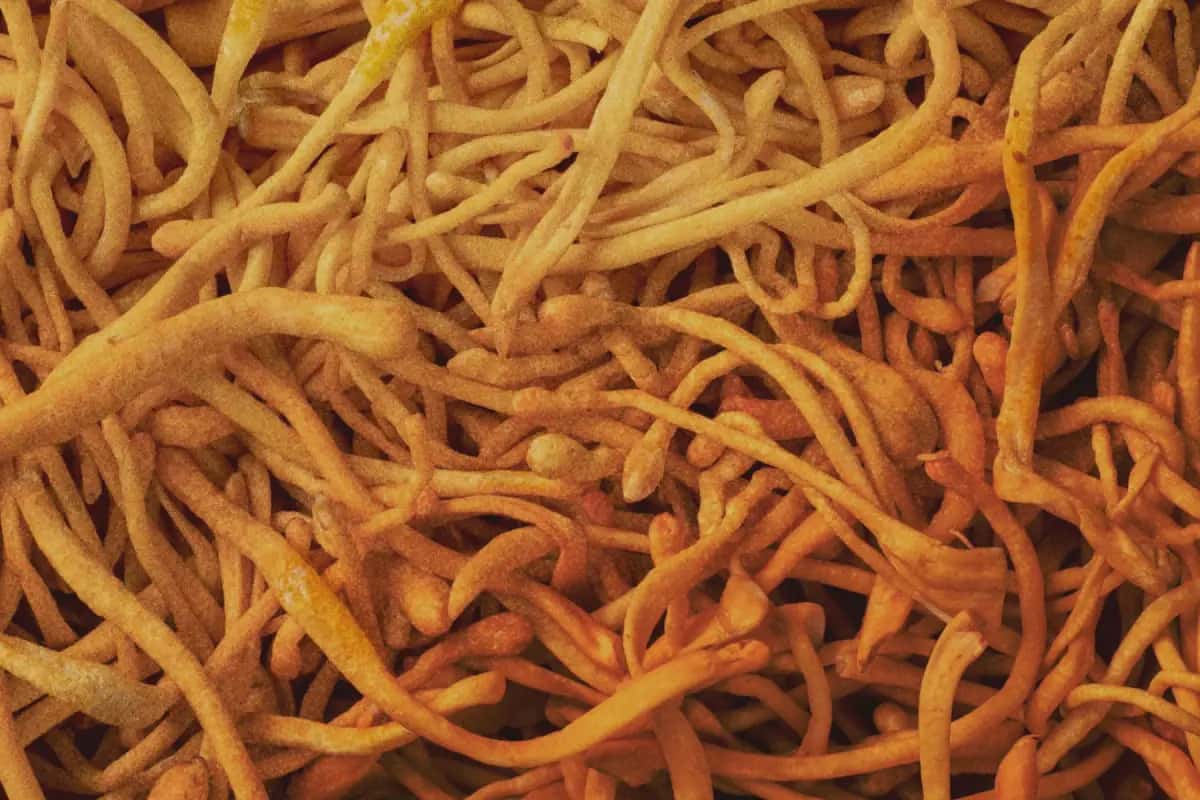
Cordyceps is a functional mushroom with orange, club-shaped fruiting bodies, used for over a thousand years in traditional Chinese and Tibetan medicine. In Polish it is called maczużnik.
In nature it is a parasite of insects: it grows inside the host body and in spring sends out an orange structure with a fruiting body, in which it accumulates the highest concentration of bioactive compounds.
It is precisely this type of fruiting body (in our case grown in controlled cultivation on a rice-based medium, not on an insect) that we use in our extract.
We will not answer “what it does”, because cordyceps is a food supplement, not a medicine. Promising an effect on specific diseases or bodily functions would be against the law. What we can honestly say is what cordyceps is: a standardised fruiting-body extract of Cordyceps militaris with a well-described composition, present in Far-Eastern culture for centuries. What you make of that is up to you.
Cordyceps was traditionally associated with daytime use, so some people choose the morning or before noon. This is traditional context and a matter of routine, not a claim about what the product does. Follow the serving stated on the label.
There is no single universal duration of use or guaranteed time at which an effect will be felt. A pack of 90 capsules lasts 30 days at a serving of 3 capsules a day. Follow the label, and if you take medication or plan long-term supplementation, discuss it with your doctor.
LONGEVITY is the everyday, value line: a gentle entry into functional mushrooms, meant as a steady part of your diet.
PRIME is the stronger, more concentrated variant with a larger extract fraction, for those who want a more intensive extract within a deliberate protocol. Cordyceps with its MOC signature is available in both lines.
Both are built on the same care for raw-material quality; they differ in concentration and positioning. If you are just starting out, consider LONGEVITY first; if you are after a stronger accent, choose PRIME.
In industrial cultivation, mycelium grows for a few weeks on grain (rice or barley), and the end product is largely a cereal substrate in which cordycepin is usually present only in traces.
We work with a mature fruiting body grown on a rice-based medium enriched with mushroom components, in sterile, controlled conditions.
The fruiting bodies are harvested at full maturity, when they reach an intense orange colour, before sporulation. This difference determines the cordycepin content and the fullness of the nucleoside profile.
Cordycepin is sensitive to high temperature. Drying and extraction at controlled, low temperatures protect it from breaking down; aggressive drying lowers its content. This is one of the reasons a cheap, aggressively dried powder rarely has anything to do with the full profile of the mushroom.
Brands today race over who has the higher percentage of beta-glucans, cordycepin or DER. A minimum of 30% beta-glucans and a minimum of 0.3% cordycepin in the extract are parameters in our specification. The laboratory document should be matched to the batch number on the packaging. Natural raw material can vary between lots, so we show the specification instead of promising an identical value above the declared minimum.
We work with cultivated Cordyceps militaris.
Wild Cordyceps sinensis from the Himalayas is today rare, expensive and burdened with contamination risk, hard to verify for purity. The quality standard is repeatable cultivation of the fruiting body under strict, sterile conditions (a stable temperature, humidity and a photoperiod that stimulates fruiting), not gathering from natural sites.
The militaris fruiting body has a repeatable composition standardised to over 30% beta-glucans, in a 10:1 extract, and does not strain high-altitude ecosystems.
It is the same LONGEVITY line and the same extract, just in a different form. You choose capsules when you want a steady serving without measuring and without the earthy taste, for example for a morning routine on the go or to take when travelling. If you prefer a ritual with a warm drink, you will find the same extract in the LONGEVITY powder. The more intensive PRIME protocol with a larger extract fraction is available in PRIME capsules.
Cheaper Cordyceps supplements are often mycelium grown on grain. Our extract comes from a mature Cordyceps militaris fruiting body harvested before sporulation, at a 10:1 ratio, standardised to a minimum of 30% beta-glucans and a minimum of 0.3% cordycepin. The document with Megazyme and HPLC results should be matched to the batch number on the packaging. The capsule is plant-based and contains no maltodextrin.
Cordyceps with its MOC signature suits people building a morning ritual, active people who enjoy an addition to their morning coffee or a pre-workout smoothie. It is not intended for pregnant or breastfeeding women or people under 18; consult your doctor if you take anticoagulant, antidiabetic or blood-pressure-lowering medicines, have an active autoimmune disease, or are planning surgery.
Yes, Cordyceps can be used alongside other extracts from our range, for example Reishi in the evening or Lion’s Mane during the day. Use each product according to the serving stated on its own label, and do not combine servings of several products into one larger dose. If you take medication regularly, discuss any new supplementation with your doctor.
Yes. We have a B2B offer for own-brand creators, therapists and venues. Details at b2b.alohafungi.pl.
The deeper layer
Research, tradition and the chemistry of the fruiting body in one place. Open what interests you.
These studies looked at extracts and preparations from the Cordyceps genus, not our product, and some used a different raw material (CS-4 mycelium strain) than our militaris fruiting-body extract. We show them so you know where the reputation of this mushroom comes from.
Cordyceps militaris is studied for tolerance to high-intensity exercise.
In a randomised, placebo-controlled trial in young, active adults, three weeks of Cordyceps militaris extract (3 g daily) extended time to exhaustion in a high-intensity test, with no significant change in VO2max.
Hirsch et al., Journal of Dietary Supplements 2017 ↗Cordyceps genus preparations (CS-4 mycelial strain) are studied for exercise capacity in older adults.
In a 12-week placebo-controlled trial in healthy older adults, CS-4 supplementation (mycelium, not the militaris fruiting body) did not significantly change VO2max versus placebo, though both groups improved on the post-training exercise test.
Chen et al., Journal of Alternative and Complementary Medicine 2010 ↗Cordycepin is one of the most thoroughly described Cordyceps molecules.
A 2020 review describes the biosynthetic pathways of cordycepin in the mushroom and methods of chemical synthesis, along with the challenges of industrial-scale production.
Yang et al., Fungal Genetics and Biology 2020 ↗The Cordyceps militaris fruiting body contains above all nucleosides, led by cordycepin (3′-deoxyadenosine), along with adenosine, uridine and related compounds. Beyond that, beta-1,3/1,6-glucans, cordycepic acid (D-mannitol) and ergosterol. The characteristic orange colour of the fruiting body comes from carotenoids.
Cordycepin is sensitive to high temperature, which is why we dry and extract the raw material at controlled, low temperatures to preserve it. We sell only fruiting-body extract, never mycelium grown on grain.
Cordyceps is among the most thoroughly characterised functional mushrooms in chemical terms. What does the Cordyceps fruiting body hold? Above all nucleosides, led by cordycepin (3′-deoxyadenosine), along with adenosine, uridine and related compounds.
Beyond that, β-1,3/1,6-glucans (water-soluble polysaccharides), cordycepic acid (D-mannitol), ergosterol and peptidopolysaccharide fractions.
Cordycepin is sensitive to high temperature, which is why we dry and extract the raw material at controlled, low temperatures to preserve it. This is one of the reasons a cheap, aggressively dried powder rarely has anything to do with the full profile of the mushroom.
The molecule that draws the most attention from researchers of the raw material is cordycepin, or 3′-deoxyadenosine, a molecule built like adenosine but missing one hydroxyl group on the sugar ring. It is a simple, well-defined structure, for which both the biosynthetic pathways within the mushroom itself and methods of chemical synthesis have been described in detail.
Cordyceps militaris also contains adenosine, mannitol (known in this context as cordycepic acid) and polysaccharides; our raw material is standardised to over 30% beta-glucans and a minimum of 0.3% cordycepin. These are two distinct families of molecules: low-molecular-weight nucleosides and polyols on one side, and on the other large carbohydrate chains, including β-glucans, whose architecture (molecular weight, branching, conformation) is described separately.
The characteristic orange colour of the militaris fruiting body comes from carotenoids and is one of the reasons this species is so easy to tell apart from others.
We test every batch of extracts in the independent EUROFINS laboratory, with particular emphasis on purity. We check for the presence of heavy metals and pesticide residues. We determine β-glucans by the Megazyme method and cordycepin and adenosine by HPLC. Every batch has its own individual certificate.
Let us be honest: these are studies of the raw material and its molecules, most often conducted in the laboratory, not of our supplement. They do not show that cordyceps is a medicine or that it resolves any health problem on its own; they show what this mushroom is at the chemical level. Standardising to over 30% beta-glucans is, for us, a reason to care about the quality and repeatability of the extract, not a basis for health promises. Bibliographic data: PubMed.
The cited papers concern the raw material and its compounds, not our product. They are not claims about treatment.
A food supplement does not replace a varied diet or a healthy lifestyle. This product is not a medicinal product. Do not exceed the recommended daily serving. Not for use during pregnancy, breastfeeding, or by children. If in doubt, consult a doctor or pharmacist.
What was studied, on how many people and with what level of evidence. This overview describes studies, not the effects of a product.
9
human studies
3
placebo-controlled RCTs
2000–2026
years of publication
Yu X. et al., 2019
Bsystematic review with meta-analysis
14 RCTs, 1192 people
The systematic review with meta-analysis collected 14 RCTs (1192 people) on Cordyceps sinensis in stable chronic obstructive pulmonary disease (COPD).
PMID 31073318Shu M.-Y. et al., 2025
Bsystematic review with meta-analysis
14 RCTs, 528 athletes
The systematic review with meta-analysis collected 14 RCTs (528 athletes) on functional mushroom supplementation in athletes; the review covers multiple mushroom species at once, not only Cordyceps militaris.
PMID 41280379Wu F. et al., 2025
Bsystematic review with meta-analysis of RCTs
15 RCTs, 1310 people
The meta-analysis collected RCTs on oral Cordyceps sinensis as adjunct therapy in patients with renal dysfunction (creatinine, oliguria duration, urine osmolality). Small samples, short observation periods, predominance of studies from China.
PMID 39839641The presence of a study is not a health claim.
Which mushroom for energy? Meet Cordyceps: TCM tradition, cordycepin, adenosine, ATP and how it fits into a daily activity ritual.
A practical, step by step morning ritual with cordyceps: timing, form, pairing with a meal. No promise of an effect, just a concrete plan for the week.
Functional coffee and a mushroom "NOT coffee" as a swap for your morning cup. An educational look at changing the habit, the time of day and the ritual.
Information provided in accordance with Regulation (EU) 2023/988 on general product safety (GPSR).