Journal
Maitake, the forest's dance · the dancing mushroom of oaks
Maitake, hen of the woods, is the Japanese "dancing mushroom". Educational notes on its name, legend, the fruiting body under oaks and its place at the table.
TCM therapist · Doctor of Acupuncture (WFAS) · author of a book on functional mushrooms
3 min read
Contents
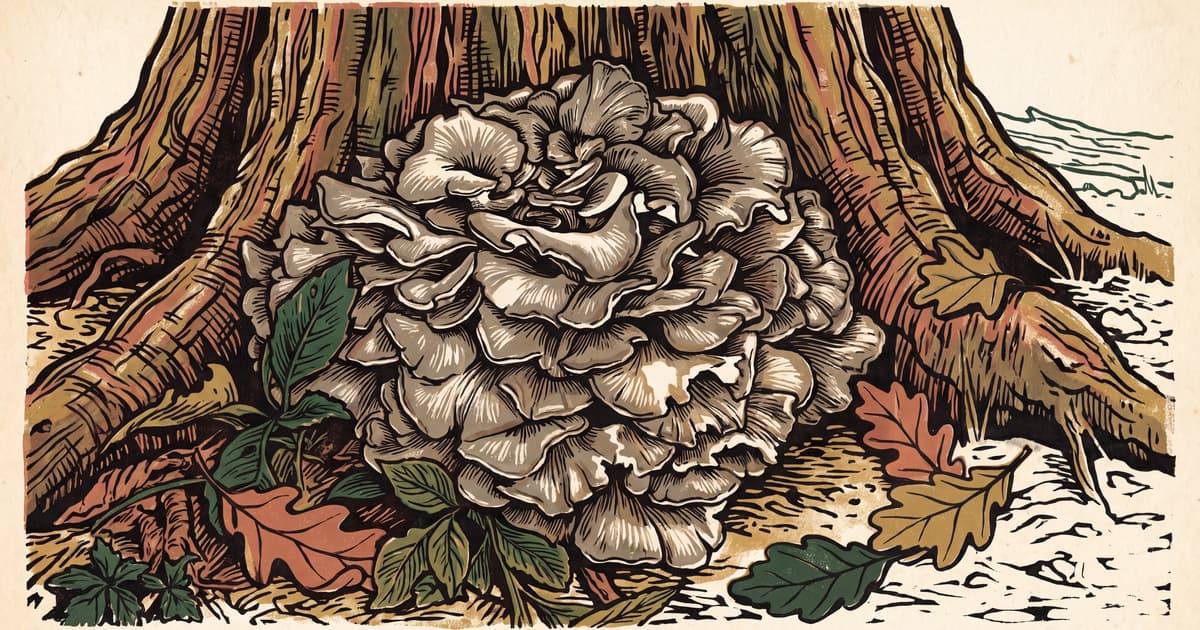
Maitake is a mushroom with two names that tell the same scene. In Japan it is the "dancing mushroom", while in English-speaking countries it is known as hen of the woods. Both names come from one sight: a lush rosette growing at the foot of an old oak.
In Latin it is Grifola frondosa. This piece is a story about the name, the legend and this mushroom's place in the Japanese kitchen. It is a piece of culture, not a promise.
Where "the forest's dance" comes from
The word "maitake" (舞茸) joins two characters: "dance" and "mushroom". Old Japanese foragers found it rarely, and each specimen tended to be large and prized. Legend says that at the sight of such a find people danced with joy. Hence the "dancing mushroom".
This is a story, do not read it as a promise. The symbolism of joy speaks of the culture of a forest find, not of an effect on the body.
A fruiting body like a wave of leaves
Maitake has no single cap on a stem. Its fruiting body is a dense rosette of overlapping "leaflets", resembling the ruffled feathers of a hen or a wave of leaves. Hence the English "hen of the woods".
It grows at the base of deciduous trees, most often old oaks. It is an autumn mushroom: it returns to the same spot year after year, at the foot of the same trunk. In the kitchen it is valued for its meaty, springy texture.
The Japanese table tradition
In Japan, maitake has been a culinary ingredient for centuries, not just a forest curiosity.
- Broth and dashi · the leaflets lend a deep, earthy flavour to stocks and soups.
- Tempura · the rosette in crisp batter is a classic of the Japanese table.
- Braising and roasting · the springy structure holds its shape in the pan and oven.
In the old understanding of tradition, maitake was counted among mushrooms valued in everyday life, woven into the rhythm of meals. Remember: this is a cultural description, not a modern claim about effects.
Maitake in your ritual
Today we reach for maitake not only on the plate but also as a functional mushroom, in the form of an extract woven into a daily routine.
- During the day · you add it where it fits the rhythm of your meals.
- Regularly · functional mushrooms belong in a routine, not in an emergency.
- Your choice · pick the form and timing that fit your day.
If you take medication, are pregnant or breastfeeding, discuss use with your doctor or pharmacist.
See also: Shiitake, from the kitchen and tradition of Asia · mushroom atlas.
FAQ: frequently asked questions
What are the properties of maitake mushrooms?
Maitake, in Japanese the "dancing mushroom", is an edible species present in Japanese cuisine and tradition. Science looks at its beta-glucans (D and MD fractions): in our Research Atlas we have gathered 13 pieces of literature on maitake, including randomized trials. At every entry we write what was checked and with what result, without shortcuts.
This content is for educational purposes only and does not constitute medical advice. A food supplement does not replace a varied diet or a healthy lifestyle. If in doubt, consult your doctor or pharmacist.