Journal
Chaga properties: compounds and what researchers measured
Chaga properties in research: see which compounds were studied in Inonotus obliquus, what preclinical papers tested and what kidney case reports note.
TCM therapist · Doctor of Acupuncture (WFAS) · author of a book on functional mushrooms
5 min read
Contents
- What is chaga and how does a conk differ from a fruiting body?
- Which compounds have researchers identified in chaga?
- How do folk traditions and TCM describe chaga?
- What did chaga studies measure?
- What can't these studies tell us?
- FAQ
- Are there human clinical trials on chaga?
- Why do kidney and oxalate cautions come up with chaga?
- How should you read the serving size on a chaga label?
- Can you take chaga alongside medicines?
Research on chaga properties focuses on the mushroom's composition, especially polysaccharides, phenolic compounds and triterpenoids. Biological studies so far come from laboratory assays and animal models, with no controlled human intervention trials. When reading a paper on chaga, check the study model, the raw material used and the safety notes first.
What is chaga and how does a conk differ from a fruiting body?
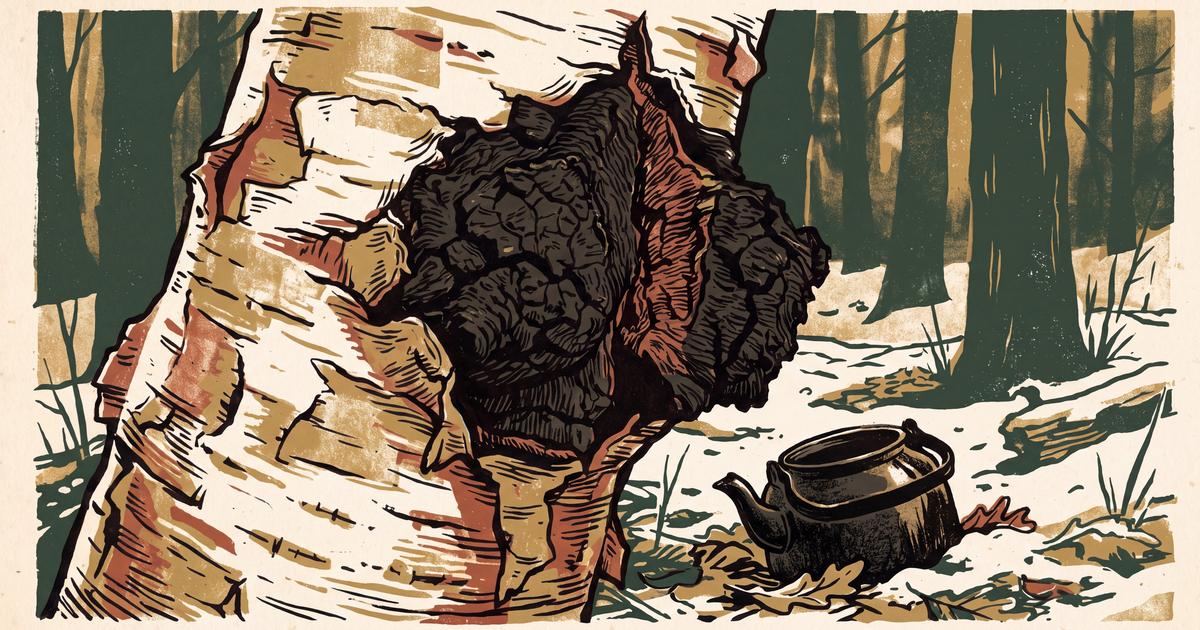
Chaga (Inonotus obliquus) is a fungus that grows mainly on birch trees in cold northern climates. The dark, cracked growth seen on the trunk is a sterile conk containing both fungal tissue and woody host material, rather than a classic capped fruiting body. Chaga, the birch mushroom: what it is
In commerce, the terms "fruiting body", "sclerotium" and "conk" are often used loosely even though they are not biologically identical. Because wild chaga is partially protected in Poland, supplement raw material should come from documented, controlled sources rather than casual wild foraging.
Which compounds have researchers identified in chaga?
In Inonotus obliquus samples, researchers have identified heteropolysaccharides (including beta-glucans), melanin pigments, phenolic compounds and triterpenoids such as betulinic acid and inotodiol. Their proportions vary with origin, wood content and extraction solvent. On a supplement label, check the raw material description, extraction ratio and stated beta-glucan figure. How to read a mushroom extract label
A 10:1 label states only the ratio of starting material to finished powder. Beta-glucan content and heavy-metal testing are separate figures. Before choosing a product, match the batch number on the package to the report on the batch lab tests page.
How do folk traditions and TCM describe chaga?
Chaga has deeper roots in folk traditions of Siberia, Russia and Northern Europe, where people brewed dark decoctions from the birch growth, than in classical Chinese materia medica. Contemporary TCM readings describe it as bitter with a cool to neutral nature. This is cultural context, not a modern clinical finding.
What did chaga studies measure?
The published literature on chaga contains no controlled human intervention trials assessing health outcomes of a supplement. Available papers cover chemical analyses, in vitro assays, mouse models and narrative reviews such as Fordjour et al., 2023 (PMID 38116085). The only human records in this bibliography are individual kidney safety case reports.
| Study | Design and group | What researchers measured | PMID |
|---|---|---|---|
| Glamočlija et al., 2015 | Chemistry and in vitro model | Chemical composition and biological activity of chaga extracts under laboratory conditions. | 25576897 |
| Wold et al., 2018 | Chemistry and in vitro model | Structure of heteropolysaccharides from inner and outer layers and nitric oxide production in mouse macrophages. | 29421057 |
| Arata et al., 2016 | Mouse study | Continuous administration of an aqueous chaga extract in a mouse tumour progression model. | 27441282 |
| Wang et al., 2017 | Mouse study | Administration of Inonotus obliquus polysaccharides in streptozotocin-induced type 2 diabetic mice. | 28954386 |
| Kikuchi et al., 2014 | Case report, 1 patient (age 72) | Oxalate nephropathy after 6 months of taking 4-5 teaspoons of chaga powder daily; similar cases were reported by Lee 2020 and Kwon 2022. | 23149251 |
For a broader cross-species summary of studies and labels, see Functional mushrooms in numbers.
What can't these studies tell us?
Cell assays and mouse studies cannot predict how a supplement will behave in people or set a daily serving on a label. Likewise, the three independent oxalate nephropathy case reports (PMID 23149251, PMID 32419395, PMID 35451393) involved prolonged high-dose powder intake and serve as a safety signal rather than a risk rate for every extract.
FAQ
Are there human clinical trials on chaga?
The collected bibliography includes no controlled human intervention trials assessing clinical benefits of chaga. Human data are limited to individual case reports concerning kidney safety.
Why do kidney and oxalate cautions come up with chaga?
Chaga conk contains oxalates, and medical journals have reported three cases of oxalate nephropathy following long-term heavy intake of chaga powder (PMID 35451393). People with kidney disease or a history of oxalate stones should consult a doctor first.
How should you read the serving size on a chaga label?
Follow the daily serving stated on the label of the specific form you hold (powder, capsules or drops). Do not convert doses from animal models or across different product formats.
Can you take chaga alongside medicines?
If you take medication, especially blood thinners, glucose-lowering drugs or immune-modulating therapy, discuss the supplement with a doctor or pharmacist and bring the product label.