Skip to content
Super promo!Reishi−50%59.50 zł119 zł (regular price)
Only 37 left at 59.50 zł, then 71.40 złSee Reishi →
Free delivery in Poland from 299 PLN

Chaga, the black mushroom from Siberian birch

Chaga (Inonotus obliquus) is a black growth on birch in the cold north. An educational look at its origin, appearance and the tradition of brewing it.

Mateusz Rosa

TCM therapist · Doctor of Acupuncture (WFAS) · author of a book on functional mushrooms

4 min read
Chaga, the black mushroom from Siberian birch
Contents

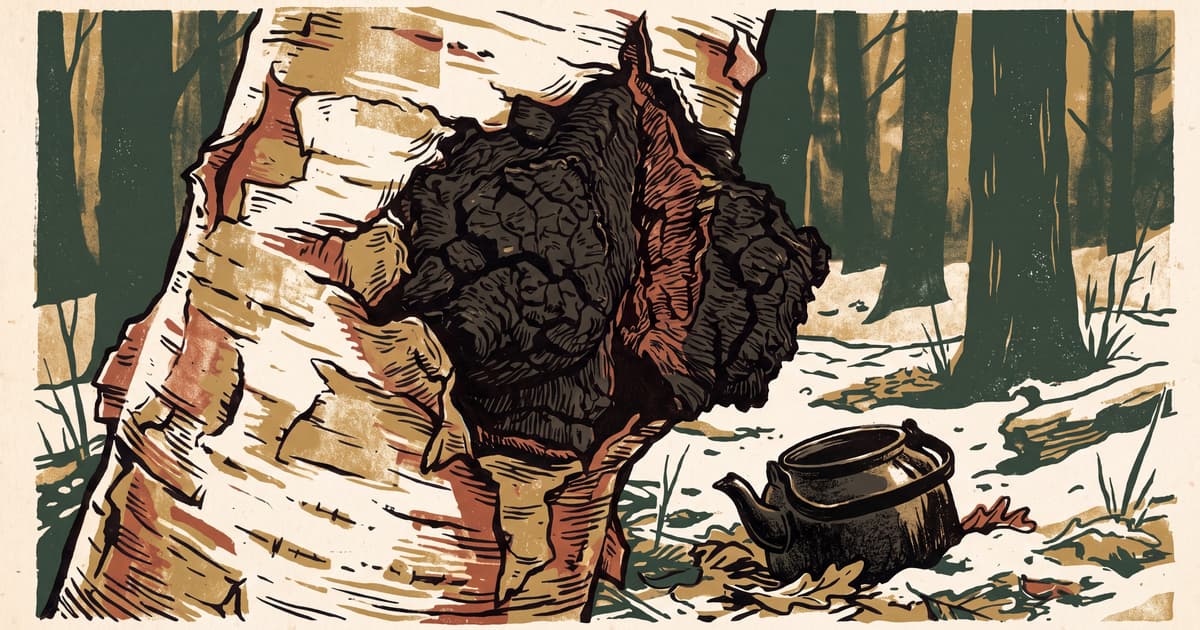
Chaga (Latin Inonotus obliquus) is a mushroom that grows unlike most species you know from the forest. It has no cap on a stem. It is a black, cracked growth that clings to a birch trunk over many years.

In the tradition of the northern peoples, chaga was a mushroom of the cold climate, tied to Siberia, the taiga and the long winter. That is a cultural story about the place it held in everyday life, not a promise of any effect. Read it as history, not as a recipe.

A growth on birch, not a cap in the grass

Most of the mushrooms you reach for are fruiting bodies rising from the ground or from dead wood. Chaga is different. It lives with a living birch and forms a hard, lumpy growth on its bark that you can spot from a distance.

This growth develops slowly, over years, drawing from the birch. That is why the northern tradition harvested it with respect and only from some trees, so the forest could renew itself.

How it looks: charcoal outside, rust inside

Chaga is easy to recognise by the contrast of two colours. On the outside it looks like a lump of burnt charcoal, a black and cracked crust. Many gatherers mistake it at first glance for a scar left by fire.

Inside hides something quite different. When you break the growth open, it has a rusty-orange core, soft and corky to the touch. That rusty centre is the mark by which you tell chaga apart from an ordinary growth on a tree.

The cold north and the tradition of brewing

Chaga is a mushroom of the north. It was best known where winters are long and birches grow in the taiga: in Siberia, in Scandinavia and in the Baltic lands. There people made a brew from it, dark and earthy in taste.

Traditionally the hard growth was crushed or ground, then steeped for a long time in hot but not boiling water. The result was a drink the colour of strong tea. It is a ritual of warmth in a cold climate, part of an ordinary day in the far north.

Fruiting body or growth, or what you actually drink

It is worth being honest: chaga is not a classic fruiting body with a cap, but a hard growth of mycelium fused into the birch. That black mass is exactly the part the tradition crushed into a brew.

At Aloha Fungi we work with a 10:1 extract. This means that ten parts of raw material yield one part of concentrated extract, in which you will find, among other things, beta-glucans, natural components of the fungal cell wall. Detail instead of a promise: we tell you the form and its concentration and leave the rest to your ritual.

Chaga in a morning and winter ritual

Where reishi was traditionally tied to the evening, chaga suits the morning and winter more. It is a mushroom of the dark brew that lovers of functional mushrooms like to weave into the colder part of the year, as part of an immunity ritual.

  • In the morning · a dark, earthy brew instead of or alongside your morning coffee.
  • In winter · chaga is a mushroom of the cold climate, at home in the season of long evenings.
  • Your ritual · brew, powder or drops. You choose the form and the time.

If you take medication, are pregnant or breastfeeding, discuss use with your doctor or pharmacist.

FAQ: frequently asked questions

What are the properties of chaga?

Chaga (Inonotus obliquus) is a mushroom growing on birch trees, traditionally brewed like tea in Siberia and Northern Europe. It is rich in phenolic compounds and beta-glucans, but let's say it plainly: our registry of 12 pieces of literature on chaga contains no randomized trials in humans, laboratory work dominates. That's why we write about chaga as a traditional brew and ritual ingredient, not as a remedy "for something".


This content is for educational purposes only and does not constitute medical advice. A food supplement does not replace a varied diet or a healthy lifestyle. If in doubt, consult your doctor or pharmacist.

Chaga in scientific research

What was studied, on how many people and with what level of evidence. This overview describes studies, not the effects of a product.

0

human studies

0

placebo-controlled RCTs

2014–2024

years of publication

  • Fordjour E. et al., 2023

    E

    narrative review · preclinical studies (in vitro and rodent)

    not applicable

    The narrative review discussed the properties and potential applications of chaga described in the literature.

    PMID 38116085
  • Tee Yon Ern P. et al., 2023

    E

    narrative review · preclinical studies (in vitro and rodent)

    not applicable

    The narrative review discussed the properties of Inonotus obliquus described in the literature.

    PMID 38813471
  • Camilleri E. et al., 2024

    E

    narrative review · preclinical studies (in vitro and rodent)

    not applicable

    The brief narrative review discussed the medicinal and nutraceutical significance of chaga.

    PMID 39170453
  • Glamočlija J. et al., 2015

    E

    in vitro + chemistry · preclinical studies (in vitro and rodent)

    not applicable

    The in vitro study examined the chemical composition and biological activity of chaga extracts.

    PMID 25576897
  • Géry A. et al., 2018

    E

    in vitro · preclinical studies (in vitro and rodent)

    not applicable

    The in vitro study examined the anticancer activity of chaga extracts on cell lines.

    PMID 29484963
  • Arata S. et al., 2016

    E

    animal study (mice) · preclinical studies (in vitro and rodent)

    not applicable

    The mouse study examined the effect of continuous administration of an aqueous chaga extract on cancer progression.

    PMID 27441282
  • Wang J. et al., 2017

    E

    animal study (mice) · preclinical studies (in vitro and rodent)

    not applicable

    The study in streptozotocin-induced type 2 diabetic mice examined the anti-diabetic effect of Inonotus obliquus polysaccharides.

    PMID 28954386
  • Kwon O. et al., 2022

    D

    case report, safety

    1 patient, 69-year-old man

    The case report documented oxalate nephropathy after chaga intake, clinically manifesting as nephrotic syndrome in a 69-year-old man. Single case, safety data.

    PMID 35451393
  • Lee S. et al., 2020

    D

    case report, safety

    1 patient, 49-year-old man

    The case report documented the development of end-stage renal disease after long-term chaga ingestion in a 49-year-old man. Single case, safety data.

    PMID 32419395
  • Wold C.W. et al., 2018

    E

    chemistry + in vitro · preclinical studies (in vitro and rodent)

    not applicable

    The study examined the chemical structure of polysaccharide fractions from the inner and outer parts of the fruiting body (structural methods) and their effect on nitric oxide production in mouse macrophage and dendritic cell lines in vitro.

    PMID 29421057
  • Kikuchi Y. et al., 2014

    D

    case report, safety (chronologically the first of three)

    1 patient, 72-year-old woman

    The case report documented a link between 6 months of chaga powder intake (4-5 teaspoons daily) by a 72-year-old woman after hepatectomy for liver cancer and worsening kidney function requiring haemodialysis; biopsy showed diffuse tubular atrophy, interstitial fibrosis and oxalate crystals. Chronologically the first of three reported cases (2014, before Lee 2020 and Kwon 2022).

    PMID 23149251
  • Shen D. et al., 2022

    E

    in vitro · preclinical studies (in vitro and rodent)

    not applicable

    The study examined the effect of the extract on nitric oxide levels and inflammatory markers in resting M0 macrophages and LPS-activated M1 macrophages in vitro, at various concentrations.

    DOI 10.1155/2022/8251344

Evidence levels: A · Cochrane review · B · systematic review · C · placebo RCT · D · pilot RCT · E · preclinical studies

What these studies don't say

  • Samples are usually small, most from a single population.
  • Results describe research interventions, not a dietary supplement.
  • The presence of a study is not a health claim.
  • No human intervention studies exist for this species. Available data comes from preclinical studies (in vitro, animal) and does not translate directly to humans.
  • 3 entry/entries are case reports about safety, not efficacy studies.

Source: Aloha Fungi literature review, 1 September 2026; entries verified via PubMed or by DOI (Crossref). See the research

Discover functional mushrooms

© 2026 Aloha Fungi™